Giant – The Play
A look at what it means to be human, to be flawed, and to understand the power of the language we use
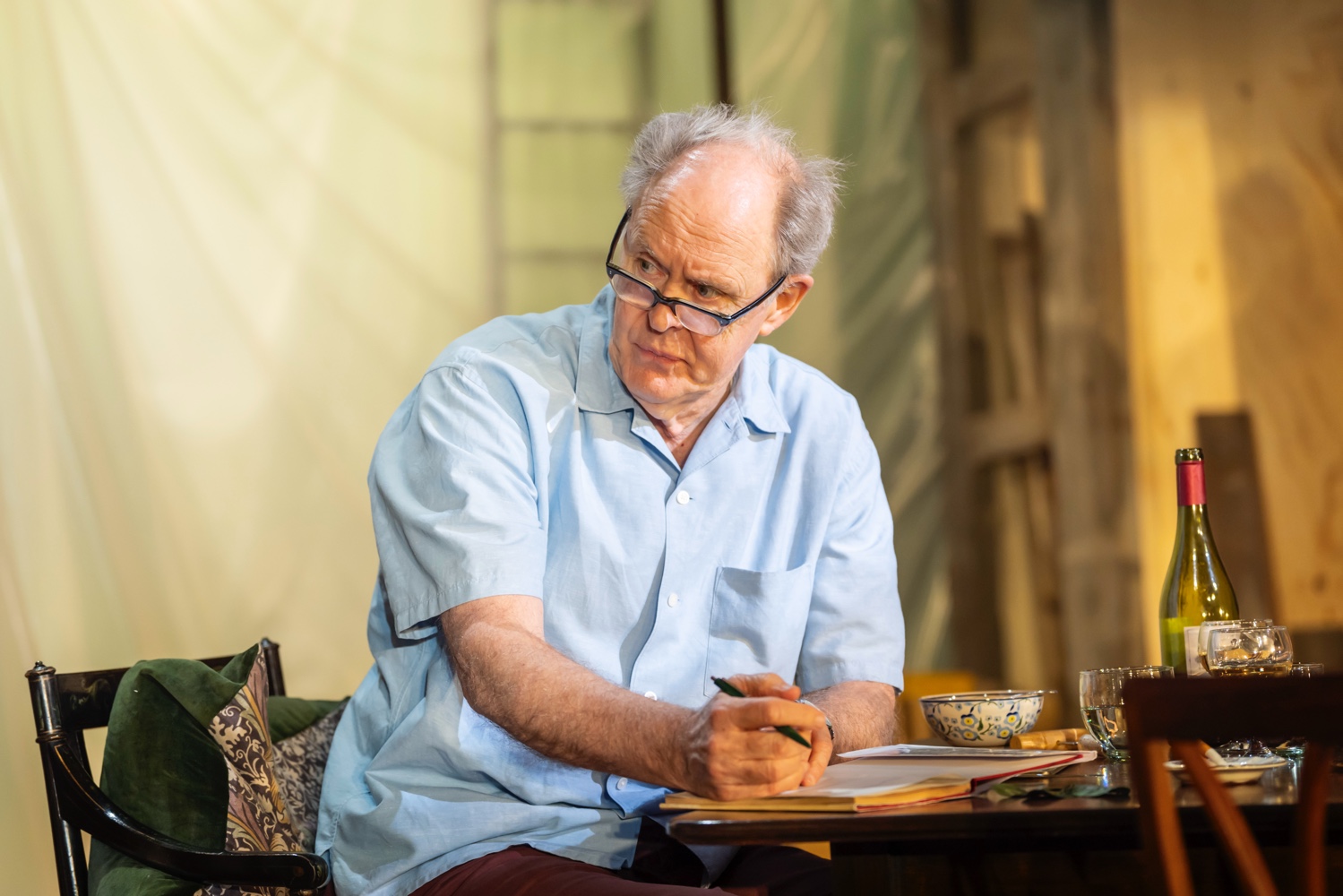
Giant by Mark Rosenblatt first appeared in London in 2024 as an off-West End production at the Royal Court Theatre, with John Lithgow playing the divisive Roald Dahl. Following its initial success, the play returned for a limited run in 2025, with Lithgow reprising his role as the polarising author. Now, audiences have the privilege of watching this critically acclaimed play in cinemas. It offers a crucial look at the power of language in times of adversity, and raises the question of whether meeting one’s heroes is ever a good thing.
The play is set in 1983, following the publication of a controversial book review written by Roald Dahl (Lithgow) in which he criticised Israel’s actions in Lebanon. It begins in the home Dahl shared with his new wife, Felicity Crosland (Rachael Stirling), a home undergoing refurbishments that clearly perturb Dahl throughout the play.
One of the first noticeable differences between reality and fiction is Lithgow’s accent. Whether this is an artistic choice or a direction from Nicholas Hytner (director), it immediately makes the audience question whether he has been cast as the “giant” because of his fame, or whether he is truly up to the task of portraying such a household name. However, the actor very quickly proves his worth, embodying the characteristics of the grizzled author in all but voice.
Aya Cash, who plays the budding Jessie Stone, is phenomenal as the tenacious antagonist to the anti-hero, Dahl. Her persistence and vim in the face of the imperious author, coupled with the glimpses of her vulnerability, make Cash one of the key players in this production. Her ability to react to each and every moment with a wonderful blend of exaggeration and subtlety makes her one to watch. In fact, the dynamic between the four main actors, including Elliot Levey as Tom Maschler, adds a fizz to the performance that feels as though it could turn into a bang at any moment.
It emerges that there is a clear reason Lithgow was chosen to play Dahl: because he is unafraid to become one with the material. Rosenblatt’s writing does not shy away from the antisemitism at the heart of the story, particularly in the context of the world of today. Instead, it digs deep and brings to the fore many things that people are often too afraid to discuss openly.
The play speaks candidly about the polarising nature of any conflict involving Israel, without necessarily taking a definitive side. This is not to say that audiences leave the theatre believing either that Dahl was a staunch antisemite who should be condemned, or that his comments should be excused. Rather, the production leaves viewers with the question: are these things really as black and white as they might initially seem?
Of course, this is not to excuse any of Dahl’s comments in the public domain. However, Rosenblatt does an excellent job of encouraging audiences to think for themselves, to investigate further, and to question what they are told rather than simply accepting what they read or hear in the media as gospel.
All that being said, the beauty of this play is that it is not some grand political statement. Instead, it is a look at what it means to be human, to be flawed, to understand the power of the language we use, and the effect it has on those around us, as well as on the wider world.
Giant is just as relevant to our times as it was to Dahl’s contemporaries in the 1980s. It’s a show that will undoubtedly withstand the test of time, and the decision to bring it to cinemas is a testament to both the gravity of its subject matter and the importance of reaching audiences worldwide.
While it can definitely be said that the magic of live theatre may be lost when transferred to the big screen, Giant proves quite the opposite. There is something rather beautiful about being able to capture a theatrical performance at a particular moment in time, preserving all its intricacies, flaws, tensions and subtleties for audiences who might otherwise never have the opportunity to experience it. Ultimately, Giant is a play that deserves to be seen, discussed and, perhaps most importantly, questioned.
Natallia Pearmain
Giant – The Play is released in select cinemas on 19th November 2026.
Watch the trailer for Giant – The Play here:
- 1
- 2
Hunting Alice Bell
Antonia Georgiou
- 3
Andrew Lloyd Webber’s Starlight Express: Live on Stage
Jennifer Hensey
- 4
- 5



Hamlet Hail to the Thief at Barbican Theatre
Cristiana Ferrauti
Ebenezer
Antonia Georgiou



Wasia Project at Roundhouse
Sofia Webster