
Dracula at Noël Coward Theatre
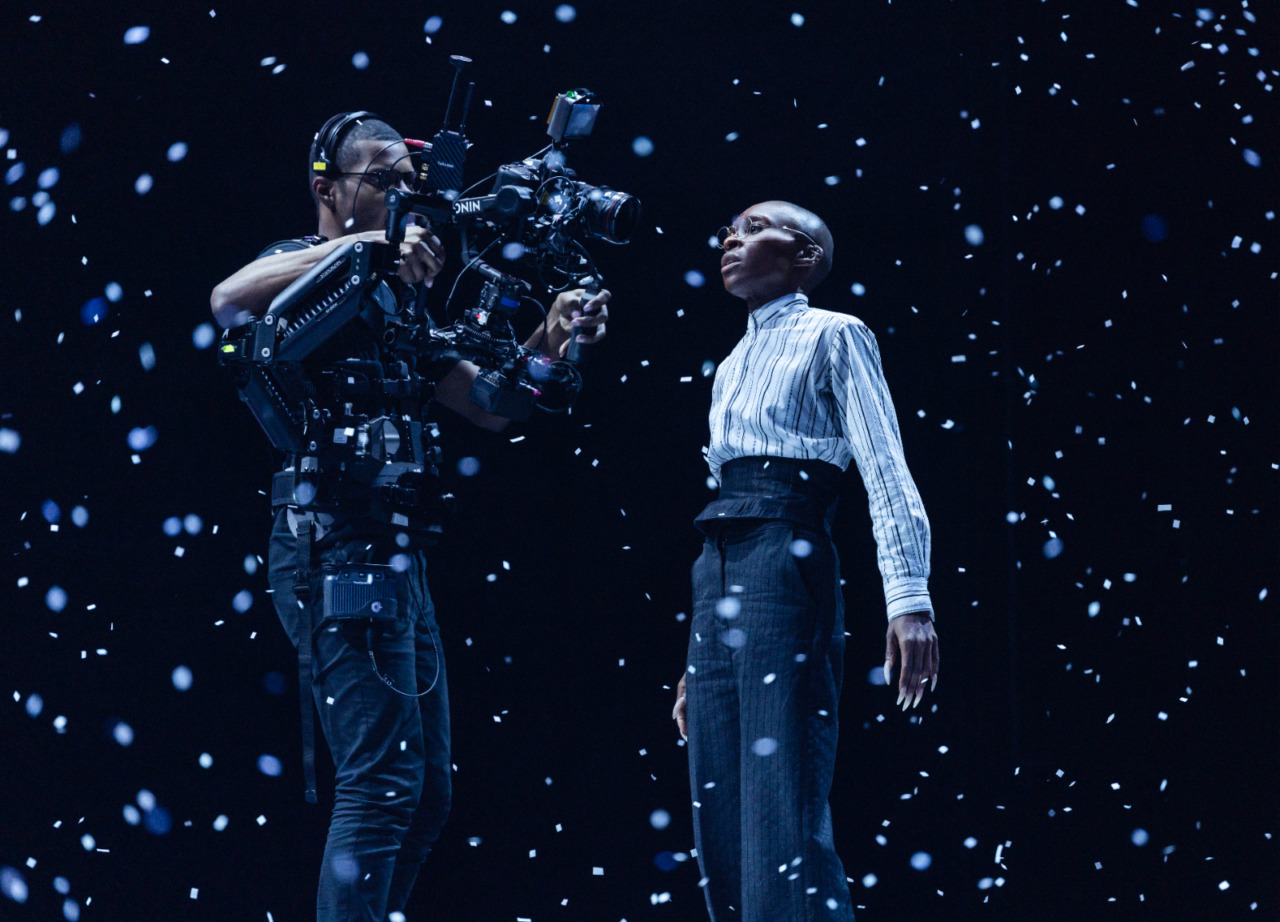

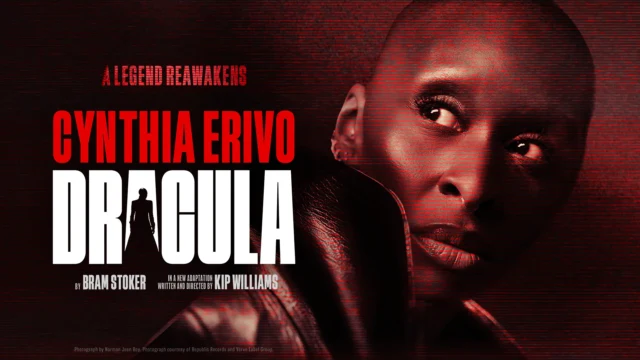
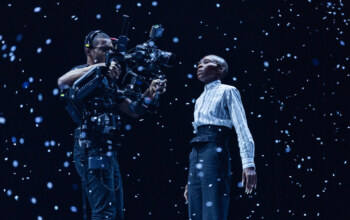
It all begins unassumingly, as Cynthia Erivo takes the stage, turns her back to the crowd and begins to address a camera positioned overhead. It may be true that this production’s lone star is to hold the stage throughout, but for the lion’s share of Kip Williams’s hotly anticipated new cine-theatre rendition of Bram Stoker’s source novel, one is encouraged to divert attention from her physical form to the large screen positioned overhead. From there, the actor not only speaks to us, but serves as her own scene partner; wet behind the ears lawyer Jonathan Harker (Erivo) makes his onstage approach of Nosferatu’s fearful castle while the virtual Count (Erivo again) takes shape to meet him overhead, and this is only a prelude of the multiplicity of Erivos (decked out in an extravagant array of wigs and facial hair, and largely pre-recorded) who will soon jostle for space.
It’s a splashy feat Sarah Snook carried out to no shortage of acclaim in Williams’s hit adaptation of The Portrait of Dorian Gray, and Erivo is a committed, commanding guide here. Still, there are rare, fleeting instances in which she turns away from the cameras (an onstage fleet of camera operators and stagehands make for her lone, ever-present, swirling co-star) to address the crowd directly, and in these moments, we receive a welcome hit of what’s been missing. It’s there too in the late game appearance of – by the show’s spare standards – a lush graveyard set, those dusty moonlit tombs offering an infusion of old-fashioned spectacle, of… well, theatricality, altering the flow of a night at the theatre that’s largely screen-driven. Within this new context, it feels almost novel.
That’s not to say that Williams’s Dracula lacks for immediacy, but one isn’t always wholly sure where the moment-to-moment suspense his production generates is really coming from. Is it from the well-worn story of seduction, societal constraints, plague, madness and real estate at its centre? Or is it from Erivo’s high wire act, compelling but unmistakably hurried? The actor is tasked with reciting large swathes of Stoker’s prose, and with doing so speedily enough to keep up with her tripled, quadrupled, quintupled video selves, a task that leaves only intermittent opportunities for her to actually act. Differentiation of mild-mannered Harker (to her credit, a character who has always been dull) with foppish Dr Jack Seward is largely left to the costuming department, with little noticeable difference in the two narrators’ characteristics at all. Though she recovers swiftly from flubbed lines and keeps the churning story engines chugging along efficiently, only with two roles does Erivo seem fully inspired by the material.
When it comes time to don the flowing blonde wig of Lucy Westenra – the socialite whose un-repressed sexual forthrightness will mark her as an immediate candidate for vampire chow – one feels the actor shifting into a more playful register, embracing Lucy’s snotty flamboyance with gusto. Second is the Count himself, an inconstant presence whom Erivo makes worth the wait. Speaking with a Nigerian accent, her Dracula is elegant and imploring, gently urging potential acolytes to take that extra step and join him in the reviled Otherness that may in fact be a state of grace, mere steps away from the polite society that so constricts them. It’s in Dracula’s climactic scenes – a tug-of-war between the Count and ghostly old Professor Van Helsing for the soul of innocent Mina Harker – that the star does by far her most powerful acting of the night. The performance’s remainder is undoubtedly virtuoso work, but work in which the assuredness of its virtuosity ebbs and flows. Come the end, one feels the exhaustive effort required of Erivo and co perhaps a little too keenly, and the final shiver of Stoker’s tale merely brushes us when it ought to sink down to our bones.
Ultimately, Williams’s new cine-theatre production is alternatingly a bracingly immediate theatrical experience and a distancing one, at times propulsive and engaging, at others overly occupied with the precarious intricacy of its own construction. The best moments in Dracula are the most old-fashioned, with no amount of digital splintering of its star able to match the power of an actor turned to face the crowd directly.
Thomas Messner
Photos: Daniel Boud
Dracula is at the Noël Coward Theatre until 30th May 2026. For further information or to book, visit the theatre’s website here.









Facebook
Twitter
Instagram
YouTube
RSS