
Bird Grove at Hampstead Theatre
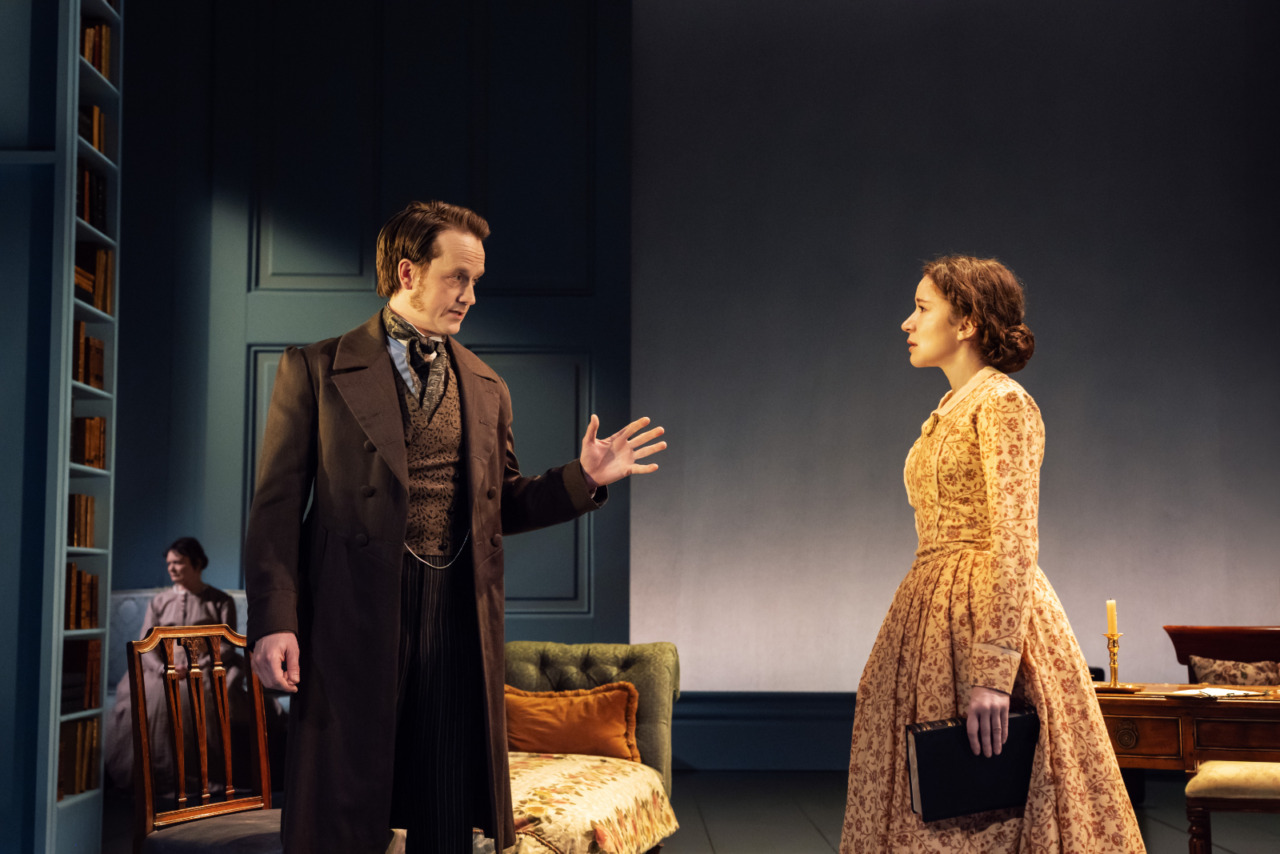

During a brief private getaway, two women bemoan their confined stations in life and look to books and plays as the answer to how they may transcend them. One, Cara Bray (Rebecca Scroggs), is the more worldly and radically minded of the two, noting the preponderance of the male perspective propagated across fiction, and how it may have confined the possibilities for their lives before they had much of a chance to stake out ground of their own. If you really think about it, she and her confidant Mary Ann (as in Evans, as in revered English writer George Eliot, played by Elizabeth Dulau) are already in a stage play of some kind, and one written by a man at that.
As a meta-reckoning from The Pride playwright Alexi Kaye Campbell with his own part in this trend, as a male writer presenting a portion of George Eliot’s biography through the prism of his own interests, it’s undoubtedly well-intentioned. It’s also an unmistakable eye-roller, as if at this moment, Campbell’s new play (and his first to be centred on known historical figures) has stepped outside of itself to administer a hearty pat on its own back. In the immortal words of Monty Python: “Wink wink! Nudge nudge! Say no more! Say no more!” It’s a needless gilding of the lily that the play will repeat at another crucial point, as Mary Ann receives a visitation from a woman with a gift of foresight and a name that will be familiar to lovers of Eliot’s bibliography, who assures her of the accolades and writerly esteem that await her down the road. In assuming such arch distance from the material at hand, and triple underlining what need only be suggested, Bird Grove in these moments betrays its sturdy foundations as a heartfelt, sensitively played father-daughter story that shirks grandeur in favour of a more personal scale.
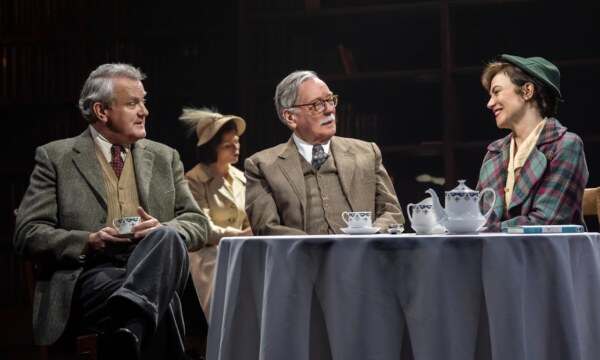
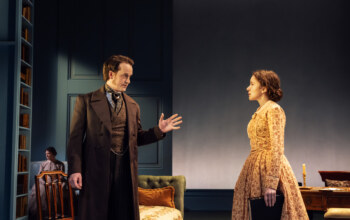
Regardless of its connections to Eliot (indeed, one notes the copies of Middlemarch displayed for purchase upon entrance), Bird Grove begins with a comedy of manners that is pure Austen, as a bumbling Mr Collins-alike (Jonnie Broadbent) arrives at the house where Mary Ann lives with her brother Isaac (Jolyon Coy) and father Robert (Owen Teale), seeking a convenient answer to both his financial woes and the yearnings of his heart, having decided that Mary Ann’s hand in marriage will serve both of these functions. The senior Evans knows as well as Mary Ann herself that she intends to refuse the imminent proposal, leaving a lengthy runway for the spectacle of Broadbent’s quivering indignation to play out. In this first section, Campbell shows a comforting ease with the screwball-adjacent pitter patter of banter, with much in the way of veiled passive aggressions, deadpan asides and, in the case of Teale’s patriarch, an endearingly clumsy bluntness at odds with the expected social graces.
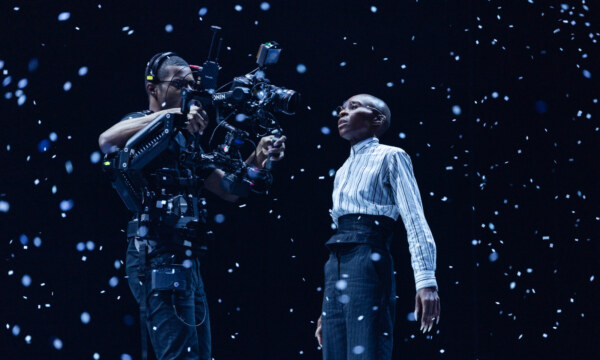
Still, this section runs too long, and the spare use of Harry Blake and Clara Pople’s score creates a curious airlessness, the long-held silences felt a little too keenly. No less awkward is director Anna Ledwich and Movement Director Chi-San Howard’s decision to have the rest of the cast take still positions in the background of the scenery (the play’s majority will be spent in the Evans’ drawing room) during Mary Ann and her unwanted suitors’ lengthy confrontation, keeping them stiffly in view when there is little need for them to be onstage at all. Still, as Bird Grove attends to the real heart of the matter – a faith-based dispute between Mary Ann and her churchgoing father – it’s impressive how much this stiffness is punctured in the play’s back half. A projection of softly falling snow against the stage backdrop infuses real atmosphere, in tandem with the cast fully relaxing into their roles. Mary Ann’s close-yet-conflicted relationship with her father emerges as the play’s beating heart, with Teale and especially Dulau lending real dramatic force to the clash of a loving but exasperated father and the daughter whose burgeoning independence of thought (and rejection of the faith so essential to him) registers as a threat. Guided by its sturdy leads, warm yet unsentimental throughout, Bird Grove confidently settles into being a pleasingly unhurried, small-scale character portrait of a specific relationship, one largely unburdened by the weight of its own foreknowledge of its subject.
Ultimately, Alexi Kaye Campbell’s new play gains in strength over the course of its runtime, journeying from airless Austen pastiche to a well-wrought, smartly played family drama that – save for some regrettably self-congratulatory meta touches – is largely content to leave its characters unburdened by the weight of legacy, with no dramatic obligations other than to the immediate concerns of a small stretch of George Eliot’s life. The result is an intelligent, refreshingly unshowy family drama.
Thomas Messner
Photos: Johan Persson
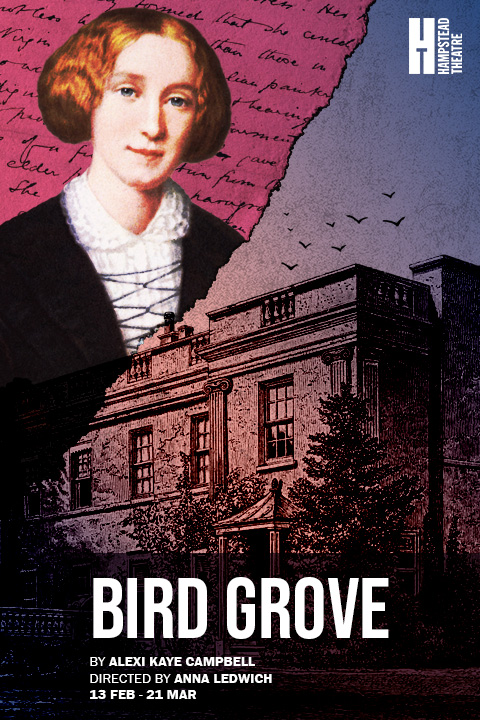
Bird Grove is at Hampstead Theatre from 13th February until 21st March 2026. For further information or to book, visit the theatre’s website here.
















Facebook
Twitter
Instagram
YouTube
RSS