
Seurat and the Sea at the Courtauld Gallery
 13 February 2026
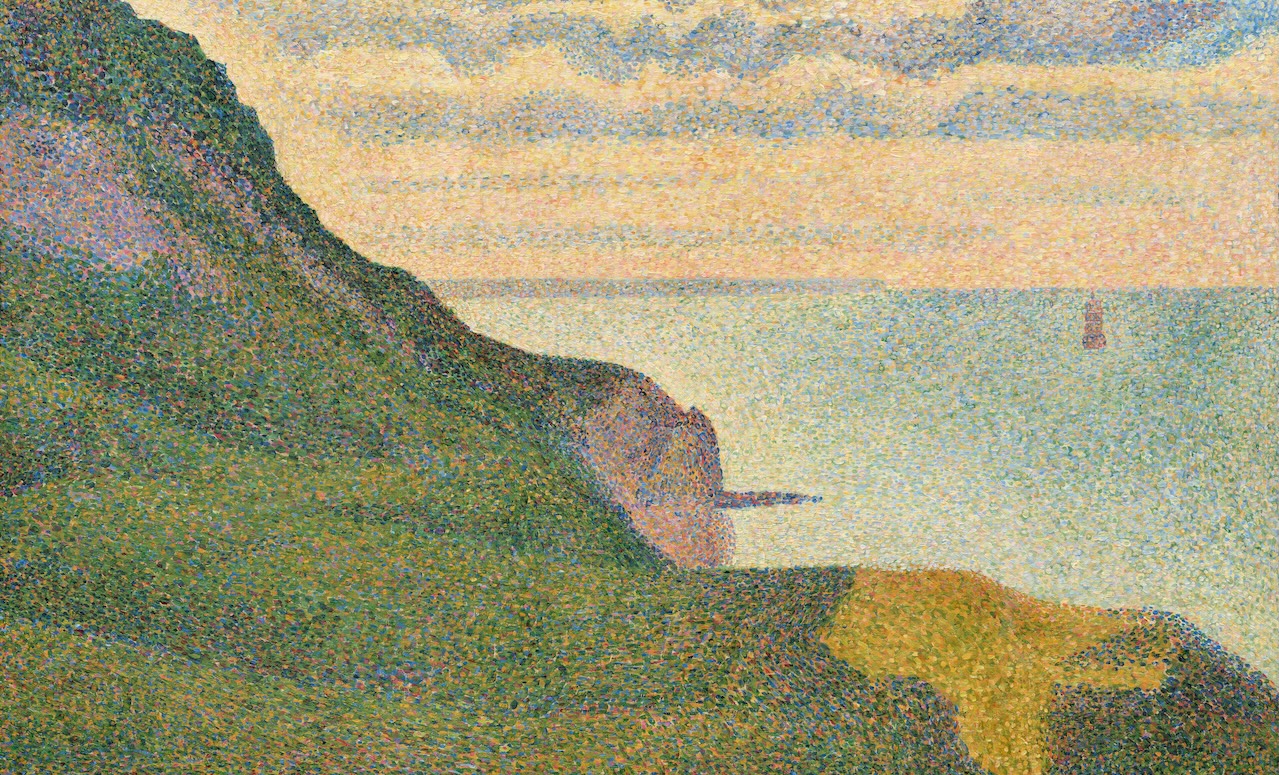
Few careers of the modern European art canon can be said to have burned so brightly and yet so briefly as that of Georges Seurat (1859-91). A keen student of the new-fangled optical theory of his day, the Frenchman is universally recognised as the father of pointillism, the technique of painting form using a plethora of coloured dots. Many a visitor to the National Gallery over the years has been entranced and transported back in time to the banks of the Seine by Seurat’s 1884 masterpiece, Bathers at Asnières. Its carefree figures, seemingly untouched by the stresses of modern life, bask in glorious sunshine like contented seals. But what truly makes the work so memorable is the artist’s complex application of colour and mastery of light. The Courtauld Gallery’s new exhibition, Seurat and the Sea, does not boast that renowned work: this beguiling gathering of seascapes is impressive enough to beat its own drum without the presence of such an old favourite.
Between 1885 and 1890, Georges Seurat left Paris every summer and headed to the Channel coast for the purpose of studying the effect of light. Stepping into the Courtauld’s exhibition here, a virtually transcendental experience awaits a London audience in desperate need of a lift after two months of near relentless rain since the beginning of the year. Seurat, who died tragically early at 31, only painted 45 canvases in his lifetime, with over half of these seascapes. 23 paintings and smaller oil studies appear in the current show, along with three drawings. There is an overriding sense of calm and serenity to be found in these two rooms. The Frenchman’s carefully composed compositions, consisting of strokes of shimmering pure colour, seem to anticipate geometric abstraction and Surrealism. Armed with his portable paint box and small panel wedged into its lid, Seurat has imbued these works with remarkable luminosity. A surprising degree of melancholy too lurks in these scenes, largely devoid of human figures.
Over the course of the five summers on display, the artist’s technique can be seen evolving. In earlier works, he deploys crisscross marks and dashes for important areas, which he overlays with large dots. Over time, smaller dots become solely applied. The concept behind pointillism or divisionism was that by requiring the human eye to combine the colours optically rather than via the usual mixing of pigments, the greatest luminosity could be achieved.
Aside from focusing on natural light and colour, Seurat is drawn to the topography of his scenery. 19th-century postcards like that shown alongside The Hospice and the Lighthouse of Honfleur (1886) testify to the painter’s fidelity to reality. In the opening room, Le Bec Du Hoc (Grandcamp), originally painted in 1885 before being reworked in 1888-89, depicts a beak-like promontory that gave the illusion of floating above the sea. Short criss-cross strokes are used to render both the rocks and blooming vegetation alike. Today, the cliff is a mere shadow of its former glory, diminished by erosion and the devastating effects of D-Day bombardment. A particularly memorable evocation of the Normandy coast proves to be The Channel of Gravelines: An Evening (1890). Here, Seurat succeeds in creating a dynamic perspective by means of the sweeping quayside, capturing the pink glow of dusk. Characterised by its alternating bands of dark and light colour, the scene is effectively framed by the lamp post on the left and docked anchors on the right, the latter of which were artfully added for the sake of pictorial balance. Astonishingly, Seurat and the Sea represents the first exhibition entirely devoted to the father of pointillism’s seascapes when one considers the fact that they constitute half of his output of canvases. By all accounts, the Courtauld, who have done a commendable job in organising this show, have pulled off a particular blinder in reuniting six paintings the Frenchman produced in Port-en-Bessin, north of Bayeux, in the summer of 1888. Always intended to be displayed alongside each other, this represents the first time they have been so since their inaugural exhibition in Brussels in 1889. Mesmerising light effects, loaded with atmosphere and yet possessing a calm quietude, Georges Seurat’s seascapes are food for the soul.
James White
Image: Georges Seurat (1859-1891), Seascape at Port-en-Bessin, Normandy, 1888, Oil on canvas, 65.1 x 80.9 cm. Gift of the W Averell Harriman Foundation in memory of Marie N Harriman, National Gallery of Art, Washington DC.
Seurat and the Sea is at the Courtauld Gallery from 13th February until 17th May 2026. For further information or to book, visit the exhibition’s website here.














Facebook
Twitter
Instagram
YouTube
RSS