
Lucian Freud: Drawing into Painting at the National Portrait Gallery
 12 February 2026
In the years since Lucian Freud’s death in 2011, there have been a number of major shows devoted to the great painter in London, the most recent being New Perspectives at the National Gallery in 2022. Now, the Trafalgar Square institution’s neighbour, The National Portrait Gallery, focuses a new exhibition on a less heralded aspect of the artist’s practice, his works on paper. Lucian Freud: Drawing into Painting sets out to make the case that a dialogue exists between his draughtsmanship and canvases. Remarkable in its breadth, encompassing the artist’s creative output from illustrated childhood letters to a copper printing plate that remained unresolved on the day he died, this exhibition further reinforces Freud’s commitment to figuration. As addressed by the NPG in the opening room, the current show owes much to the gallery’s acquisition of the Lucian Freud Archive, including 48 sketchbooks and, over the last year, eight etchings. Fittingly, David Dawson, formerly the artist’s studio assistant from 1991 to 2011 and now the Archive’s director, co-curates alongside the gallery’s senior curator, Sarah Howgate.
Throughout, one finds Lucian Freud carving out his own pathway in a diversity of drawing forms ranging from charcoal, pencil, pen and ink and etching. Relevant paintings are displayed in conjunction with the works on paper they correspond to, bringing into sharp focus the preparatory, developmental and investigatory roles that drawing played in Freud’s practice.
The artist’s work in the 1940s is characterised by its austere linearity, as exemplified by his 1943 self-portrait in oils, also featuring a detailed study of a feather. A drawing from the same period nearby depicts three thistles Freud found on the Isles of Scilly, which he somehow manages to imbue with both visual appeal and a sense of the sinister. Girl with Roses (1947-48) is a celebrated portrait of his first wife, Kitty Garman, again deploying a precise quality of line, not to mention an exacting eye for detail. In a nod to traditional representations of the Virgin Mary, the pregnant Garman sits clutching a thorny rose, a second, thornless rose half hidden by the folds in her skirt. Her wide-eyed charms, exaggerated to a virtually cartoon-like degree by Freud, are again brought to the fore in Flyda and Arvid (1947), a pen and ink work on paper thought to be the only double portrait the painter ever created of himself and his then wife.
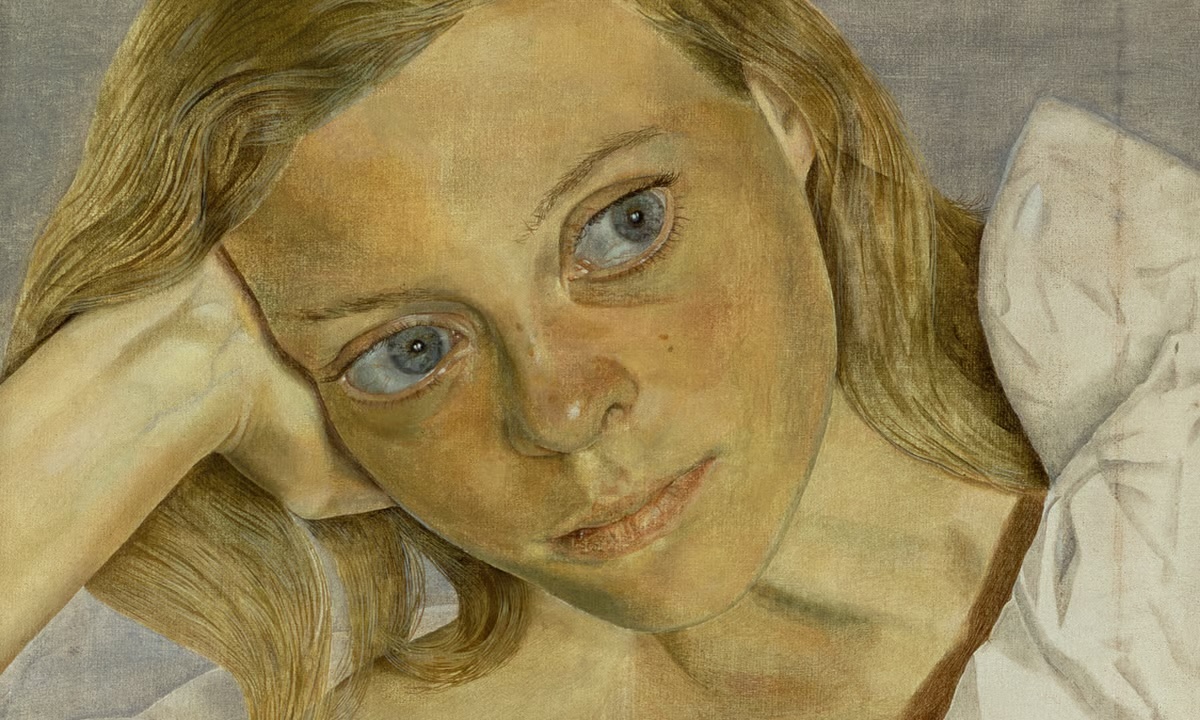
The next chapter in the German-born artist’s colourful love life sees him meticulously capturing his second wife, Caroline Blackwood’s delicate features. One of the sketchbooks, recently acquired by the NPG, sees him roughly sketching out in charcoal his composition for Hotel Bedroom (1954). The painting itself, also on display, has as its setting the couple’s room in the Hotel La Louisiane in Paris, where they were living for a period. In the foreground, Blackwood lies in bed with her left hand on her cheek as a shadowy Freud gazing down on her from the window, somehow carrying both tenderness and menace. This marks a turning point in the artist’s practice, supposedly representing the final occasion when he sat and painted using fine sable brushes before transitioning to thick hog hair brushes. They would prove the game-changer in terms of ushering in the expressive brushwork of his maturing years.
Freud’s portrait Woman in a White Shirt (1956-57), depicting Deborah, the Duchess of Devonshire, evidences the painter’s evolving technique, the Mitford sister’s face a landscape of tonal contours. The march towards Freud’s mature style was gathering pace, and yet he is seen experimenting with watercolour and gouache on paper in the early 60s, loosening up his image making with the fluid medium in studies of his daughters, Annie and Annabel, during their family holiday to the Greek island of Spetses.
Leaping ahead several decades, Freud’s unflinching charcoal drawings of his ageing mother from 1983 and 1984 seem to register every effect of the passing of time, whilst still managing to convey the formidable character and keen intelligence of this woman whose relationship with her son was a fraught one. The painting, Large Interior, London W9 (1973), hung in close proximity to those charcoals, features a seated Lucie Freud, whom Lucien reconciled with following his father Ernst’s 1970 death, seated in an armchair, lost in her own thoughts. By this juncture of his career, the painter, never demonstrably adverse to engendering a sense of tension in his compositions, decided to include a second portrait at the top of the same canvas. Here, one finds his lover at the time, Jacquetta Eliot, posing nude on a bed which eerily appears to disappear into the wall.
As Freud’s career unfolds, one finds his drawing informing his forensic examinations of the human figure. A 1988 self-portrait (displayed in the opening room) reveals his distinctive method of mapping out the essential form in charcoal before working from the centre of the face outwards. Reflection (Self-portrait), from three years earlier, finds Freud casting his coolly analytical eye on those ageing features. The later stages of this exhibition testify to the artist’s obsessive fascination with the human form. A major highlight, the magnificent, Sleeping by the Lion Carpet (1996) is a rhapsodic study of Sue Tilley’s creamy folds of flesh, juxtaposed alongside Freud’s etchings of her, one revealing a tattoo, which pale in comparison with the painting. Nearby etchings of the heads and bodily forms of his models, the film-maker Angus Cook and performance artist Leigh Bowery reveal some sensitive mark making, whilst the artist’s continued evaluation of contours leads to them resembling the construction of Freud’s figurative paintings.
For Lucian Freud, the National Gallery held a special lure. So great was his devotion to the institution’s collection that he was given a special pass enabling him to enter at any hours of the day and night. An intriguing part of the current show is devoted to some of the studies he undertook of artists’ work at the National Gallery and elsewhere. A classic Jean-Antoine Watteau’s masquerade painting, Pierre Content (1712), inspired the British artist to create Large Interior, W11 (after Watteau) (1981-83). Although that Freud painting is disappointingly not on display, the insight provided by preparatory studies, largely in pen and ink, mapping out the placement of the four featured figures, including his then lover, the artist Celia Paul and Bella, Freud’s daughter from another partner, offers some consolation. One painting in the National Gallery collection, Freud found himself returning repeatedly to, the 18th-century French painter, Chardin’s The Young Schoolmistress (1737). A copy in oil made by the British artist in 1999, somehow succeeds in attaining a level of fidelity to the original whilst bearing the hallmarks of the modern master. Alongside are two Freud etching reworkings of his beloved Chardin, with one zoning in on the ear of the female figure on the left, rated by an Anglo-German artist as “the most beautiful ear in art”.
Ultimately, the National Portrait Gallery’s reasoning behind the staging of this exhibition is clear. It provides the ideal opportunity to show off their wealth of sketchbooks, drawings and etchings, acquired from the estate of the artist in recent years, in close proximity to some of this modern master of figuration’s finest works on canvas. Sketchbooks prove consistently informative of Freud’s creative thought processes, even seeing him conjuring up love letters. Truth be known, though, not everything convinces. From a painterly perspective, the artist’s 2002 portrait of the late Queen Elizabeth II in the final room has not ceased to be a disappointment. His scrutinising study of Hockney’s reciprocal gaze is more successful if a little laboured. Freud himself described his etchings as “a kind of drawing”, and they are dexterous enough, but surely always fated to be the poorer relation to his paintings. Drawing into Painting serves to underscore the importance Lucien Freud attached to drawing as a fundamental means of communication, and yet, when all is said and done, it is the raw, unflinching figuration of his canvases which remain the true pulse setters.
James White
Image: Girl in Bed, 1952, Lucian Freud, Oil on canvas, © The Lucian Freud Archive. All Rights Reserved 2025 / Bridgeman Images. Photo © National Portrait Gallery, London. Lent by a private collection, courtesy of Ordovas, 2014
Lucian Freud: Drawing into Painting is at the National Portrait Gallery from 12th February until 3rd May 2026. For further information or to book, visit the exhibition’s website here.










Facebook
Twitter
Instagram
YouTube
RSS