
Agnes Martin at Tate Modern


Agnes Martin (1912-2004) believed that “Beauty is the mystery of life. It is not just in the eye, it is in the mind.” She was an artist who overcame her own mental health issues to practice what she preached, profoundly adept at engaging with her audience on a cognitive level. This exhibition highlights that the beauty of her work lies as much in the Zen-like serenity of the mood it creates as in its aesthetic.
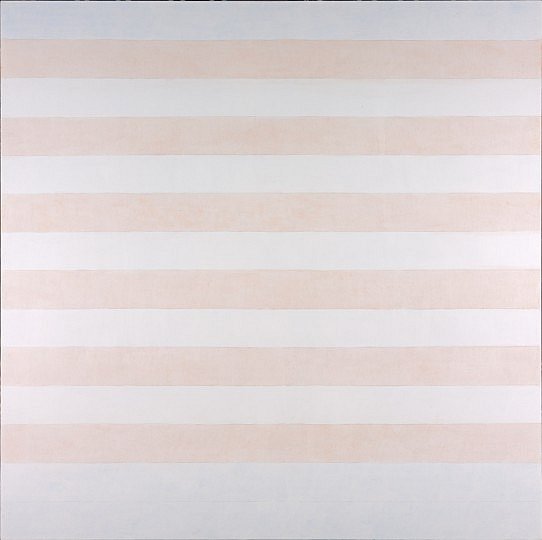
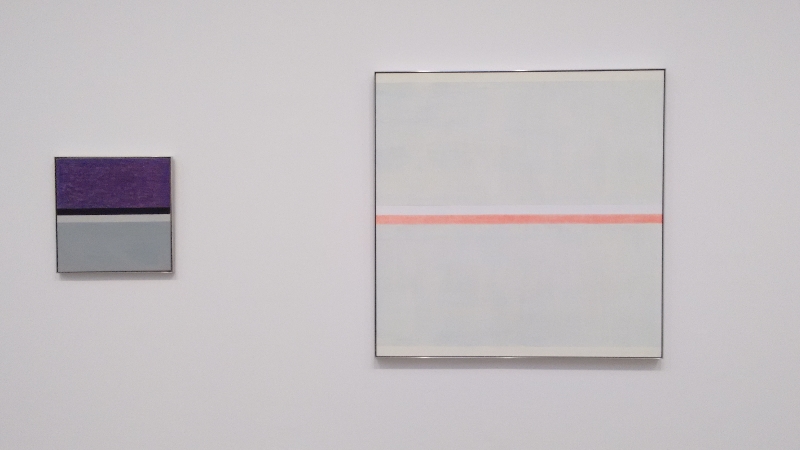
Accessible in every sense, the first room encountered on entry features some of the later works, from the ARTIST ROOMS collection, through which Martin gained renown on the UK art scene in the latter years of the 20th century. Pieces such as Happy Holiday (1999) are at once bold and contemplative; the large canvases feature symmetrical blocks and stripes rendered in near-transparent pastel-coloured oil washes, the borders of which are most often delicately, diligently marked by contrasting graphite pencil markings. From here, a route is charted through a career spanning over 50 years, from the early biomorphic impressionism of a young artist finding her voice, to the evolution of a precise and ordered signature style of abstract expressionism.
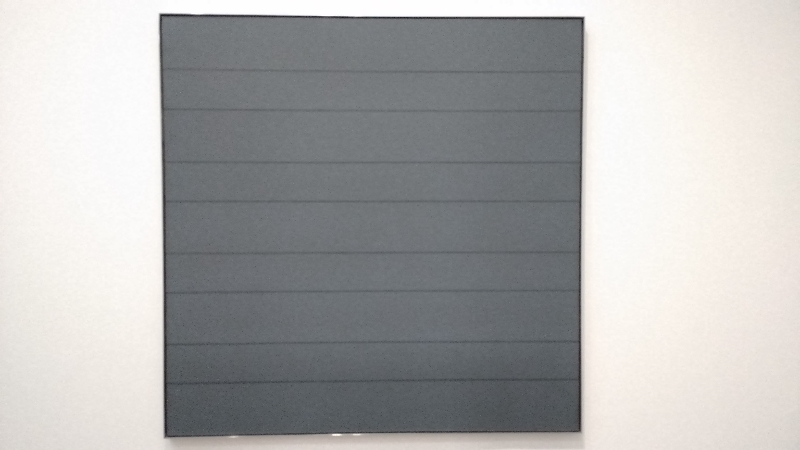
Testament to a prolific artist, this internationally touring exhibition is cavernous, spanning 11 rooms on the west side of Tate Modern’s third level. It is curated with eclectic care so as to group works through a range of criteria including palette, period, or place. The effect this has on the viewer is akin to an intimate audience with a maestro musician, with myriad influences and nuances discernible from any given point. Room eight features studies in heavy shades of grey predominantly from the 80s and makes Martin’s impact on prevailing fashions apparent; pieces such as Untitled (1989) could be enlarged fabric swatches from a tailor catering to that decade’s power-dressing pinstripe yuppies.
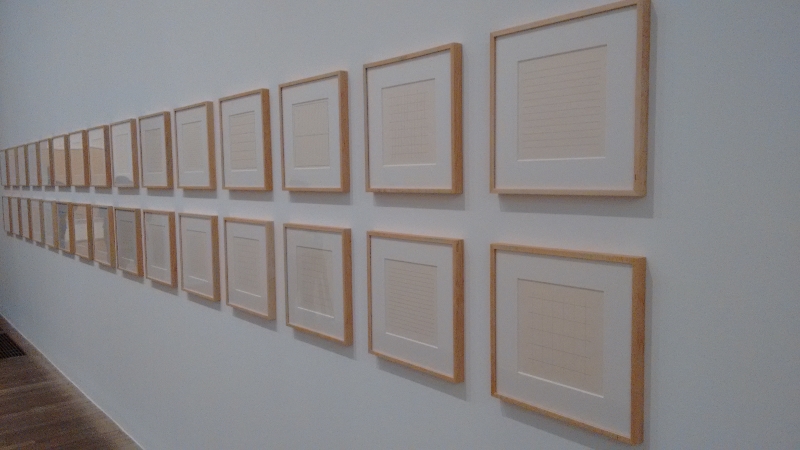
In room ten, a “retrospective within a retrospective” features a variety of smaller drawings on paper spanning more than 50 years as if to form an index documenting the thought process behind equivalent larger works elsewhere. It is here that the most poignant work in the exhibition can be found; set apart to heighten its emotional impact, Untitled (2004) is a feeble yet graceful outline of a naturalistic form, which harks back to the earliest works on display as perhaps befits the dying Martin’s final painting. As this exhibition makes clear, it was the last word in a career that comprised a wide and vital contribution to modern art.
Stuart Boyland
Agnes Martin is at the Tate Modern until 11th October 2015, for further information visit here.










Facebook
Twitter
Instagram
YouTube
RSS