
A Tramway in Jerusalem
 5 September 2018
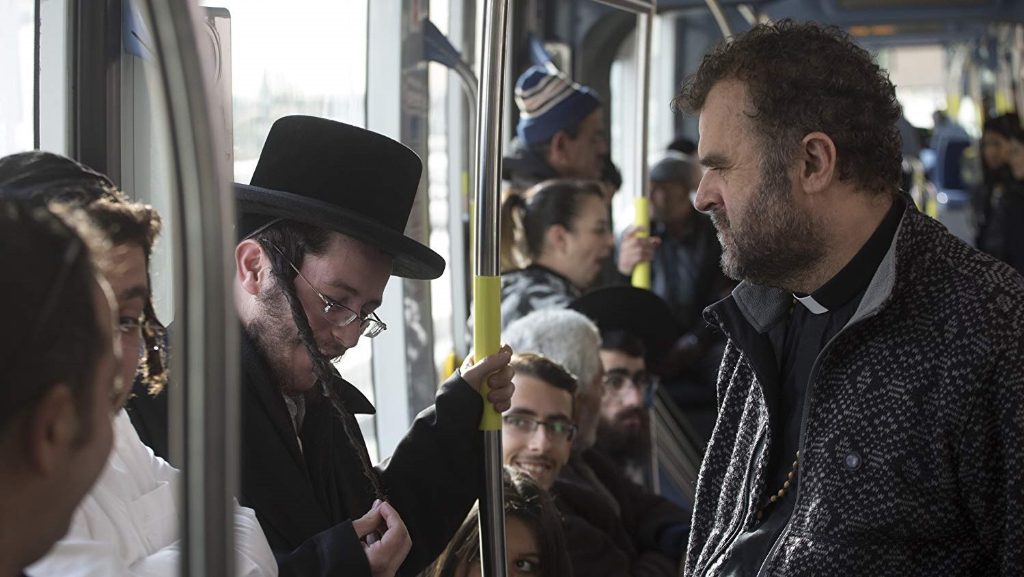
In increasingly turbulent and politically divisive times, there is an increase in art exploring divisions, oppositions and the elusive potential for cohesion. This includes films like BlacKkKlansman, television shows like The Bodyguard and hundreds of YouTube videos of Republicans and Democrats having a drink together. A Tramway in Jerusalem is another movie in this vein, exploring the religious, political and ideological tensions in the eponymous Middle Eastern metropolis through the lens of its tram system. The Light Rail Red Line runs through the city, linking east and west. The director and co-writer Amos Gitai uses this setting as a backdrop to his low-key situational comedy following a cast of travellers as they talk, fight and love each other.
The tenderness and respect the filmmaker holds for his subject matter can be seen in his perceptive and subtle use of camera angles. He uses every corner and plane of the tram carriage, the set barely recognisable from one scene to the other. The Israeli auteur utilises this to establish the tone of each shot. Sometimes, the speaker is seen as barely a slither, obstructed by someone else’s head, while at other moments, characters stand alone in a tramcar which, although full of passengers, seems eerily empty. Through this, the action can move from frightening to intimate to frustrating in a few seconds, a subtle and fitting representation of the everyday dramas of urban life.
Unfortunately, Gitai’s vision falls short elsewhere. The feature is made up of a series of vignettes, most characters not appearing more than once. Although some are presented as part of groups or in couples, these scenes are used as a vehicle for a single character to monologue, read aloud or preach to those around them or to themselves. There is little room, therefore, for change or dynamism and, with a few exceptions, there is no growth or journey for the subjects. Without this movement, they become set dressing, each a stationary symbol for a larger issue or concept. Big topics and themes are represented through this, but not expanded on or explored. Several monologues point to issues regarding the strain and intricacy of Jewish identity, while the safety of women on public transport is invoked regularly by younger, attractive characters being harassed, touched or lectured. As soon as these talking points are raised, however, they are dropped again, leaving the narrative unmoored and without forward momentum.
In the end, the director’s vision of a universal humanity beneath the complexity of identity and current affairs becomes flat. The universal will always be a challenge to portray due to its tendency to blur and blend nuance into a homogenous soup, and A Tramway in Jerusalem is not able to overcome this obstacle.
Cleo Henry
A Tramway in Jerusalem does not have a UK release date yet.
Read more reviews from our Venice Film Festival 2018 coverage here.
For further information about the event visit the Venice Film Festival website here.
























Facebook
Twitter
Instagram
YouTube
RSS