
Erica Rex’s new memoir challenges industry profiting from trauma treatment
 17 February 2026
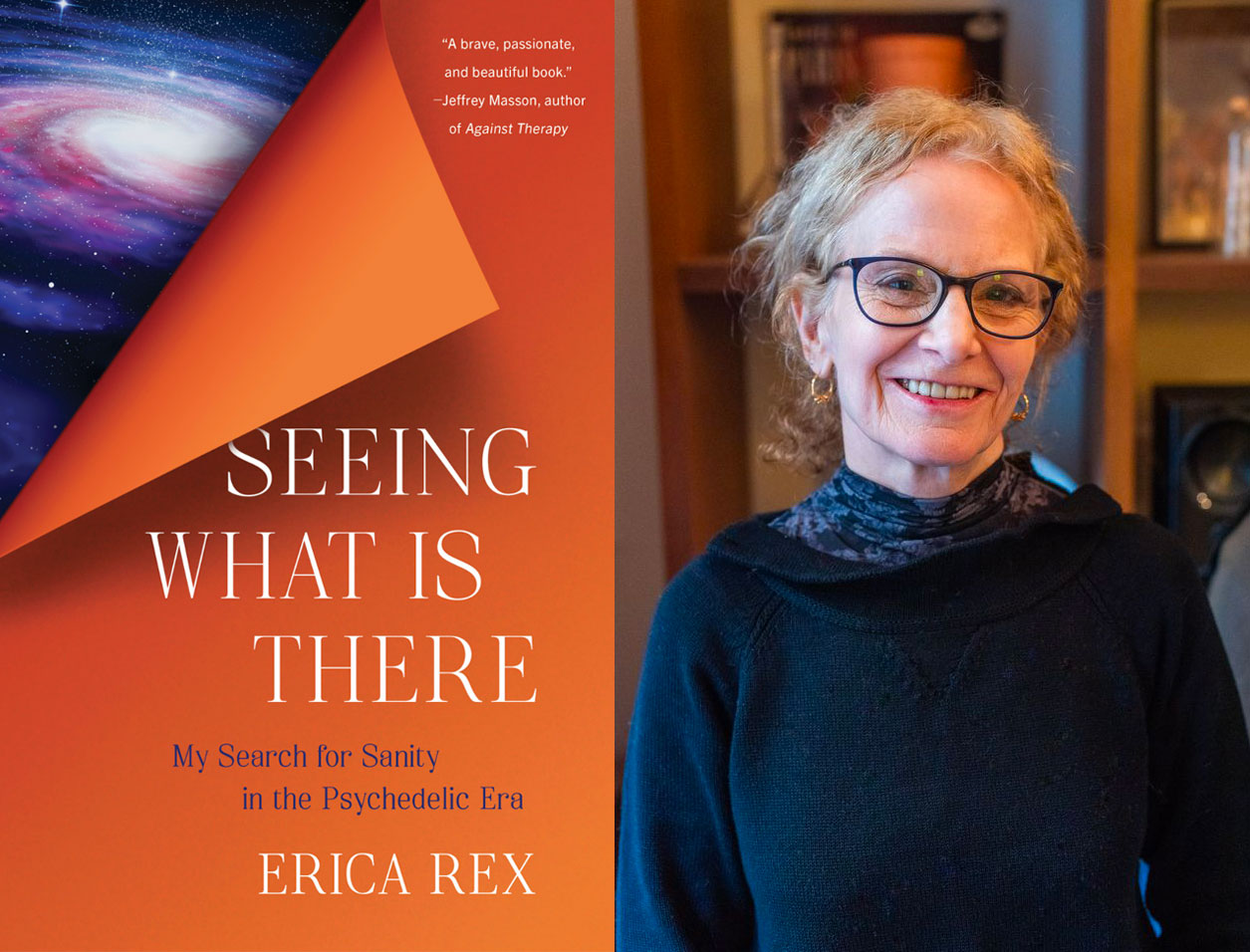
A UK-based journalist who was among the first participants in Johns Hopkins University’s landmark psilocybin trials has published a memoir that arrives as a critical intervention in debates about psychedelic medicine’s commercialization. Erica Rex’s Seeing What Is There: My Search for Sanity in the Psychedelic Era, now available through Simon & Schuster, documents her journey from cancer patient to vocal critic of an industry she believes has lost its way.
Rex won a National Magazine Award for fiction and has reported for The New York Times, Scientific American, The Independent, Salon, and Poets & Writers. Her 2014 essay “Calming a Turbulent Mind” in Scientific American Mind offered one of the earliest patient accounts of clinical psychedelic therapy following her 2012 participation in Hopkins trials testing whether psilocybin could treat depression in cancer patients.
The memoir traces psilocybin research to origins often overlooked in American accounts: the French Museum of Natural History, where first clinical trials were conducted at a Paris psychiatric hospital in the 1950s. This historical recovery forms part of Rex’s broader argument that psychedelic medicine’s current trajectory risks repeating mistakes of the past by prioritizing profit over genuine healing.
Rex’s critique draws from extensive platform work examining psychedelic therapy’s evolution. She has contributed multiple episodes to the Psychedelics Today podcast, including discussions on “Understanding Bad Trips: The Power and Potential of Adverse Psychedelic Experiences” and “Clinical Trials and Spontaneous Mystical Experiences.” Her 2021 presentation at the National Institutes of Health/National Cancer Institute’s psilocybin speaker series, “A Breast Cancer Patient’s Perspectives on the Uses of Psychedelics in Medicine,” ran 44 minutes and remains available online.
Articles for Mad in America—”Psychedelic Therapy Will Not Save Us” and “The Culture Is the Poison: Why Psychedelics Are Dangerous Medicine in a Neoliberal Society”—articulated concerns about venture capital’s entrance into trauma treatment. For The Independent, she wrote “Magic mushrooms and cancer: My magical mystery cure?” while “The Power of Psychedelics” appeared in Scientific American.
Currently serving as an advisor to the Congressional Psychedelic Therapy Caucus, Rex has presented at NIH psilocybin research series and maintains regular podcast contributions examining psychedelic research integrity, adverse experiences, and the intersection of pathology and mystical states.
Her personal history informs the book’s perspective. As daughter of two psychiatrists—her mother trained under Harvard psychologist Henry A. Murray, whose experiments reportedly influenced Theodore Kaczynski—Rex experienced childhood psychiatric treatment resulting in Complex PTSD. The memoir positions this experience within broader examination of systems claiming to heal while potentially deepening wounds.
Asked about venture capital’s impact on trauma treatment, Rex offers unsparing assessment: “Commercialization is designed to create efficiencies of scale, maximizing throughput as though humans and healing were components of computing systems. By its nature, commercialization removes all of the curative humanistic and cultural ingredients from the experience in order to maximize profit. These include: community, authentic connections with other human beings, taking part in a ritual or sacramental curative process. All venture capital exists to do is to extract the maximum profit out of any material or any generative system, including human relationships and cultural practices. It is murderously destructive to institutions that serve precisely the people who stand to benefit most from psychedelic treatment, and voids any consideration of the aspects of the psychedelic experience which make us human.”
The book documents experiences with psilocybin, MDMA, and 5-MeO-DMT while examining exploitation risks in settings where emotional exposure is extreme and regulation minimal. Rex addresses why women particularly face dangers in psychedelic therapy environments and questions spiritual language disguising commercial interests.
Narrative structure deliberately rejects conventional memoir arcs. “Yes. If you want accounts of romps with psychedelics or ‘how I ate ‘shrooms/went to the ayahuasca retreat/microdosed with LSD/smoked DMT and saw stuff’ there are plenty of books and articles to read. This isn’t one of them,” Rex states.
Joe Moore, Co-Founder and CEO of Psychedelics Today, writes: “This important memoir critiques psychiatry and the psychedelic movement, exploring trauma, healing, and the ethical challenges of contemporary psychiatry. Through her journey with psilocybin, MDMA, and 5-MeO-DMT, Erica Rex reveals the promise of transformation while advocating for a future where true healing includes social support, equity, and community. Students of psychedelics and psychiatry would do well to read this book.”
Stephen Mills, author of Chosen: A Memoir of Stolen Boyhood, describes it as “an extraordinary, beautifully written account of one woman’s lifelong journey out of unimaginable childhood trauma… Hers is a singular and prophetic voice, summoning the healing power of community in a culture that has pathologized human suffering.”
Jeffrey Masson, author of Assault on Truth, calls the work “brave, passionate, and powerful” noting it “combines research and lived truth. Difficult at times, but impossible to put down—it will leave you wiser, shaken, and opened in ways few books ever do.”
Rex returns to the United States on Friday, February 20th for the book’s launch at Powerhouse Arena in Brooklyn. The evening event at 28 Adams Street runs 7:30 PM to 9:30 PM, followed by formal Q&A and book signing.
Seeing What Is There: My Search for Sanity in the Psychedelic Era is published by She Writes Press, distributed by Simon & Schuster. Trade paperback retails $17.99, ebook $12.99, available through Amazon, Apple Books, Barnes & Noble, and independent bookstores.
The editorial unit





















Facebook
Twitter
Instagram
YouTube
RSS