
Tracey Emin: A Second Life at Tate Modern
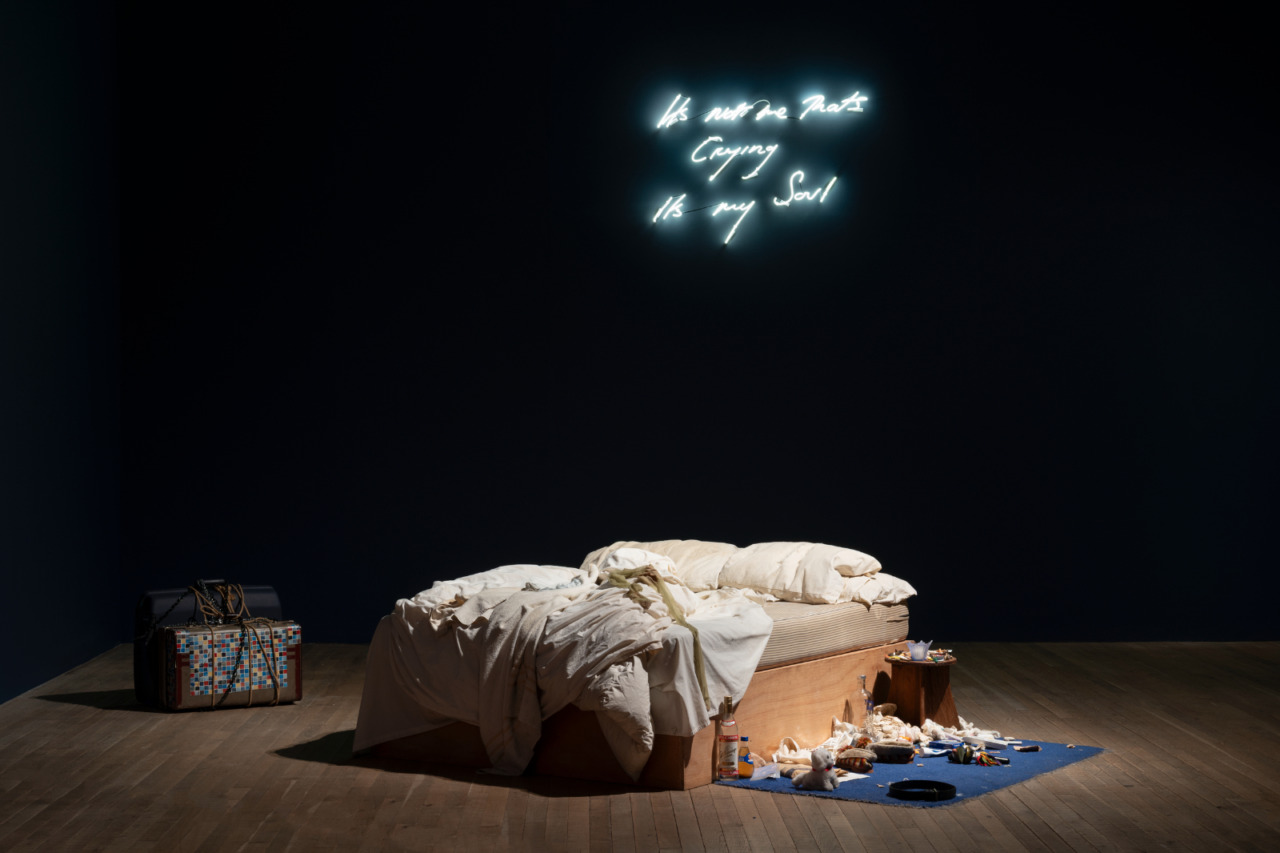

The last few years have been nothing short of an emotional and physical rollercoaster for the now Dame Tracey Emin. Against all odds, she survived bladder cancer in 2020 but was sadly forced to have several organs removed. That close encounter with her own mortality has only served to make the artist even more dedicated to her working practice. With fabled years of partying a distant memory, Emin’s energies are now largely committed to painting and supporting the development of students at the art school, Tracey Emin Artist Residency, which she set up in her home town of Margate in 2023. It will be an enduring part of her legacy, as promises to be the Tate Modern’s new career retrospective of the uncrowned queen of the movement dubbed the YBAs by the British media back in the 90s. The major exhibition’s title, A Second Life, is a clear declaration of the personal battles Emin has waged and of those that lie ahead.
For visitors of a certain vintage, Dame Tracey Emin will forever trigger memories of two seminal works etched into the public consciousness: the first, her tent appliqued with the names of anyone she ever slept with, was tragically lost in the Momart warehouse fire of 2004, the other, My Bed (1998) has become emblematic of British Contemporary Art. Made during an alcohol induced breakdown, the iconic, detritus-ridden bed proves a predictable highlight of the Tate’s retrospective. Juxtaposed on the wall, one of her inimitable neons, Its not me that’s Crying Its my soul (2011) underscores that difficult period in the artist’s life. At the press opening, Tate director Maria Balshaw – for whom the current exhibition represents a personal swansong before she steps down in the Spring – pointed out that few remember the 1996 film, Emin and Emin, showing the artist and her Turkish father swimming in the sea, was shown alongside My Bed at the 1999 Turner Prize. For all the tumult of her formative years – her father left her mother when the artist was young – she expresses a tenderness towards both of her parents. Emin’s closeness to Pamela Cashin, her mother, is a constant thread, from a 2001 film of the two of them in conversation to the trauma-filled red painting in the final room, I was too young to be carrying your Ashes (2017-18), an evocation of the Croydon-born artist carrying the box containing her mother’s ashes in windy conditions.
Featuring 100 works and covering Emin’s four-decade-long career, A Second Life brings into sharp relief the artist’s raw, deeply personal approach to her art. Tate’s essentially chronological display begins with her short film, Why I Never Became a Dancer (1995). The artist addresses leaving school at 13 and having abusive sex with older men in Margate; entering a disco dancing competition, only for a group of boys to chant “slag” at her. In the finale, she is shown dancing joyfully in her 30s to the classic Sylvester disco hit, (You Make Me Feel) Mighty Real. It’s an act of defiance that can be said to set the tone for the years to follow – life, love and suffering transformed into art.
Tate Modern reveals the sheer diversity of Emin’s choice of mediums over the years. One finds everything from painting and video to sculptures, neon, installation and textiles. In one instance, in a work from 1994, she embroiders: “There’s a lot of money in chairs” onto an armchair that had once belonged to her great-grandmother. The artist would hear her grandmother using the phrase, fully aware her relation was meaning money had a tendency to be found down the back of furniture. Emin’s memorable, vibrantly coloured appliquéd blankets, meanwhile, like No chance (WHAT A YEAR) (1999) and Mad Tracey from Margate. Everyone’s been there (1997) subvert traditional stereotypes of female creative expression whilst also providing a cathartic platform for her to process painful experiences. The Last of the Gold (2002), where she advises women facing an abortion, is especially moving.
The artist’s unflinching contemplations of events that have shaped her life have long since been a signature of Emin’s practice. In the aftermath, she described her first abortion in 1990 as an “emotional suicide”, which led her to conclude that all her work made before it was a “big bunch of crap”. A rare opportunity to view the artist’s nascent career is presented in the opening section of this epic show with small photos of her art-school paintings framed on stitched fabric. After her first abortion, Emin promptly destroyed that entire youthful output before unleashing all her pent-up emotions in a Stockholm gallery studio where she threw herself into painting with palpable urgency for three and a half weeks. The studio is recreated here in the form of the installation, Exorcism of the Last Painting I Ever Made (1996), strewn with pots of paint, brushes and drawings, a single bed in the corner. Emin, a natural storyteller, describes her traumatic experiences of abortion in her video, How it feels (1996). With characterful honesty and insight, she states: “Abortion –the best f***ing mistake of my entire life…That’s a contradiction but it’s truth.”
Tracey Emin’s no-holds-barred documenting of her life comes to the fore in a corridor of Tate Modern lined with two very different sequences of Polaroid photographs, each entitled Self Portrait. The first, from 2001, reveals Emin, then still in her 30s, posing seductively in bra and knickers. The more recent set, taken between 2020 and 2025, evidence the artist’s bloodied body following bladder cancer surgery. One image zooms in on her stoma. Bravely, Emin confronts her corporal predicament, ever the defiant survivor. Nearby, the artist’s recent bronze sculpture Ascension (2024) sees her reflecting on her post-operation body. Some genuine highlights of the latter stages here can be found in the sinewy small bronzes like Wanting (2014) that instantly recall Rodin. For the duration of the show, the bulky presence of a sculpture, I Followed You to the End (2014) can be viewed outside of Tate Modern.
The final room sees Emin confronting her own mortality in a series of large canvases which carry transcendental and spiritual overtones. Aside from the aforementioned image of the artist carrying her mother’s ashes, I watched Myself die and come alive (2023) proves especially emotionally arresting. A black figure on the right stands over a female figure rendered in red, seemingly lying on an operating table, depicting triumph over death. Notably, Emin has given particular attention to a geometric rug, a nod to her late Turkish-Cypriot father’s heritage. A haunting work, I followed you to the end (2024) features another fragile, head bowed figure, this time alongside a stream of Emin’s poetic writing, painted onto the lower half of the image. Harry Weller, her trusted Creative Director of Tracey Emin Studio, spoke at the press opening about seeing her on occasions piercing through canvases, such has been her intensity. Then, in the centre of the room, one finds the death mask the artist had cast of herself at the age of 39. Apart from the recognisability of the head, what proves most striking is how small and vulnerable it appears in the setting, as if mirroring the fragility of life itself.
For an artist once vilified by parts of the press and general public alike, Dame Tracey Emin has come a long way. Her groundbreaking, visceral work can be said to be leaving an indelible mark on the landscape of British Art. The Tate’s hotly anticipated exhibition does not disappoint, throwing a spotlight on the artist’s unapologetically human approach and raw engagement with what it means to be alive. In her authenticity, she somehow manages to turn trauma into triumph.
James White
Photos: © Tate (Sonal Bakrania)
Tracey Emin: A Second Life is at Tate Modern from 27th February until 31st August 2026. For further information or to book, visit the exhibition’s website here.










Facebook
Twitter
Instagram
YouTube
RSS