
As Villeneuve takes on Bond, why does cinema keep returning to the gaming floor?
 24 July 2026
There is a particular kind of silence a film reaches for when the story moves to the gaming floor. The soundtrack thins out, the crowd blurs and the camera settles on a single face deciding whether to push the rest of its strategy forward. That moment has appeared hundreds of times, and it still works. The gaming lounge, for all its neon lighting and cliché, remains one of the most reliable rooms in the movies.
It is about to matter again. Amazon MGM Studios has handed the next Bond film to Denis Villeneuve, the director of Dune and Arrival, and through the first half of 2026 the search for a new 007 has narrowed to a shortlist that the industry cannot stop speculating about. Whoever wins the role inherits a franchise that has always understood the dramatic value of a table with money on it. The question of who plays Bond is old news at this point; we have been asking it, and rethinking it, for years. The more interesting question is why the gaming room keeps getting the close-up.
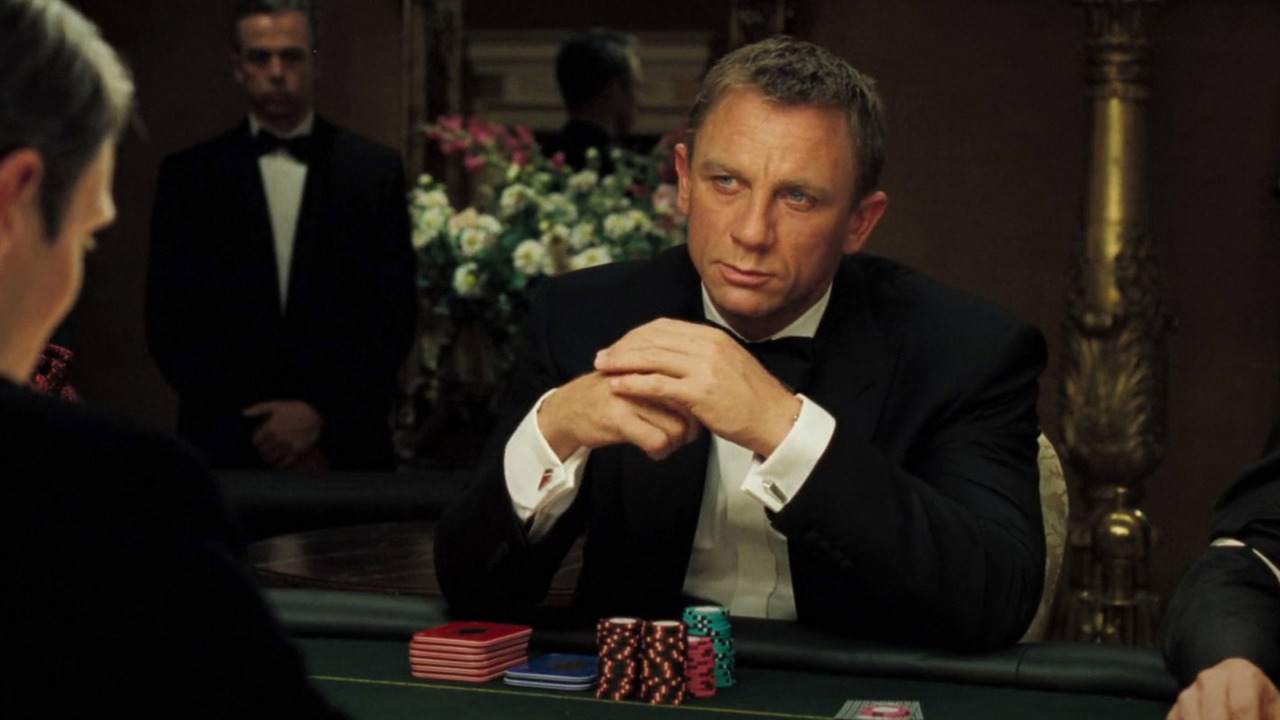
The modern template is Casino Royale, the 2006 reboot that rebuilt Bond around a single high-stakes contest and, in doing so, reminded everyone how much tension a green stage can hold. Daniel Craig’s Bond was defined less by gadgets than by nerve, and the film trusted a strategic encounter to do what a car chase usually does. It is no coincidence that the martini he orders in that film has since become a pilgrimage for fans; it’s still possible to drink the version that inspired Ian Fleming at a quiet bar in Mayfair.
A stage built for tension
Screenwriters love the gaming room because it solves several problems at once. It is a closed room with clear rules, which means the audience always knows what is at stake and roughly how the contest works. It puts strangers around a table and gives them a reason to mislead one another. And it turns the human face into the main special effect, because everything hinges on whether a player can read a signal or hide one.
That is why the setting has outlasted so many trends. The Cincinnati Kid built an entire film around one long contest and the slow education of a young hustler. The Sting made the con itself the pleasure. Scorsese used the gaming floor as a portrait of a whole American economy of greed and consequence, and the Ocean’s films flipped the perspective, turning the venue from a temple into a target. Each of these treats the room differently, but all of them rely on the same basic promise: sit at this table and something will be decided.
The reality behind the fantasy
The trouble is that the movies are, gently, misleading audiences. On screen the gaming room is a duel of wills, a place where a brilliant player can outthink the system and walk away transformed. But the system is the whole point, and the system does not falter. The mechanics are built into every activity on the floor, the outcomes are shaped long before anyone sits down and the experience for most people is repetitive rather than operatic. Nobody films the far more common scene, which is a person slowly tapping a machine on a wet Tuesday afternoon.
The real industry is also a great deal more regulated than the films suggest. In Britain, operators answer to national regulators, which license businesses, set the rules on advertising and fairness and can strip a licence when a company fails its customers. The romance of the private premium room has very little to do with a market bound by age verification, affordability checks and audited performance rates.
Off screen, the modern game looks almost nothing like the fantasy. Most interactive play now happens on a phone rather than under chandeliers, and where cinema offers glamour, the online version is picked apart in the open by review guides such as casino.net, which rank and assess services for users on the things that actually matter to them, such as safety, fairness and how reliably a platform operates. There is no orchestra and no villain across the table, only a comparison of terms and a licence number in the footer. It is a useful corrective to remember whenever a film makes the whole business look like destiny.
None of which is a reason to be po-faced about it. Gaming is entertainment, and treated as entertainment within a budget it is harmless enough. The problems begin when the screen fantasy of the transformative victory leaks into real behaviour, which is why consumer support bodies exist and why the responsible approach, for anyone who participates, is to set a limit before starting rather than afterwards. The films almost never show the morning after. Real life mostly is the morning after.
What Villeneuve inherits
So what does a Bond director do with the gaming room in 2026? Villeneuve is a film-maker who takes his environments seriously, who treats a desert or a spaceship as a character rather than a backdrop, and it is hard to imagine him staging a strategic contest as mere decoration. The challenge is that the fantasy has aged. A tuxedo and a stack of tokens read differently now that the actual activity has migrated to an app and a set of terms and conditions. The glamour that the 2006 reboot could take for granted twenty years ago has to be earned again, or reinvented.
The smart move might be to lean into exactly that gap. A Bond who understands that the system always prevails, and who sits down anyway because the point was never the reward, is a more modern figure than one who simply gets lucky. The gaming room on screen has always been a fiction that audiences enjoy, a place where character beats probability for a couple of hours. That is not a flaw to be fixed. It is the reason the setting keeps returning.
Whoever ends up in the dinner jacket, the table will be waiting. And when the music drops out and the camera finds a single face deciding whether to push everything forward, the audience will still lean in and hold its breath, as if the outcome were ever in the room’s favour to begin with.
The editorial unit























Facebook
Twitter
Instagram
YouTube
RSS