
Cecil Beaton’s Fashionable World at the National Portrait Gallery
 9 October 2025
Back in 1968, under the stewardship of young director Sir Roy Strong (then just plain “Roy”), the National Portrait Gallery took the momentous decision to hold the first ever solo show by a photographer at a British museum. The subject of the retrospective, Cecil Beaton, collaborated in its organisation. Now, over half a century later, the institution opens its doors to its fourth Beaton show, surprisingly the first to entirely focus upon the legendary dandy’s fashion photography. Curated by Vogue Contributing Editor, Robin Muir, Cecil Beaton’s Fashionable World charts the pioneering image-maker’s extraordinary creative career, which saw him transform fashion photography into an art form. There are over 250 items on display, ranging from photographs and fashion illustrations to letters and costumes, all conjuring up a bygone era of beauty and glamour shaped so fundamentally by the man dubbed during his lifetime as the “King of Vogue”.
Right from the outset, Beaton seems to have been fueled by an indefatigable desire to escape the confines of his middle-class background. After leaving Cambridge University without a degree, one finds him ingratiating himself into the glamorous, aristocratic world of the so-called “Bright Young Things”, cultivating friendships with the likes of the gilded aesthete, Stephen Tennant and the Sitwell siblings. Beaton’s charm and ability enabled him to integrate into such privileged circles, leading to Vogue taking him on as a 23-year-old photographer. His dramatically lit portraits of the androgynously elegant Tennant and his high society friends, along with Beaton’s own artfully posed self-portraits (Tennant and he stand together donning identical striped sports shirts in Riviera Wanderers from 1927), capture that extraordinary period of carefree upper crust impetuosity between the wars.
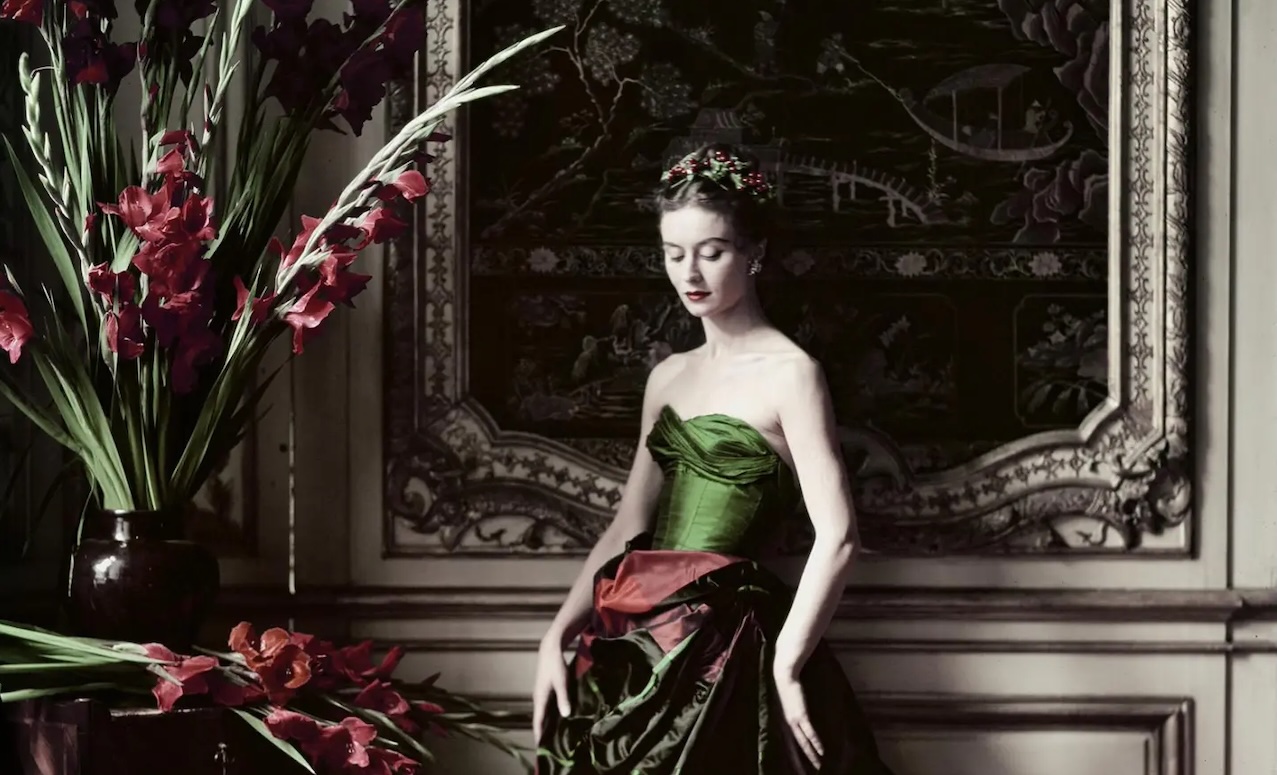
The current exhibition provides fascinating insight into how the fiercely ambitious Beaton developed his own distinctive photographic aesthetic over the course of his long career. At the very entrance, one is virtually bowled over by two wall-sized reproductions. The first is Beaton’s 1948 Worldly Colour printed in Vogue, featuring eight models wearing colourful ball gowns by designer Charles James in the salon of a Manhattan antiques dealer that resembles an opulent interior from 18th-century France. It sets a glamorous tone that is further amplified by the striking unpublished advertisement for Modess from 1956 of Joan Romano clad in pink satin. Exhibited only metres away are 16 silver gelatin prints of society beauties like Princess Marina, Duchess of Kent, Beaton imbuing each with a shimmering luminosity through theatrical lighting and flowers in full bloom. Later, his friend, the American author Truman Capote, encapsulated the photographer’s style with the phrase “Cecil’s lacquered luminosity”.
The multi-talented photographer, fashion illustrator, costume designer and diarist’s work is suffused with a sense of theatre; it courses through every fibre of his creative being, shaping his very identity. At times that artifice becomes jarring within the exhibition, and yet Beaton sets his stall out in a youthful diary entry declaring: “I don’t want people to know me as I really am, but as I am trying and pretending to be.” Numerous times at the NPG, one finds Beaton as a less-than-reluctant subject, forever striving for visual glamour. In one 1935 photograph, he poses in front of an armoire bedecked in vases of white flowers. An oil portrait of Beaton by Christian Bérard from 1938 depicts the photographer’s head cocked to one side as if contemplating his latest creation. A boy stands next to him, seemingly about to hand over a palette knife to the world-renowned image-maker.
The lure of Golden Age Hollywood proved irresistible to Beaton. One finds him here immortalising some of the silver screen’s most glamorous figures and biggest stars for London and New York Vogue, deploying his own particular brand of European surrealism manifested in his elaborate backdrops, and feel for mood. A calmly determined young Fred Astaire is captured, suited and booted in Conde Nast’s apartment in Star of the Year (1930). Norma Shearer’s profile is set against a glittering sheeted backdrop in another Beaton photograph from the same year. Then, in 1938, he experienced a major personal setback: with war on the horizon, he was fired from American Vogue after including an anti-Semitic slur in a drawing for a published article. He would not work for the publication for a year and a half, and his reputation was tarnished.
Later, one comes across a future pantheon of screen deities: Marilyn Monroe in Venus Unmasked (1956), who he found to be disarmingly mischievous and Elizabeth Taylor (in a 1955 photograph), whom he actively disliked, regarding the violet-eyed beauty as vulgar. One Hollywood star, more than any other, however, will forever be entwined with Beaton. Greta Garbo entranced him. One finds a scrapbook the spellbound Beaton filled with cut-out images of the enigmatic star before the two of them were to embark on an ultimately doomed on/off love affair after she had posed for him at the Plaza Hotel in New York. His 1946 photograph of Garbo displayed nearby sees the screen siren coquettishly bestride a chair dressed in a clown’s outfit. Convinced it was a private shoot, the actress found it published in Vogue and never fully forgave him.
Beaton’s enduring engagement with high society was perhaps always destined to see him bringing his flair for glamour to the depiction of the British Royal family. His first photographs for the Windsors date from the late 1930s as Britain edged towards another world conflict. In Faerie Queen (1939), the then Queen Elizabeth, the mother of our late monarch, strides down steps in an elegant white dress by Hartnell, holding a white umbrella to shield her from the sunshine. Surely the intention is to align her with that most defiant of British queens, her namesake Elizabeth I, in the face of the German foe. Two years earlier, Beaton had been the official photographer at the Duke and Duchess of Windsor’s wedding in France. Wallis Simpson, previously regarded unfavorably by the Englishman, had by then gained his respect for her elegance. The American socialite at the heart of a regal abdication sits composedly facing the camera in an outfit by Schiaparelli against a curtained background. In the war years, Beaton engages in the presentation of George VI and his family as a steadfast national bedrock.
Beaton served as an official war photographer during the six years of World War Two, and there is a small area of the current exhibition devoted to this period. Arguably, his most famous and powerful work of the entire conflict is Age of Innocence (1940), a photograph of three-year-old Blitz victim Eileen Dunne sitting in a hospital bed with her head wrapped in a bandage as she grasps a doll. The image would appear on the cover of Time magazine and allegedly bring the US closer to joining the Allied cause. Other war photographs displayed give a human face to the combatants, the man behind the camera not adverse to investing in them a kind of earthy glamour as they face up to their challenging circumstances with a mixture of cheerfulness and resignation.
Once victory had been achieved, and as far as this exhibition is concerned, back around the corner, the doyen of British fashion photography is found chronicling a new age for the Royal family. Beaton photographs Princess Margaret in a fabulous Dior ballgown for her 21st birthday and, on a separate occasion, her older sister, Princess Elizabet,h playfully peering around a pillar as the young Prince Charles (now King Charles III, of course) animatedly engages with an unseen party out of shot.
In 1954 and 1955, Beaton suffered the dual ignominy of having his contracts terminated first from New York Vogue and then London Vogue. He turned his attention to the performing arts arena, making costumes and set designs both for the theatre and film industry. In 1956, My Fair Lady, based on George Bernard Shaw’s Pygmalion, opened on Broadway. It became a huge hit, with Beaton receiving a coveted Tony award for his costume design. The National Portrait Gallery’s exhibition is brought to a glorious conclusion by perhaps the crowning achievement of Beaton’s long career, his costumes and sets for the 1963 film version of My Fair Lady. Starring the gamine and universally adored Audrey Hepburn in the lead role of Elisa Doolittle, the cinematic production was again a huge success, earning Beaton two Oscars, one of which appears in all its glittering Hollywood glory here. Famously, Julie Andrews, who played Elisa on the New York stage, was not chosen to reprise the role for the film adaptation and its an interesting subplot to see the English actress photographed in her stage costume alongside her Broadway co-star, Rex Harrison. However, it is the wall-sized reproductions of Beaton’s wonderfully vivid photographs of Hepburn adorned in fabulous costumes which ultimately best capture the emotional heartstrings. In his lifelong exploration of beauty and glamour, Beaton, the pioneering master of elegance, left his inimitable mark on 20th-century aesthetics.
James White
Image: “Best Invitation of the Season” Nina De Voe in Ballgown by Balmain, 1951, by Cecil Beaton. Photograph by Cecil Beaton. Courtesy of Condé Nast Archive
Cecil Beaton’s Fashionable World is at from 9th October 2025 until 11th January 2026. For further information or to book, visit the exhibition’s website here.







Facebook
Twitter
Instagram
YouTube
RSS