
GeeGee collection proves that true luxury in London now means traceable fabrics and handmade seams

 16 January 2026
In an industry that can turn even the most romantic idealist into a spreadsheet, Georgia Crossley did something unusual and paid attention. The British-born designer spent her formative years moving between Paris, Cyprus, Hong Kong, and London, then did a tour of duty in the fashion trenches at Alexander McQueen and Jenny Packham, absorbing the alchemy of cut, drape, and drama that usually ends in red carpets and perfume deals, not in biodegradable textiles and carbon audits. It might have gone the usual way with a big house, a big salary, and a big compromise if she had not stared down the underbelly of mass production in China and decided that the industry’s favorite accessory, willful blindness, no longer suited her.
Instead, she responded with a small, determined venture called GeeGee Collection, a London-based label that treats each swimsuit and kimono as if it were a gallery piece with a clear paper trail. The supposed frivolity of resort wear becomes a way to ask a more serious question: what if luxury stopped hiding how it is made and started being transparent about it?
Traceability as the new status symbol
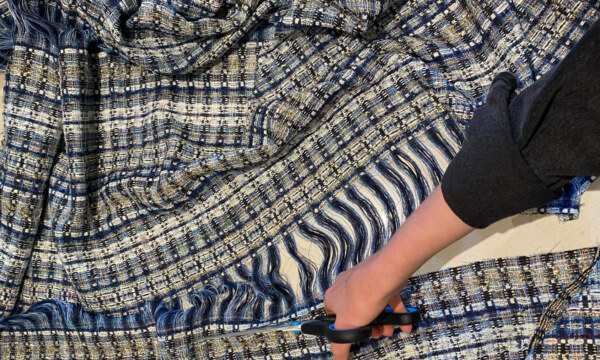
GeeGee Collection’s appeal is not in heavy branding. It is in receipts. Fabrics are personally sourced or designed by Crossley in Italy and France, handwoven by artisans, then cut and stitched in the United Kingdom and European Union, with every step in the journey intentionally traceable. In an age when brands use the word ‘sustainable’ casually, Crossley’s insistence on showing the entire supply chain feels less like marketing and more like a standard she refuses to compromise on.
The label’s non-seasonal model, where new pieces appear thoughtfully throughout the year rather than in large drops, directly challenges the cycle that has turned fashion calendars into a source of unnecessary waste. GeeGee Collection pairs its traceability with a formal commitment as a member of 1% for the Planet, diverting a portion of gross sales to environmental nonprofits, one of the rare cases where giving back is built into the business rather than added as an afterthought. In this corner of London luxury, the quiet statement is not a limited-edition capsule but knowing exactly whose hands brought a garment into being.
Handmade in an algorithm world
The clothes themselves lean into a restrained, confident kind of opulence. GeeGee Collection’s swimwear and kimonos are crafted from exclusive, hand-designed textiles that do not reappear on rival rails, and each piece is made in small batches, often entirely by hand. Crossley calls it wearable art, and in a landscape focused on speed and repetition, there is something quietly resistant about a garment that exists precisely because it will not be everywhere.
Behind the romance lies a clear understanding of what fast fashion has cost both the planet and the wearer. Fashion is responsible for a significant share of global carbon emissions, yet consumers are often encouraged to treat clothing as disposable and forgettable. By embracing slow fashion, with pieces designed to be cherished, repaired, and re-worn rather than replaced, GeeGee Collection presents a direct challenge to the luxury establishment. If a garment cannot survive more than one season in a wardrobe, the label suggests, it was never truly luxurious to begin with.
London’s new definition of luxury
What Georgia has built in her East End studio is both a brand and a statement. London, with its historic tailoring houses and crowded high streets, has long been a mix of heritage and overproduction. GeeGee Collection offers a quiet approach that combines ethics and elegance, rather than competing with them. The designer is already planning expansions into knitwear and home decor, extending her meticulous, small-batch ethos into pieces that follow the same map of traceable, European-made, biodegradable materials.
The larger houses are likely to continue launching sustainability campaigns and themed collections. Georgia, meanwhile, will still be in her studio, working over another hand-drawn print, making the case that true luxury is not the piece that appears in the most posts but the one whose every seam can answer a simple question clearly and honestly: who paid the real price so it could exist?
The editorial unit
Photo: Courtesy of Georgia Crossley




















Facebook
Twitter
Instagram
YouTube
RSS