
MC Escher: The Exhibition at Somerset House
 5 June 2026
Certain artists seemingly have a universal allure that appeals to all. One thinks of Dali, Matisse, Kahlo and the late David Hockney, who has just passed away at the time of writing. The new major exhibition at Somerset House Embankment Galleries offers an opportunity to experience over 150 works by another name who belongs in that elitely popular company, the Dutch graphic artist Maurits Cornelis Escher (1898-1972). Celebrated for his optical allusions, ingenious patterns and impossible buildings, the artist’s practice enticingly blends maths, science and art. Everything is shaped by the Dutchman’s remarkable imagination and technical wizardry.
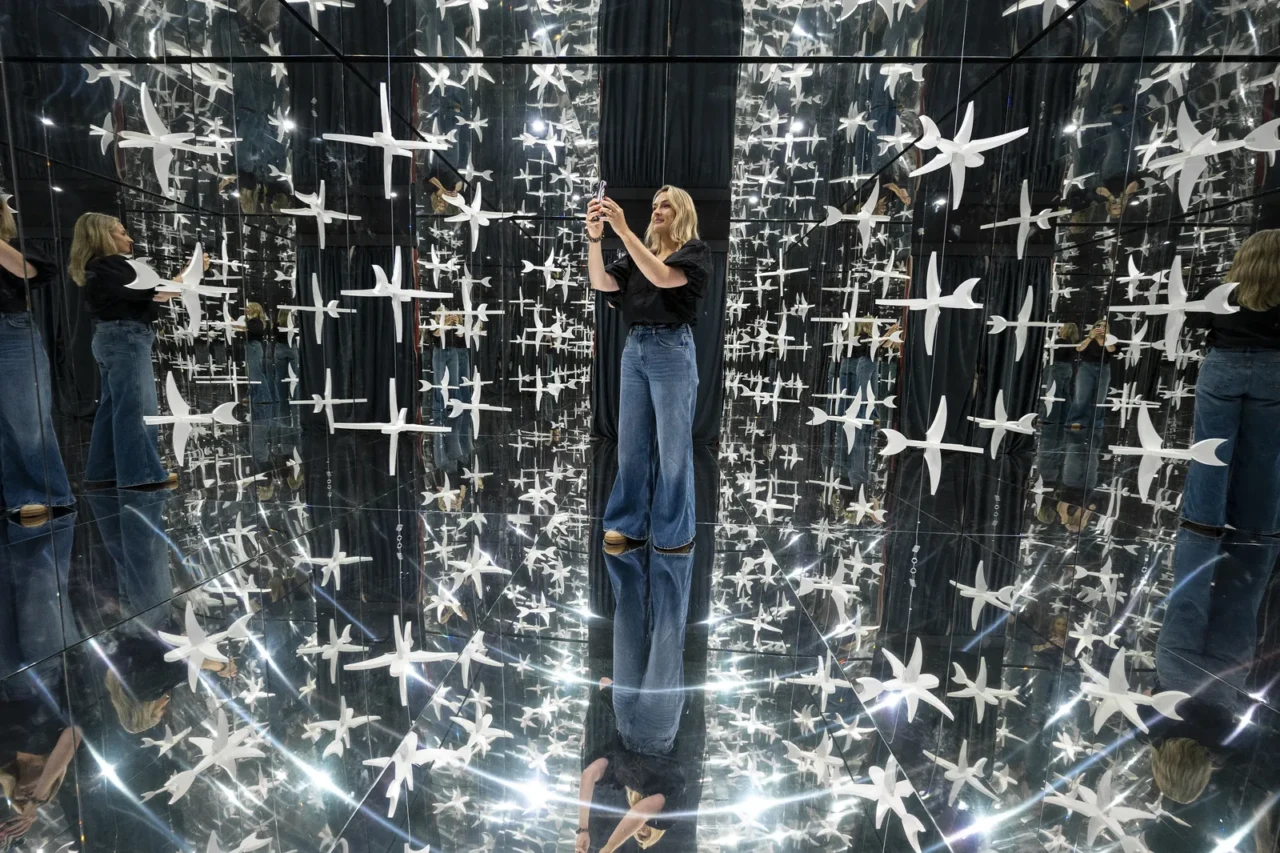
Organisers Arthemisia and Fever have put together a family-friendly, adventure trail of a show that charts the key chapters of Escher’s life and career, whilst also providing immersive displays to give insight into the ideas at the heart of his work. Throughout, a series of short films demonstrate the precise techniques behind his woodblocks, lithographs and mezzotints, with the meticulous Dutchman’s tools also on show.
Born in Friesland in the Northern Netherlands in 1898, Maurits did not enjoy the greatest of health as a child, with art offering some form of solace. At 21, he enrolled at the School of Architecture and Decorative Arts in Haarlem, where he was taken under the wing of the Jewish printmaker Samuel Jessurum de Mesquita, an important figure within Dutch Art Nouveau. Escher enthusiastically learnt the graphic art techniques that would later shape his career. Encouraged by his tutor to study nature, Maurits is seen over time scrutinising sunflowers, a toadstool and a frog on a lily pad, all revealing a heightened awareness of geometric forms.
Undoubtedly, Escher’s visit to Italy in 1921 is found having a transformative effect on his practice. He fell under the spell of Renaissance architecture and the splendour of the Italian landscape, perhaps no better evidenced in his dramatic, bird’s-eye view 1931 lithograph of Atrani on the Amalfi coast. The artist sets the spectacularly located town, bathed in rich sunshine against a dark concentric-waved ocean, making play on the cuboid forms of the building. Three years earlier, Escher had produced the even more vertigo-inducing woodcut, Tower of Babel. The steep, linear perspective and careful application of geometry would prove future stalwarts.
So inspired was the Dutchman by Italy that he settled in Rome until 1935, when he chose to return to the Netherlands. En route, he took the momentous decision to explore Spain, momentous because it introduced him to Islamic tessellations. It was in the Muslim palace, the Alhambra in Granada, that he was bewitched by the vibrantly coloured interlocking tiles and their rich patterns. Subsequently, from 1937, we find the artist creating his ‘cycles’ and ‘metamorphoses’ works, transforming one being or object into another. Some of his most breathtaking, not to mention amusing, masterpieces tantalise the eyes and rattle the brain at this juncture of the exhibition. Day and Night (1938), a woodcut merging airborne ducks with a Dutch landscape, sold reasonably well with the public as a print at the time. It is Metamorphosis II (1939-1940), however, the glorious melting pot of tessellations – where fish are transformed into cubes and the aforementioned view of Atrani is regenerated into a chess board – which is arguably one of the artist’s crowning achievements.
By the post-war period and moving into the 50s and 60s, Escher is found at his absolute peak, using his intuitive understanding of mathematics to craft his geometric paradoxes. Displayed highlights here are the celebrated lithograph works: Drawing Hands (1948); Relativity (1953); Ascending and Descending (1960); and Waterfall (1961). Ascending and Descending has an interesting background. Two years previously, the British mathematician Roger Penrose and his father Lionel had published an article on the “Penrose staircase” principle in the British Journal of Psychology, which included a drawing and 3D model of a continuous flight of stairs. Having met Escher in Amsterdam in 1954 at the International Congress of Mathematicians, Roger Penrose sent the Dutchman a copy of the article, inspiring the artist to make the iconic lithograph of a staircase looping back onto itself, where hooded monks seem condemned to traverse forever.
Over the course of the exhibition, it becomes obvious why Escher’s work has been a source of inspiration for mathematicians, architects, film directors, game designers and musicians alike. His brilliant imaginings unsurprisingly soared in popularity during the psychedelic era. A wall display of vinyl covers featuring the graphic master’s work, often published without his permission, tells its own story. Mop the Hoople’s eponymous 1969 debut album and Pink Floyd’s Ummagumma are particularly memorable, the latter featuring the band in receding Escher-esque perspective on the sleeve. Other examples of Escher being referenced by advertising and popular culture are on show, with even an episode of The Simpsons getting in on the act.
MC Escher: The Exhibition represents a rare chance to see the mind-boggling inventiveness and virtuosity of the Dutchman’s art in the flesh and beyond the confines of the printed page. Organisers have done a good job of pulling together displayed works and digital installations, ensuring its appeal to all. There is also a nice balance of education and fun with the immersive experiences providing insight and plenty of entertainment: in one room, visitors are encouraged to create a digital image of themselves in the position occupied by Escher within his Hand with Reflecting Sphere self portrait, marked by distortion; whilst another room offers you and a companion the choice of either growing or shrinking in the optical illusion space. “Only those who attempt the absurd will achieve the impossible”, M.C. Escher once declared. How gloriously he made good on that objective.
James White
Photos: Stephen Chung
MC Escher: The Exhibition is at Somerset House from 5th June until 6th September 2026. For further information or to book, visit the exhibition’s website here.















Facebook
Twitter
Instagram
YouTube
RSS