
Richard Dadd: Beyond Bedlam at The Royal Academy
 25 July 2026
Emerging as a young talent of real promise whilst a student at the Royal Academy Schools, Richard Dadd (1817-1886) seemed destined for great things. His exceptional technical prowess saw him win prizes at the institution for architectural and figurative drawing. The Kent-born Dadd also had a rebellious streak, becoming a founding member of the youthful artists’ brotherhood, the Clique. And yet this group of RA alumni would never challenge the British artistic establishment to the extent of the Pre-Raphaelites. A successful career of relative conventionality seemed to lie ahead of Dadd. Then, in 1842, the artist was invited to accompany Sir Thomas Phillips on a Middle Eastern tour for the purpose of documenting the adventure in water colour. Months of heat and exposure to ancient religions took their toll on Dadd, inducing, in the words of his aristocratic travel companion, a series of hallucinations. Never the same again, the artist would return home alone and later in a fit of psychosis, stab his own father to death with a razor and pocket knife. Arrested on his way to Europe, Dadd was sent to the notorious Bethlem psychiatric hospital in Lambeth. Here, befriended by management and doctors, he was permitted to continue his painting practice, producing portraits and many of the fairy works he is best remembered for. Bethlem (or Bedlam as it was dubbed) served as Dadd’s home from 1844-64 before his transfer to Broadmoor Criminal Lunatic Asylum for the last chapter of his life. The Royal Academy’s compelling new exhibition charts this gifted, troubled character’s art from early, sensitively rendered images of his family, through to intricately detailed flights of fantasy and references to literature. Featuring over 100 of his works, it marks the first major showing of the artist since the 1970s, drawing upon his extraordinary imagination and skill.
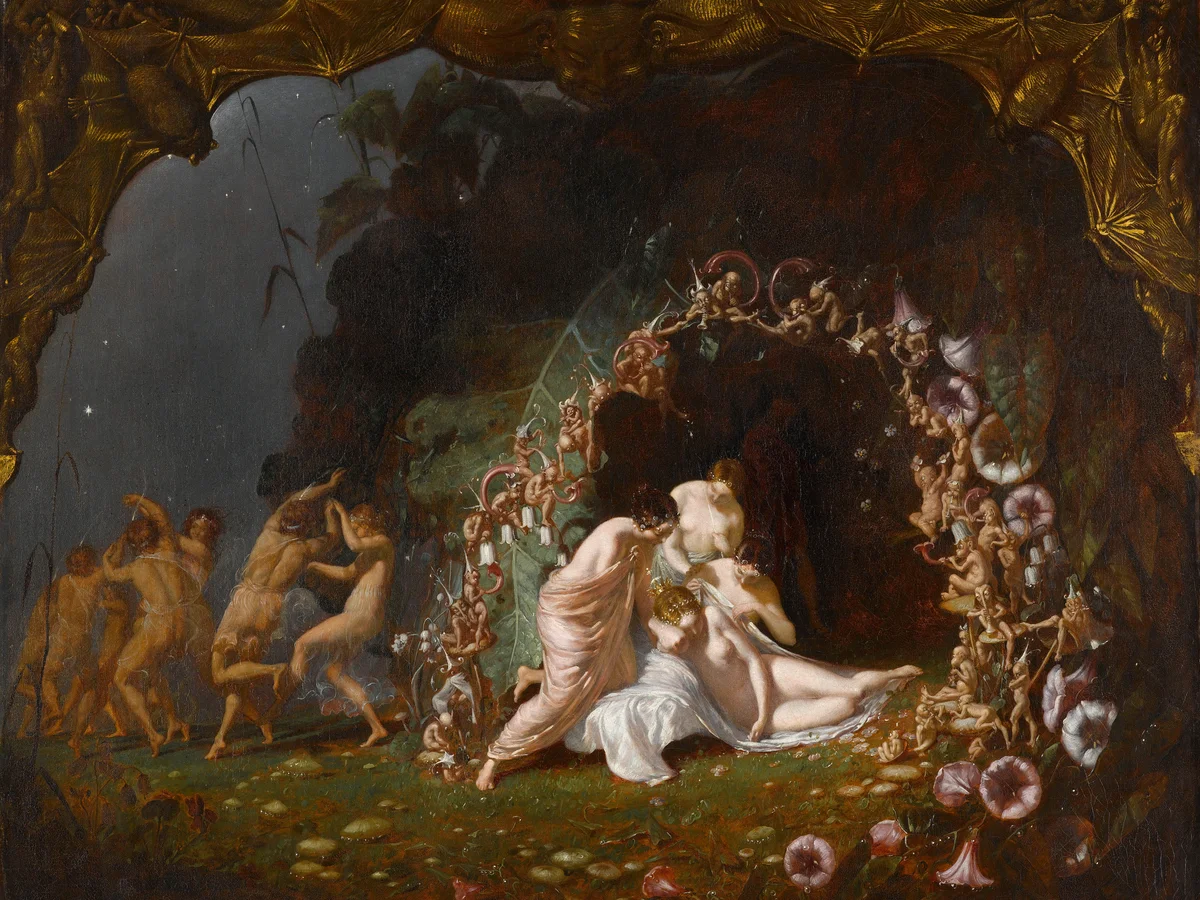
Chronologically displayed, the exhibition arrives at a time of heightened awareness of mental health issues. Gallery texts reveal the degree of sensitivity deployed by the co-curators, the art historian and author Nicholas Tromans and Sylvie Broussine, RA Associate Curator. Dadd’s total of 42 years in psychiatric confinement are rightly engaged with, considering the significant period of his life encompassed. That said, calls are made here for the Victorian to be re-evaluated on his artistic merits rather than mainly through the limited prism of his mental state. Manifestly, the young Dadd was a natural talent as evident in tender early watercolour studies of his family. Nearby, the artist’s oil portrait depiction of his fellow Clique member, Augustus Egg, in the guise of a Roundhead soldier from the English Civil War, testifies to the group’s tendency to model for each other as characters from history and literature. Dadd’s passion for Shakespeare quickly emerges as his career progresses, notably in Titania Sleeping (1841). Displaying a characteristic eye for detail, dramatic lighting and the artist’s penchant for dancing fairies, the work marks a major turning point in his career. Another canvas from the same year, Puck, also disproves incorrect assumptions that Dadd’s fairy paintings only arose from his incarcerated mind. A beyond mischievous, giant baby-like version of the Midsummer Night’s Dream character of the title, illuminated by the moon, appears to delight in the frenzy of naked male and female figures dancing below. From a curatorial standpoint, the message is clear: Dadd’s imagination soared before Bethlem.
And then came the fateful 1842 tour of Europe and the Eastern Mediterranean. Dadd’s uncannily accurate draftsmanship is brought to the fore here in his sketchbook work from the journey. One finds him carefully chronicling landscapes, ancient temples and local people encountered with his distinctly sensitive hand. The painter’s subsequent mental deterioration and the tragic event that followed (he believed the Egyptian god Osiris had ordered the patricide), which led to him being institutionalised for the rest of his life, could have spelt the end of his creativity. It was thanks to enlightened management at first Bethlem and later Broadmoor that Dadd was allowed to continue pursuing his art. Initially prone to occasional acts of violence, over the years he turned into a calmer presence as he dedicated himself to his canvases. A lack of patrons led him to paint hospital employees with his 1852 portrait of Bethlem’s outgoing Visiting Physician Sir Alexander Morison setting the ageing doctor against a background of his estate and home in Newhaven near Edinburgh. A drawing of the sitter’s property made by Morrison’s daughter enabled Dadd to finish the scene. Another rather idiosyncratic portrait, A Young Man (1853), is thought to be of Sir Thomas Hood, the new Superintendent of the hospital. Thoughts of Pre-Raphaelite realism are summoned even though Dadd’s incarceration would have made exposure to Millais and company unlikely.
By some distance the most celebrated of Dadd’s works, The Fairy Feller’s Master-Stroke is an undoubted highlight of this show. Painted over nine years between 1855 and 1864 while the artist was confined in Bethlem Royal Hospital, the masterpiece shows Dadd achieving remarkable new levels of veracity and sheer invention. The viewer is thrust into a fantastical, miniaturised fairy world from a scene in Romeo and Juliet. Tiny beings gather, dwarfed by daisies and a forest of plant stems; the minutiae of the detail are something to behold. The action focuses on the cracking of a hazelnut to repair a carriage for fairy Queen Mab. Victorians loved a fairy painting, but none surpassed this one for originality, technique or pure weirdness. A century after its completion, the late Freddie Mercury of Queen fame was so entranced by the work at the Tate Gallery that he recorded the track The Fairy Feller’s Master-Stroke for the band’s 1974 album Queen II. Completed after Dadd’s move to Broadmoor, the oval canvas Contradiction. Oberon and Titania (1854-58) provides further explanation as to why the artist’s precise wizardry brought him acclaim during the psychedelic era.
Dadd’s formidable memory, alongside sketches made during his 1842 travels, enabled him to revisit landscapes and experiences otherwise long since inaccessible to him in person. The exhibition’s final chapter sees him producing watercolours in Broadmoor harking back to his past adventures like the ethereal View of the Ancient City of Tios in Lycia (1883) and atmospheric seascapes evoking his childhood in Chatham, Kent. There is undeniable pathos to be found in such a talented artist spending more than half of his life incarcerated, be it for justifiable reasons. However, despite these imposed restrictions, Dadd was able to build a body of work of exceptional imaginative power and technical virtuosity. This long overdue career examination promises to assure his legacy as a true Victorian artistic visionary.
James White
Photo: Titania Sleeping, 1841. Photograph: © GrandPalaisRmn (musée du Louvre) / Jean-Gilles Berizzi
Richard Dadd: Beyond Bedlam is at The Royal Academy from 25th July until 25th October 2026. For further information or to book, visit the exhibition’s website here.











Facebook
Twitter
Instagram
YouTube
RSS