
Berberian Sound Studio at the Donmar Warehouse
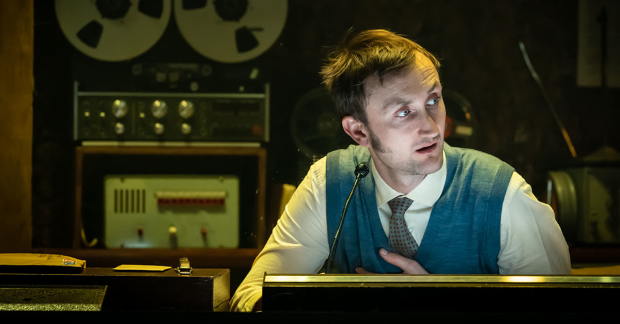



Berberian Sound Studio is based on the screenplay by Peter Strickland that pays tribute to the Italian giallo tradition of murder mystery thrillers. Set in the 1970s, it relates the experience of a British sound engineer, Gilderoy (Tom Brooke), who is hired by a well-known Italian director to create the soundscape of his latest picture.
The play sets off with a comical tone as the excessively polite protagonist arrives in Italy and finds himself amidst an animated crew of colleagues at the post-production studio. Alienated by his reserved attitude and the language barrier, Gilderoy immediately feels uncomfortable. When he gradually begins to understand the unethical storyline of the film he is working on, and the full extent of the violence involved, he is increasingly perturbed.
Nevertheless, his passion for his work leads Gilderoy to obsess about finding the perfect sounds to bring to life the gruesome final scene of the movie. Many vegetables are snapped and crushed to achieve the desired effect, and he becomes dangerously immersed in the task. Meanwhile, two female voice-actresses open up to him about their distress at taking part in the project, which seems to them a pretext for the men involved to mistreat them and play out immoral fantasies.
While the details that unsettle the characters so deeply are hinted at, and one can guess their psychological impact, the tension and dread they feel is not extended to the audience. The horror element is subdued and the climax is reached without the due escalation. The play’s flow is hindered by its pace, which is too slow for the most part and then abruptly reaches a high at the end.
Tom Brooke is excellent in his evolution from innocence to disturbance, and the silent sound assistants add to the eeriness with their presence alone. The highly atmospheric set and effective lighting lend the production a cinematic feel. Sound is, naturally, a central feature. One of the most valuable elements of the production is the invitation to consider the importance of the aural dimension and the way so many sounds we hear have a significant, albeit subtle, effect on us.
The play is visually appealing, presents a valid social critique, and sound designers Ben and Max Ringham have hit the spot. Still, Berberian Sound Studio somehow fails to provoke the strong emotions and reactions it represents, with technical precision surpassing feeling.
Mersa Auda
Photo: Marc Brenner
Berberian Sound Studio is at the Donmar Warehouse from 8th February until 30th March 2019. For further information or to book visit the theatre’s website here.










Facebook
Twitter
Instagram
YouTube
RSS