
Dirty Looks: Desire and Decay in Fashion at the Barbican
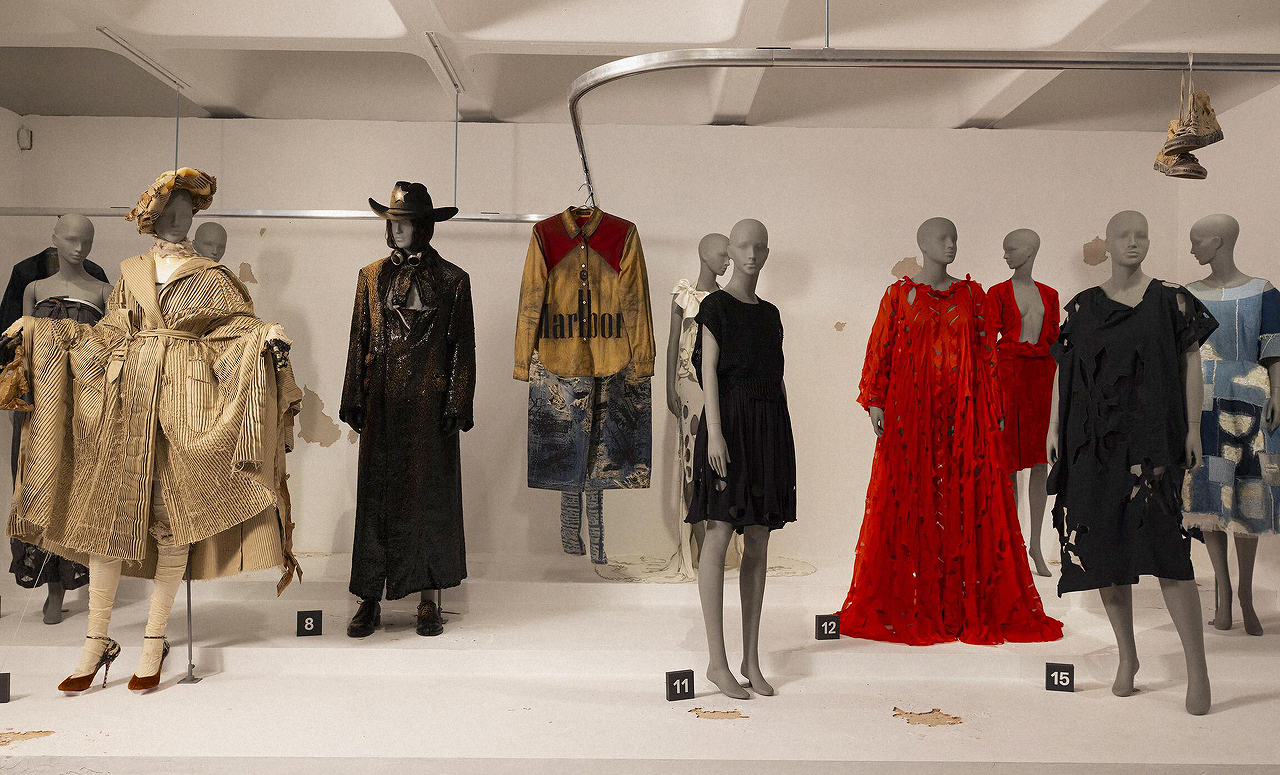

The new exhibition at the Barbican Centre, aptly titled Dirty Looks, is an interesting concept but rather mildly executed. Exploring dirt in all its varying forms and how that interweaves with fashion and culture holds plenty of intrigue. Even more so when the opening display sees two boots, one streaked in mud, while the other is immaculately pristine. The tags reveal that these pairs are from the model Kate Moss and the late great Queen Elizabeth II; their stark contrast as individuals and in their shoes touch on the idea of desire and decay in fashion – the different ways people show their longing to be in touch with nature, and the earth’s close ties to the fragility of life. From there, the audience will travel up the stairs, traversing through scenes of crud and dirt.
A dirty look can be achieved in various ways; the overarching theme of this collection is vast and diverse. The pieces range from discussing colour and patterns, items that evoke the imagery of mud and soil, to challenging the notion of cleanliness as closer to godliness. One section of interest is “Spectres of Dirt”, a showcase of mess as a symbol of rebellion and authenticity. It dissects people’s attachment to historical context and signs of past life in clothing, finding comfort in pieces that have been “lived in”, highlighting movements such as the hippies of the 1960s, the punks of the 1970s, and even the growth of bohemian culture in the 1990s. However, this part fails to provide pieces that highlight these eras of inspiration. Furthermore, there’s no mention of the popularity of thrift shopping, which is one of the modern forms of acquiring used items – items that have history and are “lived in”. Thrift shopping also stands as a form of rebellion, rejecting industrialisation and the rise of fast fashion. Its omission renders this area of the collection lacking.
There are some standout segments, most notably “Stains as Ornament”. This is a display of how everyday spills, from coffee to wine, can also be seen as fashionable and artistic. It aims to contradict the look of uniformity by intentionally creating scuffs and marks. There’s an interesting autopsy of cleanliness, accidents and hierarchies uncovered here. It delves into the kind of people who are allowed to make a mess, and the divide between intentional dirt for artistic purposes and actual dirt that mars the everyday person. One striking piece is The Wine Stain Gown, Fear by Robert Wun – a gorgeous white gown splashed in red wine, topped with a hat bedazzled in deep maroon gems.
Dirty Looks features designers and artists such as JW Anderson, Hussein Chalayan, Vivienne Westwood, Alexander McQueen, Paco Rabanne – to name but a few. Beyond the simplistic topic of dirt, there are also traces of the marriage between art and science and how that connects with nature. The main backbone for the theme is the research and work of Mary Douglas, with the expansion of her quotes used as the guide for most of the curated segments. The presentation is also tailored to the theme, with broken tiles and platforms used to achieve an unkempt aesthetic, lending more credit to the dirty look as a statement of style. It adds to the immersion of the experience. However, Dirty Looks doesn’t dive deep enough into the important topics of challenging the tide and sustainability. There are mentions here and there, spotlighting artists who do champion these ideals. Still, the exhibition doesn’t penetrate that superficial layer far enough to evoke any meaningful discussions surrounding these topics and their interplay with fashion.
Mae Trumata
Image: Courtesy of the Barbican
Dirty Looks: Desire and Decay in Fashion is at the Barbican from 25th September 2025 until 25th January 2026. For further information or to book, visit the exhibition’s website here.







Facebook
Twitter
Instagram
YouTube
RSS