
Zurbarán at the National Gallery
 2 May 2026
The Spanish Baroque master Francisco de Zurbarán (1598-1664) is arguably best known for his austere depictions of saints, a notable example being Saint Francis in Meditation (circa 1635-39). Dramatically lit before the starkest of black backgrounds, the hooded figure kneels in prayer, clutching a human skull in testament to the fate that awaits us all. Part of the National Gallery’s collection since the 19th century, the painting features in the Trafalgar Square institution’s captivating new exhibition devoted to this outstanding contemporary of Velázquez. The retrospective marks the first time that the artist has been accorded such an extensive career survey on these shores.
As with early Diego Velázquez and Zurbarán’s younger compatriot, Bartolomé Esteban Murillo, Sevilla was both the artist’s home and work hub for much of his prime. Moving to the then thriving Andalusian port from his native Extremadura in 1629, Zurbarán can be seen quickly forging an impressive reputation on his brand of rapturous Catholic iconography. In the opening room at the National Gallery, one is met by the mesmeric presences of two colossal Christ on the cross canvases. Crucifixion, painted in 1627, reveals the artist’s startling ability to inject his figures with an illusionistic solidity that bears out his sculptural training. Zurbarán’s earliest signed work, it is hung in the sacristy of San Pablo el Real, a 13th-century Dominican convent and later headquarters of the Inquisition in Seville. Displayed nearby, a work portraying St Peter Nolasco receiving a vision of the original St Peter being crucified upside down, evidences the painter’s imagination alongside his awareness of human physiology: the apostle’s blood visibly rushing to his face.
Zurbarán’s mastery of chiaroscuro and characteristic way of suffusing his work with drama and emotional intensity ensured him a regular flow of commissions for religious orders throughout his career. The National Gallery have achieved a major coup in bringing together the original painterly components of the altarpiece from the Charterhouse of Jerez de la Frontera: The Adoration of the Magi (1638-39), The Circumcision (1639) and Virgin of the Rosary with the Carthusians (1638-39). Imbued with tremendous late Counter-Reformationary fervour, each of them is impressive in scale and visual impact. The Spanish painter’s remarkable naturalism extends to his capturing of fabrics, a case in point being his magnificently rendered dress of Saint Casilda, the 10th-century Muslim princess who smuggled bread to Christian prisoners. As the son of a textile merchant and sometime trader in fabrics himself, Zurbarán’s extreme precision in the painting of materials proves a real hallmark of his practice.
In 1634, the artist is found being summoned away from his usual Sevillian stomping ground and given the task of painting a series of mythological works, namely the Labours of Hercules, for the Hall of Realms in the King of Spain, Philip IV’s new Buen Retiro Palace. Works like Hercules and Cerberus (1634) fail to emulate the success of Zurbarán’s religious masterpieces. Far more memorable here, however, is a painting of a gigantic head, two-and-a-half metres in height, that has recently been attributed to the artist. The darkly bearded figure is known to have hung at the top of a grand staircase of the Buen Retiro palace in Madrid.
It is perhaps the penultimate room at the current exhibition that proves the most revelatory. Here one encounters the still lifes of Zurbarán and his son, Juan, the latter of whom tragically died at the age of 29 during the Sevillian plague epidemic of 1649, which wiped out nearly half of the city’s population. Exquisitely observed lemons, pomegranates and grapes are lined up on stone ledges alongside pale china vessels, set against that characteristic pitch black background. Zurbarán’s only signed and dated still life, Still Life with Lemons, Oranges and a Rose (1633), is deceptively simple in composition, its components carefully balanced in arrangement. A cup of water and rose imbue the work with religious connotations, being symbolic of the Virgin Mary.
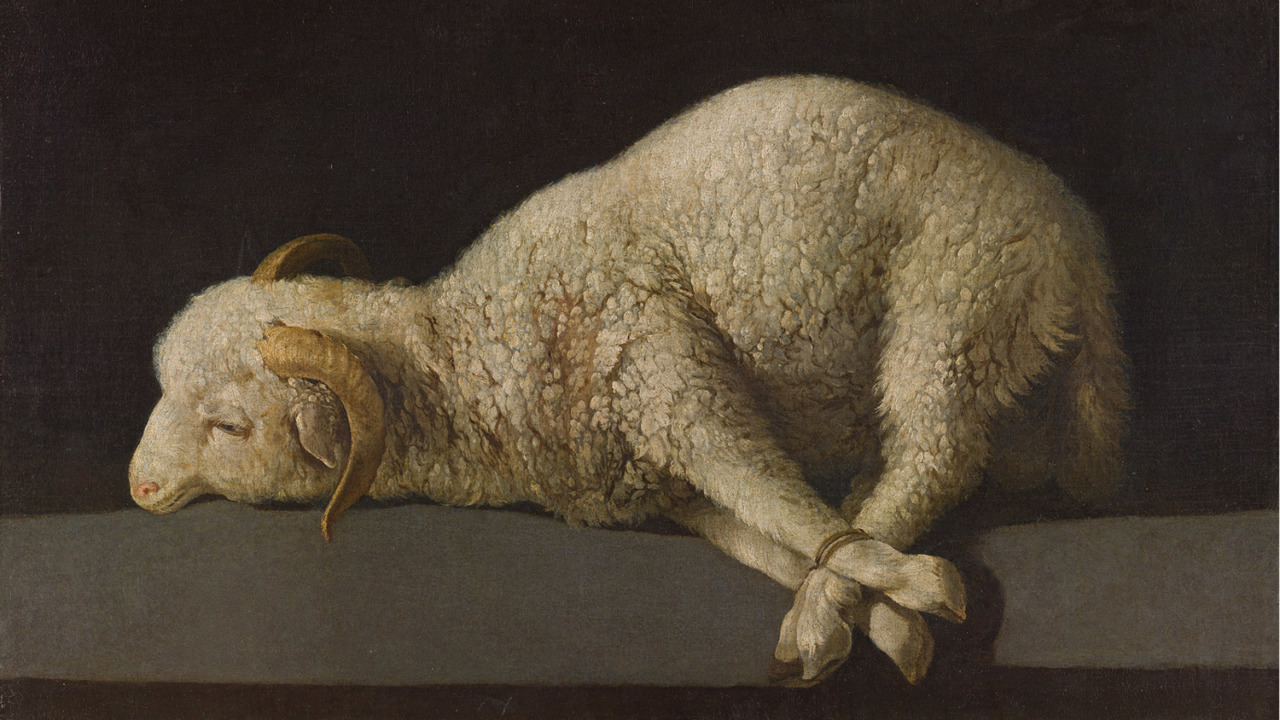
In his late period, Zurbarán’s work becomes markedly smaller and more intimately devotional. The Veil of Veronica (1658) sees the artist conjuring up the imprint of Christ’s face said to have been miraculously left on a veil offered to him by a woman of that name as he carried the cross on which he was to be crucified. Quite at odds with artistic predecessors, the Baroque master imagines the image as a stain rather than an archetypal portrait of Jesus. He paints a “cartellino” or an illusory piece of paper on the canvas to establish his authorship. A few feet away in the exhibition’s final room is displayed a genuine show stopper, the Agnus Dei (1635-40). Rendered with incredible fidelity, a bound lamb appears resigned to its fate. So lifelike is the wool that it seems palpable, the hooves projecting beyond the picture plane. There can be no doubt that Zurbarán is using the lamb as a biblical metaphor for Christ’s sacrifice.
This much-needed and excellently curated exhibition is brought to a conclusion by the intriguing Crucified Christ with a Painter (around 1650). Gazing up at Christ on the cross is an artist with brushes in his left hand and a palette loaded with paints. He holds his right hand to his heart as if in penitence. Some have identified him as St Luke, patron saint of artists. However, surely the more romantic notion is for the figure to be viewed as representing Zurbarán himself, this most enigmatic of Baroque visionaries.
James White
Image: Francisco de Zurbarán, “Agnus Dei”, 1635–40 Museo Nacional del Prado, Madrid © Photographic Archive Museo Nacional del Prado
Zurbarán is at the National Gallery from 2nd May until 23rd August 2026. For further information or to book, visit the exhibition’s website here.





Facebook
Twitter
Instagram
YouTube
RSS