
Nigerian Modernism: Art and Independence at Tate Modern
 8 October 2025
For many, any mention of “modernism” in art channels thoughts of the leading lights of the Western canon: the likes of Duchamp, Kandinsky, Matisse and Picasso. The Tate Modern’s much-anticipated new exhibition sees the continuation of the institution’s campaign to dismantle such a narrow understanding of what that term needs to encompass. Nigerian Modernism: Art and Independence, held on the 65th anniversary of Nigeria’s independence from British colonial rule, represents an ambitious undertaking. It charts the evolution of modern art from its first emergence in early 20th-century Nigeria, spanning the period from indirect rule to the decades of change that followed independence in 1960. On display are 250 diverse works from over 50 artists, hailing from a range of Nigeria’s ethnic groups. Through every media imaginable, from painting to political cartoons, they respond to the evolving state of their country’s socio-political landscape.
What emerges is that Nigerian modernism, rather than being a singular movement, was in reality a series of them, a fact attested to by Osei Bonsu, Curator of International Art at Tate Modern and curator of this seminal exhibition. One finds Nigeria, a nation of around 500 languages, shaped artistically by its indigenous heritage and interchange with European colonial culture. A single ageing photograph by Jonathan Adagogo Green of Ovonramwen, the Oba of Benin, shortly after the notorious sacking of his kingdom by British troops in 1897, in the opening room acts as a reminder of the enforced nature of the transitions of power. None of the celebrated Benin bronzes, still held somewhat controversially by the British Museum, feature in this exhibition. Instead, the Tate has secured the loan of an exceptional carved panel of doors by the Yoruba sculptor Olowe of Ise (1910-14) in which the ogoga (or king) of Ikere meets a colonial officer, Captain William Ambrose.
In the intervening years between the formal imposition of colonial rule and independence in 1960, the European tradition of realist portraiture as a means of signifying wealth and status is seen to take hold in Nigerian society, exemplified by the 1922 oil painting of the Lagosian philanthropist, Charlotte Obasa. 30 years later, painter Aina Onabolu imbues his subject in Portrait of an African man (1955) with a stately dignity worthy of his social standing. Onabolu’s protegee, Akinola Lasekan, perhaps in rebellion against the prevailing colonial Christian missionary culture of his day, made everyday Nigerian scenes his subject, like Hausa traders at Lagos market. Ajaka of Owo or Ajaka Owa (1944), a watercolour and gouache portrayal of Obatala, the orisha who descended from above to create the Earth, also reveals Lasekan exploring Nigerian mythology.
A quarter of the entire exhibition is dedicated to Ben Enwonwu, arguably the most internationally recognised African artist of the 20th century. On her 1956 tour to Nigeria, the late Queen Elizabeth II commissioned an over-life-size portrait from the sculptor for the Nigerian Parliament. A large wall photograph shows him working on the royal likeness in his Maida Vale studio. Metres away, proud and slender is Enwonwu’s bronze Anyanwu – The Rising Sun (1979-81), depicting an Igbo mythological figure alongside his 1953 sculpture, Bust of a Young Girl. The artist refuted a suggestion that the former work referenced Giacometti, insisting he, Enwonwu, had been informed by his own nation’s cultural heritage.
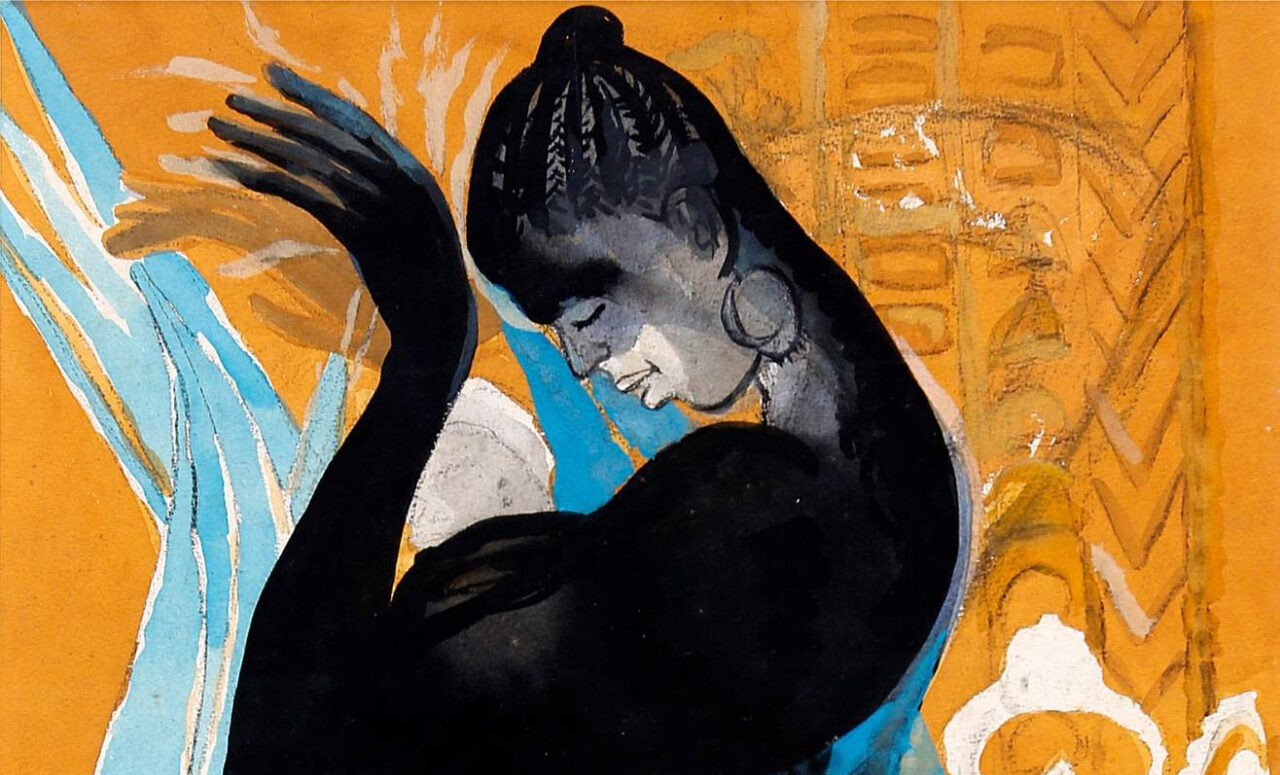
Commissioned by the Daily Mirror in 1960 to mark his country’s independence, another of the esteemed Nigerian’s works, consisting of seven figures carved from African hardwood, carries both visual power and metaphorical meaning. Five of the characters read outstretched newspapers that can dually resemble angelic wings, as if to imply the nation is destined to now soar to new heights. Enwonwu’s paintings here also have impact, notably a lively 1955 oil on canvas street celebration of Eid in Kano and a gouache work, Negritude (1976), depicting sinuously rendered women dancing. Other paintings like The Dancer (1962) portray Igbo masquerade culture, a traditional ritual involving the wearing of masks and costumes to embody the spirits of ancestors. Storm Over Biafra (1972) sees the artist expressing his loss over his homeland, ravaged by the devastating Nigerian civil war (1967-70). Enwonwu’s artworks see him mediating between his Igbo ethnic identity and heritage and classical training at the prestigious Slade School in London.
Nigeria evidently became a hotbed of artistic activity after independence. At the halfway point here at Tate Modern, visitors are made aware of the Zaria Art Society, hailing from the city of the same name in the north of the country. Founded in 1958, the group set out to decolonise Nigerian arts education. Key artists within the Society, like Demas Nwoko and Uche Okele, threw themselves into the creation of what they called Natural Synthesis, the intention of which was to harness modernist abstraction alongside traditional forms. Their art tells stories about their nation’s cultural heritage whilst aiming to forge a new Nigerian identity. Demas Nwoko’s Nigeria in 1959 (1960) depicts three rather disconsolate-looking white colonial soldiers seated in the front plane, at a loss for their future roles with independence on the horizon. Behind them in the shadows, indigenous Nigerian troops loom over, ready to take over. Uche Okeke’s oil painting, Primaeval Beast (1961) – resembling a monstrous giant toad – draws on native folklore, while Bruce Ononbrakpeya’s spectacular triptych, The Last Supper from two decades later, depicts the biblical scene forever linked with Leonardo Da Vinci surrounded by the Fourteen Stations of the Cross, unmistakably setting the events in Nigeria.
The years immediately following independence saw a boom in Nigeria’s economy. One room in particular testifies to this with large-scale photos of modernist architecture of a distinctive European style, reshaping Lagos’ skyline. A grouping of “Highlife” album covers is displayed, and a little ambience is introduced by the playlist of DJ Peter Adjaye, evoking the energy of 1960s Lagos. Also featured here are striking black and white photographs by JD Okhai Ojeikere of women with an impressive array of intricate hairstyles, dating from the 1970s.
The curator, Osei Bonsu and his team situate these artists firmly within the global art narrative. A number of them are known to have immersed themselves in the European and American avant-garde communities from the early 20th century. Sometimes that immersion has happened in reverse, an exceptional case being the Austrian-born artist, Susanne Wenger (1915-2009). Becoming a Yoruba priestess and senior member of the Ogboni cult in Osun, near Osogbo, she worked with local craftspeople and artists for four decades to redevelop and redecorate the Osun Osogbo Sacred Grove. Some of that work features in the current exhibition.
A far more consistent theme throughout Nigerian Modernism: Art and Independence is that of a developing diaspora, with increasing numbers of people of Nigerian origin found across the globe. The exhibition culminates in a room devoted to Uzo Egonu. Moving to the UK from Nigeria in the 1940s to study art at the precociously young age of 13 at Camberwell School of Arts and Crafts, he is best known for his Stateless People series. Made in the 1980s and reunited by the Tate after years apart, his singular portraits of a musician, an artist and a writer have a particular geometry to them. They stand as archetypes, pronounced reflections on displacement and the complexity of migration. At times emotionally engaging, at others complex, this intriguing exhibition sheds light on how Nigeria’s artists forged its rich cultural identity over a century marked by the transition from colonialism to post-colonialism.
James White
Image: Benedict Enwonwu Black Culture 1986 Lent by Kavita Chellaram 2025 © The Ben Enwonwu Foundation
Nigerian Modernism: Art and Independence is at Tate Modern from 8th October 2025 until 11th May 2026. For further information or to book, visit the exhibition’s website here.





Facebook
Twitter
Instagram
YouTube
RSS