
British Music Experience at the Pier Head, Liverpool
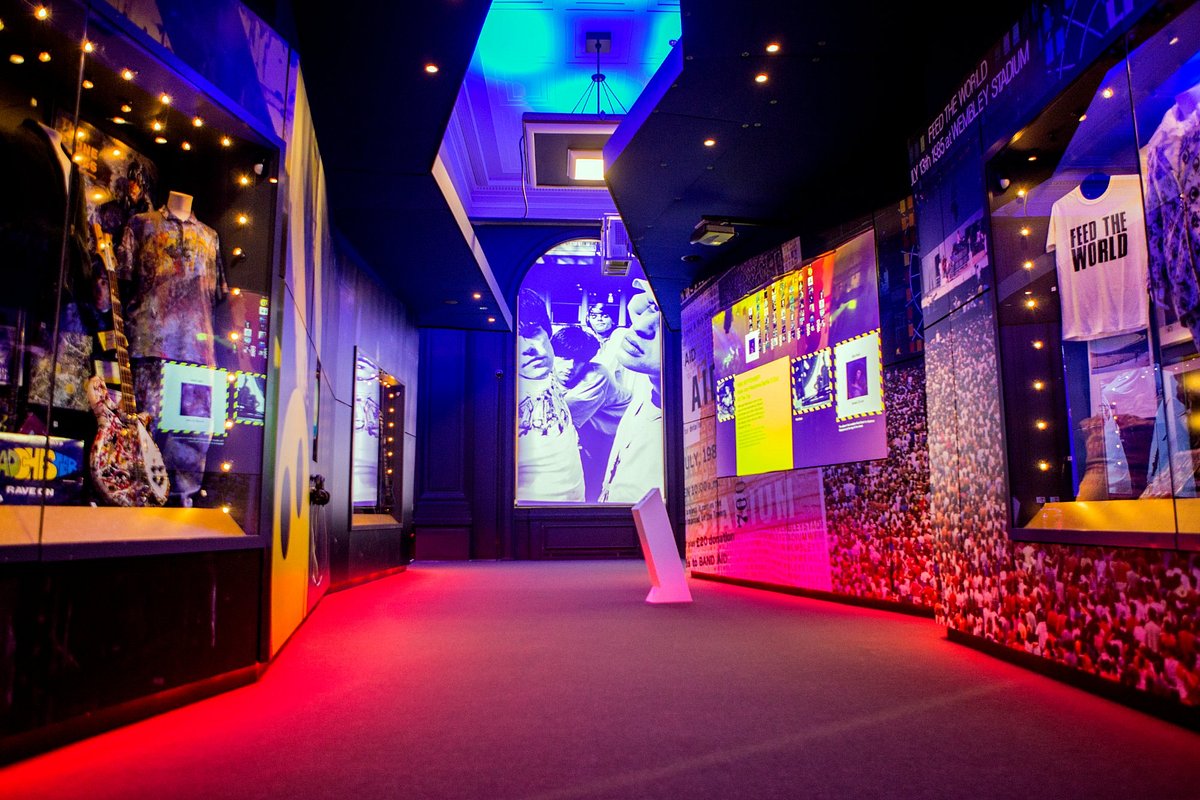


While contemporary success may frame British music primarily through the lens of pop (regardless of Eurovision results), the breadth of its currents is far more intricate. The British Music Experience endeavours to trace the last eight decades of progression and diversification within one (very large) space through interactive tools designed to encourage exploration and offer an overarching celebration of the country’s legacy and creativity in the industry. Alongside the hymns and praises to national production, it also stimulates connections to wider global events.
The exhibition first launched at the O2 in London in 2009, before announcing its relocation five years later. In 2017, the British Music Experience opened the doors of its new museum at the Cunard Building on Liverpool’s waterfront.
The room is divided into eight aisles, each dedicated to a particular moment in the history of music – with varying spans of time, from covering only four years, with Zone Two (1962–1966), to an entire decade, such as Zone Five (1975–1985). The most revolutionary shifts and swerves are the guiding principles determining the focus of each area. To begin with, the first part examines the birth of skiffle and the arrival of Trad Jazz and Dixieland in the UK – proving how the Anglo-American relationship cemented after the end of the Second World War was not only political, but cultural too. In addition to memorabilia belonging to Tommy Steele and Lonnie Donegan, an interactive table allows visitors to visualise the connection between US idols – Elvis Presley, Jimmie Rodgers, Mahalia Jackson and Louis Armstrong – and their influence on British music.
Beatlemania plainly takes over a large part of the second zone – dubbed Britain Goes Global. Moving into the following section, covering the years 1966–1970, a small display introduces The Crickets and Buddy Holly, highlighting their immense impact on the bands that followed, The Rolling Stones among them. The dense interconnection between the biggest names and those less known to the general public is one of the exhibition’s most interesting components throughout.
The section devoted to the beginning of the 1970s – with David Bowie, Elton John and Led Zeppelin – places particular emphasis on the glamorous and theatrical aspects of performance. Alongside the guitar played by Brian May and handwritten pages bearing the lyrics to Queen’s Machines, this corridor too (as with the other seven) includes a projector with a cursor at the visitor’s disposal to browse tiles reporting snippets of key acts, breakthroughs and developments not only in British music, but also in wider world events. These greatly help to provide a broader overview and place the musical movements into context – later on, references range from the release of Michael Jackson’s Thriller to the outbreak of the Vietnam War and natural disasters.
The fifth zone presents a punchy dive into the shocks brought about by societal changes, as the arrival of punk – introduced by a narrator in a video interview as a “short, expensive and disruptive” movement – foregrounds the unease of a new generation. The period between 1985 and 1993 witnessed the Madchester phenomenon and the large-scale performances made possible by the Live Aid concert. As the waves of Cool Britannia subsequently take hold, another challenge emerges on the horizon with the digitalisation of music: downloading begins to supplant LPs, bringing with it the threats of hacking and piracy.
The presence of songs played loudly in every inch of the venue certainly meets expectations for a museum of this kind. Given the open-plan layout, it can be difficult to keep the atmosphere of each aisle contained within itself, but the overlap of tracks – hearing Bowie’s Starman while in the trad jazz section, or Elton John’s Your Song as you read about the New Romantic phase – proves quite disruptive.
In the central area, there is also a temporary display which, on the day of our visit, focused on the making of the Arctic Monkeys’ album sleeves. A long cabinet is entirely dedicated to the photoshoot for Whatever People Say I Am, That’s What I’m Not, extending an interesting excursion into another creative facet of the sector.
At the very end, individual booths equipped with instruments from guitars to electric drums, and even a studio-style microphone, are available for visitors to have a go at crafting tunes for themselves.
Music, like every art form, is a personal expression that captures and shapes the feelings of a community – and the British Music Experience has found an engaging, compact way to share significant chapters of the UK’s musical history.
Cristiana Ferrauti
Photo: Courtesy of British Music Experience
British Music Experience was at the Pier Head, Liverpool. For further information, visit the exhibition’s website here.













Facebook
Twitter
Instagram
YouTube
RSS