
BBC Proms 2026: Miles Davis Centenary
 21 August 2026
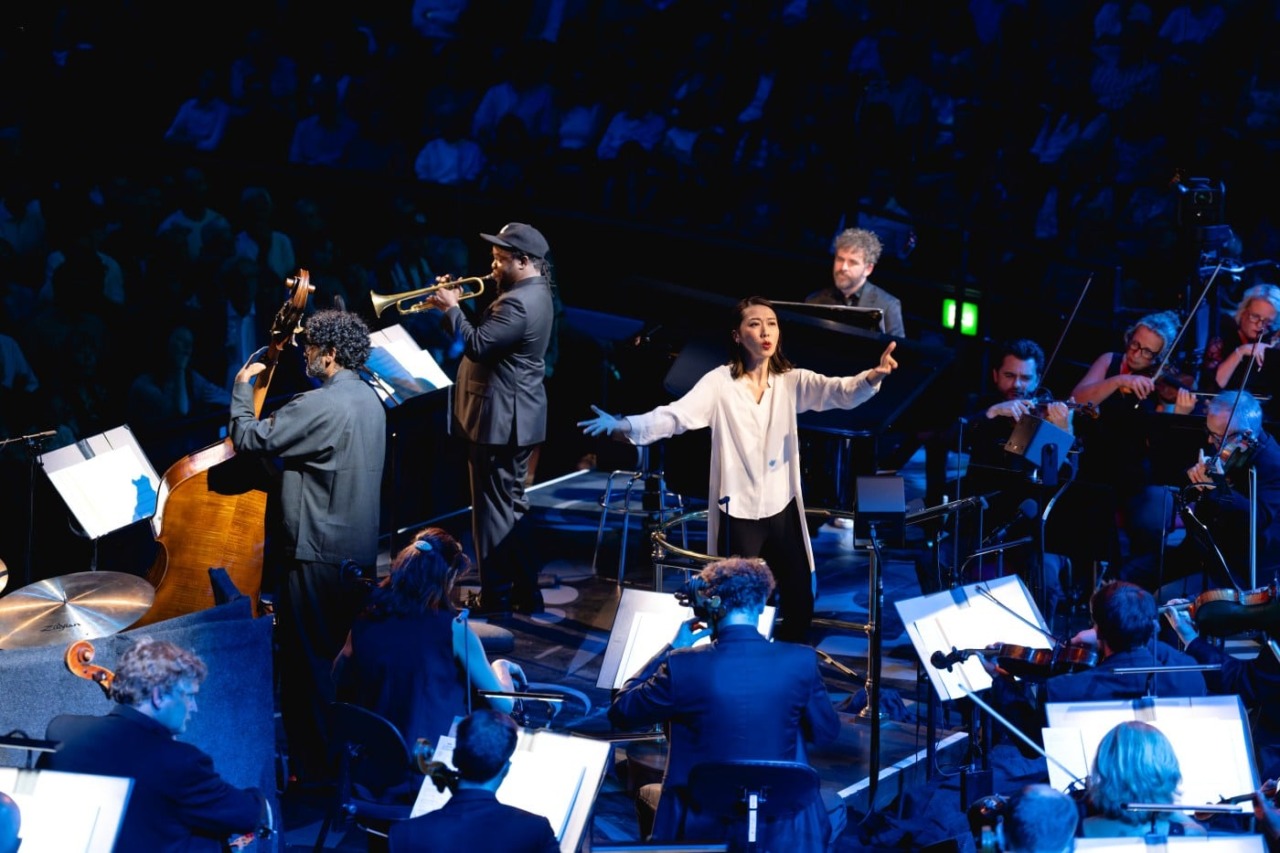
The BBC Concert Orchestra, conducted by Miho Hazama, joined with a jazz quartet for last night’s Prom, in celebration of jazz legend Miles Davis, with Hazama’s own orchestrations featuring throughout. Centre-stage was Ambrose Akinmusire on trumpet, who played with cool virtuosity, though bringing a very different emotional musical range to Davis’s. Alongside him were Harish Raghavani, anchoring with fluid control on bass, drummer Kendrick Scott, whose casual artistry and finesse were a highlight throughout the evening, and the dynamic Taylor Eigsti on the keys, filling in last minute for Sam Harris but in no way playing second best.
The line-up was stellar, the concept hotly anticipated and the repertoire promising a range of Davis-inflected favourites and influences; nonetheless, what transpired was underwhelming. Rather than being a convincing tribute to a musician and style, the performance often lacked cohesion, playing out as a clash of genres that negates both the intuitive fluidity of the jazz quartet and the emotive power of the orchestra by trying to squeeze both into the same box.
To start, there was a series of pieces from Porgy and Bess, the 1959 album arranged by Gil Evans and Davis from the original Gershwin, here orchestrated by Hazama to include strings, harp, classical woodwind and percussion. Evans’s 19-piece jazz orchestra’s rich, brass-led texture is a world away from the oddly disjointed sound created here. It was an experience that felt frustrating, with beauty and intrigue evident in both the orchestra and band, but each getting in the way of the other. The mic’d up strings were intrusive at times, rather than contributing the intended shimmer; likewise, the detail-oriented woodwind interjections. Akinmusire’s soaring soprano lines were nonetheless mesmerising.
Next was Hazama’s Little Variations on Boplicity (from Davis’s Boplicity), again in places a victim of its sound mix, but featuring some stupendous piano licks from Eigsti, luscious orchestral playing (particularly a section foregrounding cello, horn, clarinet and bassoon) and stretches of Hollywood-style strings that allowed the trumpet to really shine as it balanced on top. After that, Blue in Green, which offered an organic, expansive interlude. Finally, for the first half, we heard versions of pieces from Manuel de Falla, including an El Amor Brujo medley, Dance of the Terror, Will O’ The Wisp and Ritual Fire Dance. These were effective; the jazz reworking of the 20th-century classical composer’s music making much more sense, as well as finding exploration and flexibility. Here, the genres complemented one another, often alternating or dovetailing, rather than combining.
After the interval, there was Kurt Weill’s My Ship (arranged by Gil Evans and orchestrated by Hazama), where clunky articulation from the woodwind and a sensation of “too many beats” from the conductor interfered with the intimacy of the piece, then her take on Miles Ahead that had the Prommers dancing. A very nicely delivered figure with three trombones layered with the jazz quartet was notable, and Akinmusire’s creativity really came to the fore. Eddie Barclay’s Once Upon a Summertime (arranged by Evans and Davis, with Hazama’s orchestral treatment) was quirkily reimagined.
The quartet had an uninterrupted moment alone in Henya, by Akinmusire, Bill Frisell and Herlin Riley, which was blessedly natural, with a comfortable, cushiony modal sound. This was jazz in its truest sense, with the musicians playing off each other as an instinctive, united whole. One couldn’t help wanting to stay in this vibe when the final number on the programme rolled over – an orchestral interpretation of Evans and Davis’s arrangement of En Aranjuez con Tu Amor referencing the Adagio from Joaquín Rodrigo’s Concierto de Aranjuez – but what happened next was also one of the better numbers. It played with the contrasts in style and sound from the two ensembles, brilliantly juxtaposing them with surprising instrumentation such as the inclusion of bassoon inflections under a brass-accompanied trumpet solo and a scintillating passage with bass, kit and castanets.
Overall, this was an evening of evident skill and musicianship that felt like a battle of wills (though there were fleeting periods where the musicians on stage came together to intriguing effect). Rather than the classical orchestra and jazz quartet being fundamentally incompatible, perhaps this was a question of rehearsal (as well as some more sensitive sound engineering)? To be truly convincing, a jazz – or hybrid – ensemble needs an almost symbiotic relationship, and that was simply not possible here, for one reason or another.
Alexandra Fletcher
Image: Andy Paradise
The BBC Proms 2026 are on from 17th July until 12th September 2026 at the Royal Albert Hall. For further information and future events, visit the BBC Proms website here.










Facebook
Twitter
Instagram
YouTube
RSS