
Archimedes’ Principle at the Park Theatre
 24 April 2014
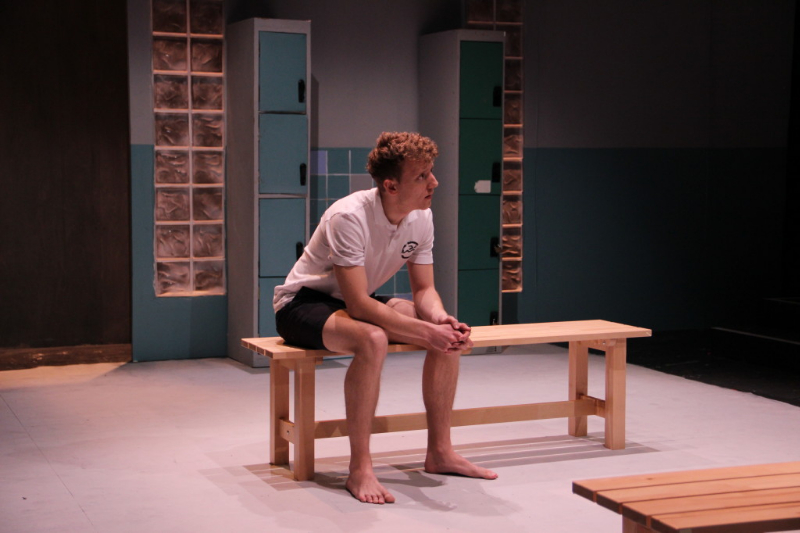
Premiering in London after an award-winning sell-out run in Spain, Archimedes’ Principle is the theatrical adaptation of social paranoia and its surprising yet all-too-familiar consequences, in the wake of recent revelations of paedophilia among well-loved entertainment figures.
Set in a swimming pool, a place where children and adult instructors come into contact in an innocent exchange of swimming lessons, the play dramatises the corrosive effect of our anxieties around child safety. It absorbs the viewer in an unremitting examination of the principle upon which those anxieties are based.
That principle, it appears, has very little to do with that of Archimedes, the play’s namesake. Archimedes’ Principle refers to the buoyancy of an object immersed in a body of liquid, such as a pool, equivalent to the weight of the displaced liquid. In this context, it alludes to the observed linear correlation between two events, where the direct relationship between them might appear perfectly logical. For instance that the sexual preferences of Brandan, the coach accused of inappropriate conduct towards one of his pupils, might help to predict the likelihood of his paedophilic tendencies. Or that his minor deceptions through the course of the play should similarly point the finger at his having lied about this more extreme accusation.
These factors should not be relevant to judging Brandan’s case, and yet all characters, including ourselves as audience members, are complicit in inappropriately allowing them to obscure our reasoning. We apply Archimedes’ Principle of direct correlation when the correlation would be coincidental at best, and the play comments on our tendency to jump to conclusions.
It also reflects on the changing attitudes towards child interaction of both anxious parent and fearful stranger, in a media-dominated society in which we have been forced to reassess our habits, and in which social media has made us cautious about the smallest of gestures.
Though the multiple themes explored through the play risk drowning the viewer in philosophical complexity, director Marta Noguera-Cuevas successfully manages to keep the viewer afloat, through total psychological immersion. This is achieved through our engagement with the unresolved question of whether Brandan is innocent or guilty, but also with our continued reassessment of character sympathies. The traverse staging arrangement creates a tense atmosphere, which is complemented by the play’s nonlinear narrative, as we as jurors piece together the evidence for ourselves. As much a physical as a psychological experience, Archimedes’ Principle will leave the viewer totally immersed in thought.
Lena Anayi
Archimedes’ Principle is at the Park Theatre until 11th May 2014. For further information or to book visit the theatre’s website here.
Watch the trailer for Archimedes’ Principle here:




















Facebook
Twitter
Instagram
YouTube
RSS