
“As an audience, you’re transported to this mythical jazz age”: Anders Danielsen Lie and Bill Pullman on Everybody Digs Bill Evans at Berlin Film Festival 2026



Everybody Digs Bill Evans premiered this weekend at the 76th Berlin International Film Festival, where it is competing for the Golden Bear. Instead of a conventional biopic, director Grant Gee opted for a restrained, introspective look at one of the darkest periods in the jazz pianist’s life. The death of his colleague Scott LaFaro sends Evans on a path of quiet but relentless self-destruction that Evans’s family is desperate to pull him out of, but seems ill-equipped to handle.
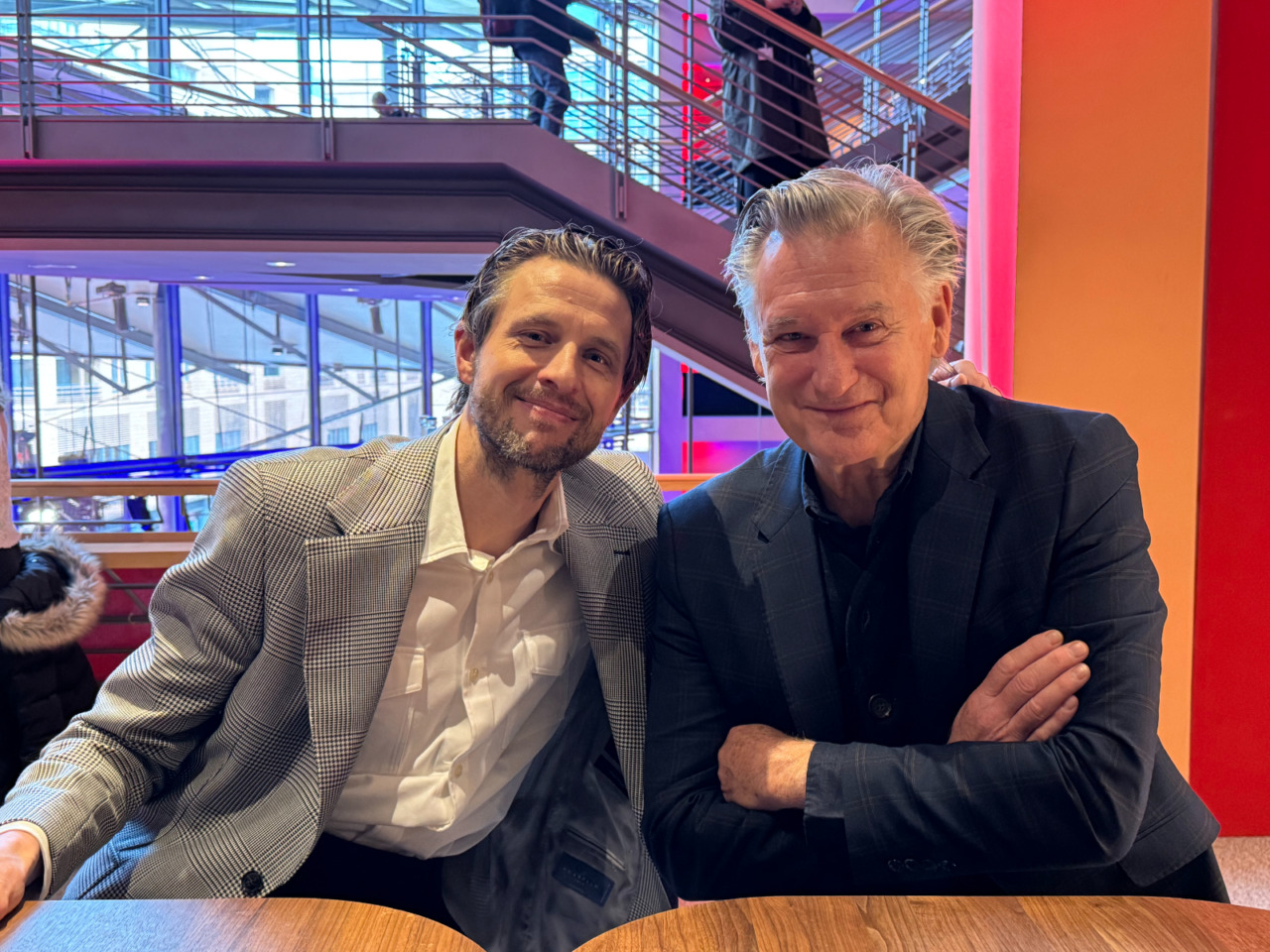
Joachim Trier’s muse Anders Danielsen Lie takes on the starring role of Bill Evans, and screen legend Bill Pullman plays his father. In Berlin, The Upcoming spoke to the stars about music, their collaboration and the unexpected similarities that connect them.
Outside of this project, what’s usually on your playlist? What kind of music do you listen to?
Bill Pullman: You gotta lead it off.
Anders Danielsen Lie: Well, I’m actually an omnivore when it comes to music. But I’ve listened a lot to jazz, obviously. I discovered Bill Evans some… 25 years ago? So that’s one of life’s weird coincidences, because I don’t think Grant even knew that I was playing the piano when I was cast. You have to ask him about that, but maybe he had seen Oslo, August 31st, by Joachim Trier, where I also play a person with a severe drug addiction? And there are obviously similarities between that character and the Bill Evans of the film. The way I approached this character was definitely through his music. I felt that I really knew his music well, and I tried to kind of build a character based upon my relationship to him as a musician. Which is something I haven’t done before with other characters.
BP: Well, I wish I were as knowledgeable… We were in the car talking together, and I spent most of my time wishing I had heard or would hear soon, whatever was mentioned – you were talking about this composer who had the most mysterious chord?
Anders: Yeah, Scriabin. A Russian composer whom Bill Evans was obsessed with, he lived at the turn of the 20th century. You know, Bill Evans was so interested in Western classical music, and he was trying to put some of that harmonic complexity into the world of jazz.
BP: And Scriabin somehow had an anticipation of a chord that later became more familiar to jazz people, or was not so mysterious?
ADL: Not as mysterious for the jazz community, but it was considered avant-garde in classical music at the time. But what do you listen to, Bill? What kind of music do you like?
BP: I usually have a whole set of choices that I was making my way through, but now with Spotify – I have a son, who’s also an actor, Lewis, and we share this Spotify account. He makes these playlists, and I listen to what he likes. I don’t know how that happened; he usurped my taste. And there is quite a bit; he’s really an omnivore, he goes left and right.
I found out about this guy, Blake Mills, who is an LA-based singer-songwriter. I knew a guy named Ben Bullington from Montana, who was an emergency care doctor, who happened to play and write songs, and just had this extraordinary… Like, I think Anders has just got the same plague that I have, where I wish I could have 14 lives…
ADL: I know that feeling.
Were you ever intimidated by taking on Bill Evans?
ADL: He’s an icon to me, but he’s also an icon in American cultural history. So of course, it’s a huge responsibility to try to fit those shoes. I tried not to do that. Actually, I was quite inspired by the Gus Van Sant movie, Last Days, because I knew that whenever you’re making a feature film, there will always be some element of fictionalisation.
Especially in an American context, I know there are actors who, whenever they’re supposed to portray a historical person, they want it to be as alike as possible. And I deeply respect that when Bradley Cooper plays Bernstein, I’m deeply impressed, knowing that I could never do that myself.
But doing it that way is not always what acting is about, in my world. Because acting is more a process of abstraction, trying to ask myself that question, “Who was this character? Is there an essence? Did he represent any values? Does he symbolise something?”
And that’s what I’m trying to play. I’m not trying to put make up on my face to look exactly like Bill Evans. I want to create a character that will work in a fictional feature film. And to me, that result will always be a mix of the real Bill Evans, and then you have me, Anders, I’m playing the piano. There’s something in between.
So I really want to pay tribute to this icon. It’s an homage to him. But at the same time, he’s too great. I can’t be him. You know what I mean? And I have to be aware of that.
Do you look at him any differently now, after playing him?
ADL: That’s a difficult question, because I think he’s deep down a mysterious character.
Sometimes I feel that I understand characters that I play on screen well enough to figure them out. With Bill Evans, there are so many – he puzzles me. Still. After having tried to play him, there are things that I don’t understand. There’s this big contrast between the order, the classicism, the refinement, the pureness of his art, and the total chaos of his life. And he was kind of constantly rationalising his own problems.
He could say something along the lines of, “I think that people worry too much about the flesh, whereas they should be more interested in refining the soul.”
He could say things like that. And he’s often perceived as a deeply tragic figure.
But then again, he could say, “I never had an unhappy moment at the piano.”
We have all these stereotypes about artists suffering to make this great art. But I think that whenever he played, he was happy.
But when you watch the film, his life is a story about lost connections, and he lost a lot of the people that were closest to him. I think the relationship between him and his father is deeply moving. Maybe he even inherited some of his addictive traits from him, and they both kind of understood that? I don’t know. You have to ask yourself that question: “The addiction, the self-destructive streak, did it have anything to do with him not being able to connect with other people?”
Speaking about the relationship between your characters, how much of it were you able to explore?
BP: Actually, when we saw the movie yesterday, it was really informative. There is this connection that happens in Florida. For Bill, that seemed like a peaceful time. I really was appreciative that there was a growing comfort with each other, as Bill was getting through the hardest part of it, getting off cold turkey. It grows to be the most unlikely comfort that we [the characters] have in each other’s company, and that we [the audience] realise these two injured people are most exposed to each other, more than to anybody else in their lives, in a way.
And you can see that in Anders’s eyes, in Bill’s eyes, when he’s with his father in the bar – he’s really narrating the scene silently. We understand the power of what’s happening in this pub, which is a phenomenal night. It starts one way: bravura, bullshit, and everything, and then it goes to the singing, which is quite unfortunate, and painful to Bill –
ADL: I was so moved when you sang. I was moved. Yeah, but it’s exactly what you’re saying. They’re kind of exposing their vulnerabilities. There’s a mutual exchange of vulnerability between father and son in a time when you probably weren’t supposed to expose those kinds of feelings.
BP: And I was of a generation that never did. Exactly. I was just gonna say, if you don’t mind, we share the fact that we had that breakfast at the end. We were working together pretty well. I could see that Harry Sr only exists because of Bill’s availability and that this guy, Anders, just knows something, that we share something. Then we decided to have a last breakfast before taking off, after we shot the last scenes. We’re meeting at the hotel again, to have breakfast, and there we realised that our personal biographies are so parallel to each other. With the challenges with our parents, particularly. We realised that we had more genetic compatibility than you normally have. So it was great to see it affirmed in the movie.
Do these kinds of realisations about communication in a family ever trickle into your personal life?
BP: I strive for that. With Lewis, we had this fortunate thing where, last fall, we were shooting a movie together, where he played my son. This was Spaceballs, the sequel – so a profound piece of work, you know?
I was 32 then. It was only my second part in a movie – I was older ’cause I did other things, yeah, our interest in following other trails… then all of a sudden, we’re here in the acting world…
But I was 32 when I made the first one, and Lewis was 32 last fall, doing the same thing. So I’d see his shoulders or something, and it was like, “Wow, this is almost like watching me, in the same modalities of Druidia and Schwartzes and stuff like that!”
And there’s a meta thing that Mel did in there… Hopefully, it’s all going to work.
In some ways, I can be more candid with Anders than I could be with Lewis, but we’ve had some great engagements. We’ve been taking off together to do some things around our property.
Where I grew up, we have some maintenance things. And we’ll go there for a couple of days, and something happens, you know? Did you ever have that with your father? Were you able to spend time alone with him for days?
ADL: Yeah, that’s happened. But I was just thinking, also, one of the wonderful things about acting on film, which is probably a difference from acting on stage, where you have to work a lot because you’re supposed to play the same show every night. So things have to be really well planned. Whereas what you sometimes aim for, acting on film, is that you, ideally, you want to be there with the camera, when the actors understand what the scene is really about.
So there’s almost a documentary element of screen acting at its best. Like you want to be there when the actors finally discover the hidden meaning of the scenes. And I felt that we had many moments like that, shooting the film.
BP: I know I had moments where I felt like, “Why, I didn’t know this colour was possible at this moment,” you know? Yeah, a door opened with the context of the other actors giving you a lot, [like] with Laurie Metcalf, who’s brilliant, and the awkwardness was real in some ways.
Does knowing that the film is going to be largely set in black and white change anything about your performance? Is there perhaps an impulse to adapt to the lack of hue in the image or the opposite, compensate for it?
ADL: That’s a good question. What do you feel about that?
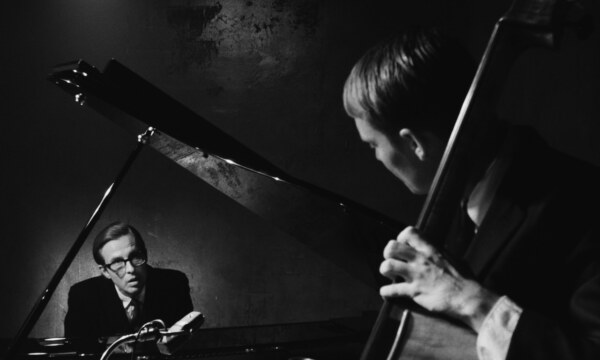
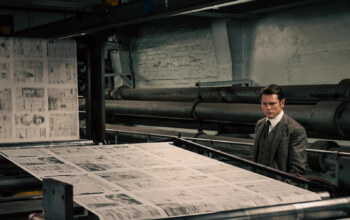
BP: I was glad to see it feeling like we achieved a world that no longer exists. There’s something about being accurate, just all the specific details. And black and white, that’s how television looked when I was, in that period, and the reality had a lot of black and white about it.
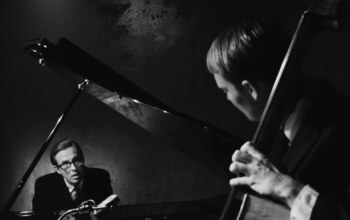
ADL: Yeah, it also gives a sense of… You are, as an audience, you’re kind of transported to this mythical jazz age, something that belongs to the past, and it works for me also well with the flash forward sequences in 1973 and 1980. But I don’t think, and now I’m speaking for myself, it doesn’t really affect my performance. It’s not that whenever I play, I think about how this is gonna look in black and white. But I think it’s a very good and bold choice by Grant to shoot it in black and white; it looks nice, and I sometimes ask myself that question, “Why don’t more directors choose black and white?”
Anders, you are also credited as an executive producer on this film.
ADL: Well, the role of the executive producer is that it can be a lot of different things. But it made sense to me to be executive on this film, because I felt so closely attached to Bill Evans, and it just made sense, having that responsibility as a Norwegian, to play one of the greatest icons of jazz, which is a true American art form. So I wanted to just supervise.
At the press conference, you were hesitant about your future in acting?
ADL: I didn’t say I’m giving up acting. I said that sometimes an intermission is important. To just ask yourself a couple of questions, like, “Am I at the right place?”
I’m the kind of person who needs to reflect every now and then on what I’m doing.
And I have another profession to take care of as well. I’m a trained physician, and I need to do that and spend time doing that every now and then. But I haven’t retired.
BP: Me neither.
Selina Sondermann
Everybody Digs Bill Evans does not have a release date yet.












Facebook
Twitter
Instagram
YouTube
RSS