
“Storytelling in person is a medium we have always used”: Michael Buffong on TALAWA 86:26
 9 April 2026

Michael Buffong is the Artistic Director at Talawa Theatre Company, the UK’s leading Black British Theatre Company. Talawa is entering its 40th anniversary year with a programme dedicated to championing the next four decades of Black talent. TALAWA 86:26 presents an ode to the past as well as a celebration of their present with the launch of a lecture series, a tour of outdoor festivals, and ongoing initiatives that place advocacy, community, storytelling and talent development at the forefront. We caught up with Michael Buffong to discuss what Talawa has planned for the 40th anniversary, as well as his own experience as an actor, stage director, and the company’s artistic director.
You started your career as an actor. How did you end up making the pivot to directing? Do you ever think about returning to the stage yourself?
I very rarely think about returning to acting, but there have been times when I’m watching really good performances, like when a scene is really crackling between performers, and I think wow that looks like fun!
The pivot from acting came to me once I realised that I was continually thinking about how the scenes should be done, or staged, rather than how my character was wanting to do it. It was a eureka moment when I realised that what I really wanted to do was direct.
It was, in fact, Yvonne Brewster, one of the founders of Talawa, who gave me one of my first directing gigs. After which, I was fortunate enough to alternate between directing for television and directing for stage. I’m not sure how easy that would be today, but at Talawa we are still giving opportunities to early-career directors.
Do you have a production that you have directed that has been particularly meaningful or rewarding for you? And if so, what was it about that production that made it special?
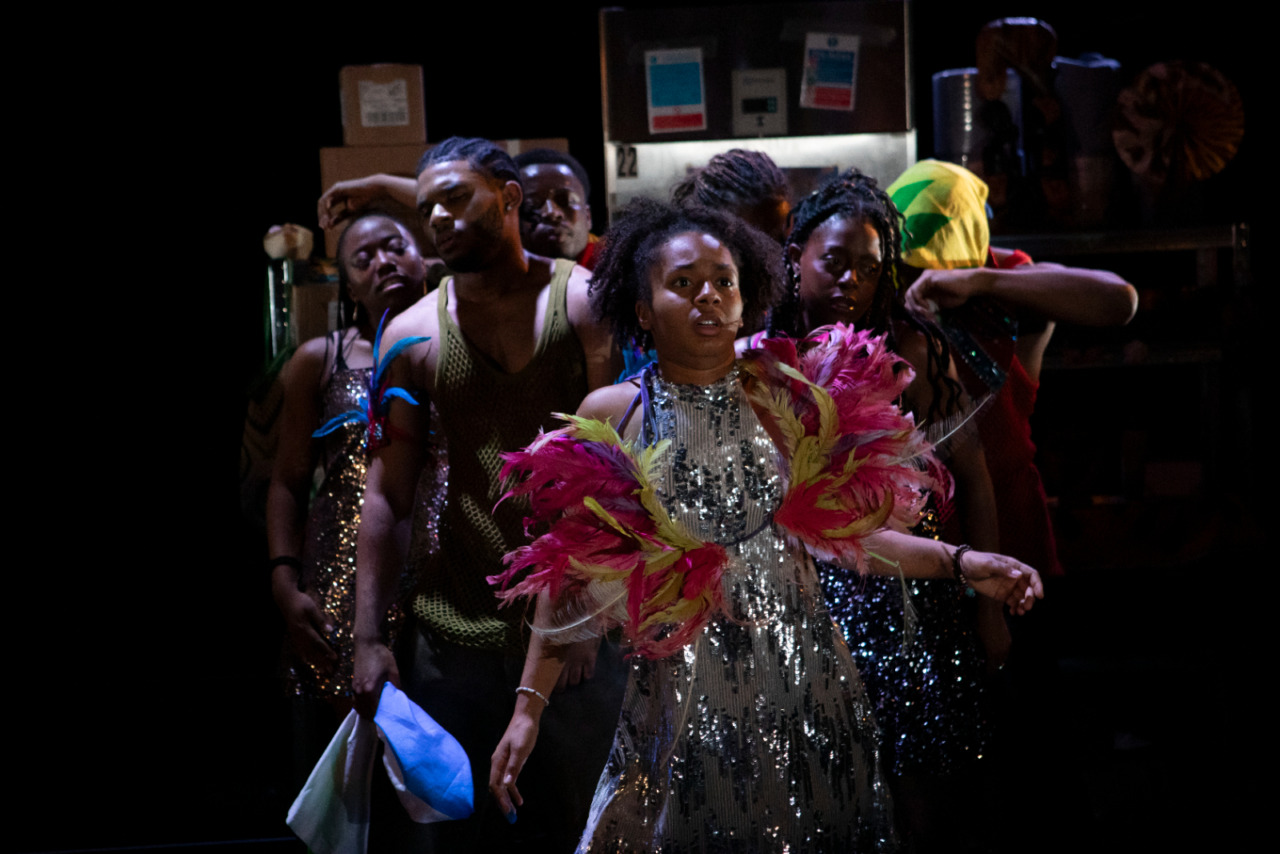
There are so many meaningful productions, all for different reasons. Most recently, Play On! was particularly meaningful as it was the biggest show we have ever done at Talawa; a national tour and a four-week run at the Lyric Hammersmith. The music was phenomenal, and the feeling the audience left with could be summed up with one word: joy! Other new writing plays, such as Running with Lions and A Place for We, were also beautiful pieces of work.
You’ve worked across television, film, radio and theatre. Is there one area of the arts that you’ve most enjoyed working in or felt was the best fit?
I’m fundamentally a storyteller, and happy to use any medium. I’ve had great experiences working in television, radio and film. But I guess theatre is my first love, after discovering it as a teenager and as part of the East London Youth Theatre at Theatre Royal Stratford East.
You joined Talawa as Artistic Director in 2012. How did you come to be involved in the organisation and what drew you to it?
I had known about Talawa since its inception. Talawa’s first production, The Black Jacobins by CLR James, about the only successful slave revolution in history, was causing quite a stir, as it had some of the biggest names in Black theatre at the time as part of its cast, including Norman Beaton, Brian Bovell, Trevor Laird and Talawa founder Mona Hammond: this show was as a big deal.
As well as offering me one of my first directing jobs, I was also drawn to the company because of its ethos of championing Black artists.
What are, in your opinion, some of the most significant changes and accomplishments made within Talawa since you joined 14 years ago?
Although it was already running successfully when I joined in 2012, the Young People’s Theatre Programme (TYPT) has been one of the major accomplishments during the past 14 years. It has offered such a rich and positive experience to participants. Its importance within the ecosystem cannot be underestimated.
The other vital programme is Talawa Firsts, our new writing programme, which has had a huge impact on the theatre ecology and given so many writers a wonderful platform for their work.
Talawa Theatre Company is entering its 40th anniversary year with a programme dedicated to championing the next four decades of Black talent. Can you tell us a bit more about TALAWA 86:26 and what’s in store for 2026?
As well as the return of TYPT and Talawa Firsts, look out for our big 40th anniversary celebration night in autumn, the Mona Hammond Lecture Series in collaboration with RADA, a new audio piece called Omann and the Sun Orb, as well as a special reading of Talawa’s inaugural play, The Black Jacobins.
Talawa is acclaimed for its numerous initiatives (IWG, Talawa Firsts, TYPT): can you tell us about the plans for these initiatives in 2026? Are any big changes coming up or potential new initiatives being introduced?
No big changes: these three programmes have proven successful. We will continue to run them, while considering what else we can do in the sector to support emerging director talent.
According to its online messaging, Talawa aims to reflect Black experiences through art like no other. What do you think makes art, and particularly theatre, such a unique and effective vessel for doing this?
The first thing is the immediacy of theatre; it’s all happening right there in front of you. Storytelling in person is a medium we have always used. From tales around a fire, or in an amphitheatre, it has always been with us and is vital for us to see ourselves reflected in our own stories.
In a culture of constant scrolling, theatre offers something different: a mirror to the world.
Talawa was founded by four Black artists and activists. What role do you think activism plays in the organisation today?
We advocate through our artistic practice: art is political!
What are the biggest challenges you have faced thus far in your time as Artistic Director, and what do you anticipate your biggest challenge for 2026 will be?
The biggest challenge will undoubtedly be financial, although I think our art, Black art, is surely something that can and must be invested in. There’s so much evidence proving the positive return on investment in the arts; this needs to be more widely known.
40 years ago, Talawa was founded with the vision to diversify the theatre industry to make it fully representative of the UK’s population. How far do you think the organisation has come in achieving that vision, and how far do they have still to go?
I think there is no doubt that Talawa has been instrumental in diversifying the theatre industry. There is still much to be done. We are now in a time where more than ever, we need to remember the hard battles that have been won, because due to numerous factors, we seem to be facing many of those battles again.
Madison Sotos
Photo: Ali Wright
For further information, visit the theatre’s website here.










Facebook
Twitter
Instagram
YouTube
RSS