
James McNeill Whistler at Tate Britain
 21 May 2026
With his prominent white forelock, monocle and cape, the American artist James McNeill Whistler (1834-1903) in his pomp looked every inch the archetypal bohemian dandy, as indeed he aspired to be. The major new retrospective on the aesthete at Tate Britain, the most substantial to be held in Europe for 30 years, sets out to present the pugnacious character as a pioneering force forever in pursuit of beauty. Chief curator Carol Jacobi and her team chart Whistler’s development from boyhood years spent in St Petersburg, thanks to his civil engineer father’s work on the Russian railway, to his late maturity precursors to modernism. Thrown into the mix are a litany of the artist’s personal possessions, often revealing his debt to East Asian aesthetics.
Born in Massachusetts, Whistler was sent to West Point, the USA’s answer to Sandhurst, as a young man, where he excelled at technical drawing – displayed examples of his recreational drawings at military college evidence his talent – but was thrown out for academic and disciplinary issues. The American’s growing artistic prowess managed to earn him a six-month stint as a map maker for the US Coastal Survey, where his lifelong love of etching began. However, it is his decision to pursue his dream of becoming a bohemian in Paris in 1855, which is seen to truly light the touch paper of his career. Over four productive years in the French capital, Whistler’s etchings capture Pariseanne life with increasing dynamism and panache, a prime example being found in the gritty Rag Pickers, Quartier Mouffetard, Paris (1858). His oil painting, meanwhile, carries the influence of Gustave Courbet, the master of Realism, who became something of a mentor as revealed in La Mère Gérard (1858-9). Here, Whistler’s rendering of the subject’s ageing features owes much to the rugged style of the illustrious Frenchman.
Another portrait, At the Piano, produced in the same period, would ultimately play a pivotal role both in enhancing the young artist’s reputation and convincing him to seek pastures new. Depicting Whistler’s sister playing the piano to her daughter, the work juxtaposes the black dress of the seated mother with the white dress of the girl. Both are set against a series of horizontals: the dark piano itself, two paintings on the wall and a maroon carpet. Rejected by the Paris Salon, the painting was consequently accepted and sold by the Royal Academy in London, leading to Whistler’s decision to move across the channel to the hub of Victorian Britain with all of its bustling modernity.
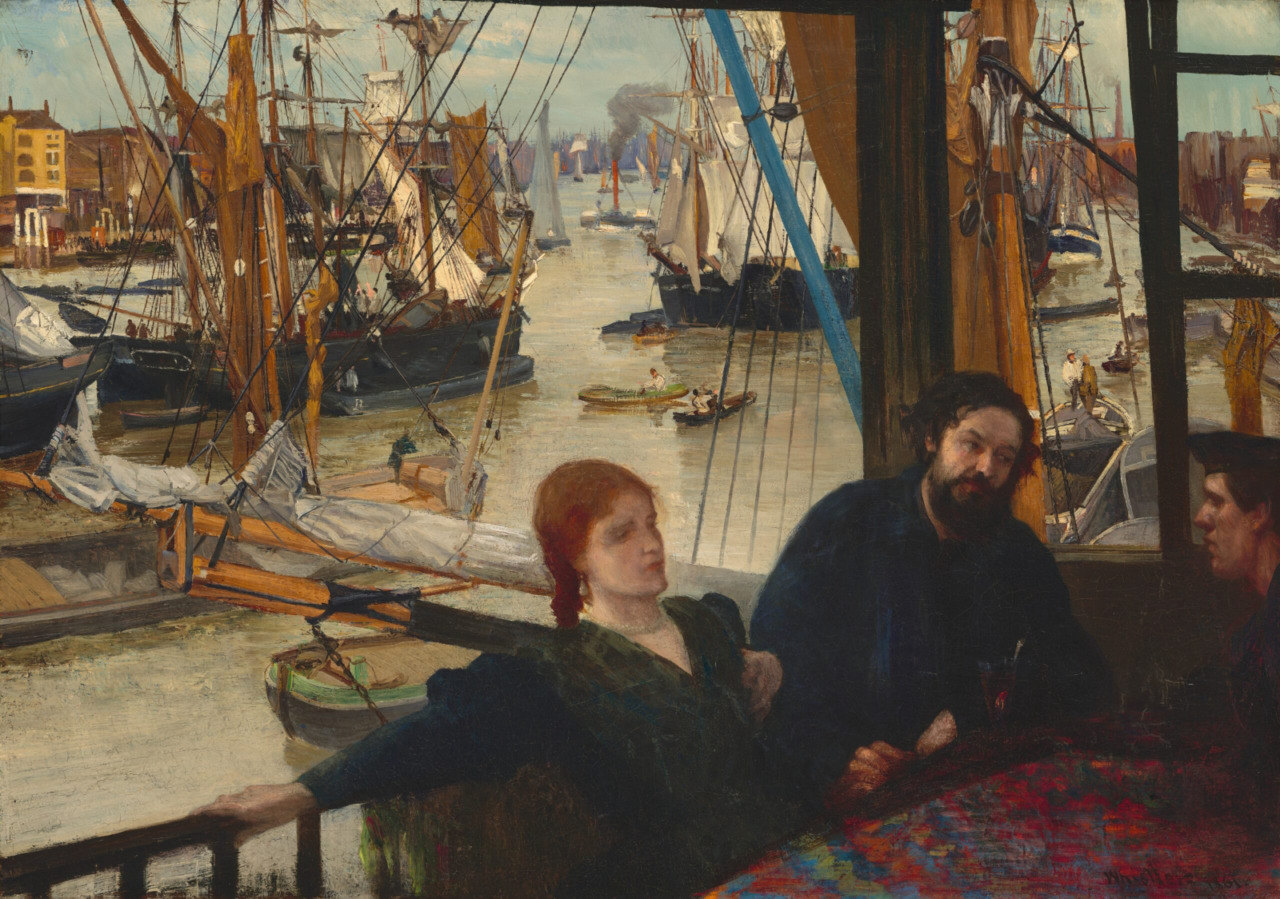
During his four years in Paris, Whistler had become friends with Edgar Degas, each man sharing a liking for working-class subject matter. The American continued to nurture this interest following his move to London, as borne out by the etchings he made of the East End docks like Rotherhithe (1860), where grizzled sea dogs relax in a pub before a sea of tall masts. Tate can also boast Whistler’s well-known 1860-1864 painting, Wapping. In the foreground, a beautiful red-headed woman, the artist’s model and lover, Joanna Hiffernan, is seen in conversation with a couple of men on the terrace of the Angel pub in Rotherhithe. Father Thames behind throngs with steamers and sailing ships, the canvas’s painted surface revealing the artist’s usage of a palette night alongside more subtle brushwork.
Portraiture is a constantly intriguing aspect of this cosmopolitan artist’s practice. One self-portrait, entitled Whistler Smoking from 1856-1860, is on show for the first time since his 1903 death. Elsewhere hangs the memorable Symphony in White, No 2: The Little White Girl, where Whistler again depicts Joanna Hiffernan, who on this occasion leans against a mantelpiece in a rather theatrical white dress. She stares rather impassively or perhaps with a touch of the forlorn at a Chinese vase and its pink flower, her reflection caught in the mirror as her right hand clutches an oriental fan. The title tells its own story, with Whistler’s objective being to engage in a formal exercise in nuances of white.
Only a few feet away is displayed the most celebrated painting in the entire exhibition. In something of a coup for the Tate, the Musée d’Orsay have agreed to loan Arrangement in Grey and Black No 1 (1864), better known as Whistler’s Mother. Those of a certain vintage might well owe their familiarity with the masterpiece to 1997’s Mr Bean film. Painted in the artist’s house on Cheyne Walk in Chelsea, the work stands as a carefully composed study of tonal variations. Whistler’s mother Anna, who had travelled from the United States to stay, appears seated in profile in mourning clothes, her husband having died tragically of tuberculosis at 49. The artist makes use of deep blacks for her dress, setting Anna against the backdrop of his minimalist studio. Here, the wall is grey, and yet it is Whistler who came up with the revolutionary concept of displaying his work on a white painted background. The ageing matriarch’s feet perched on a rest for comfort, led to a grey curtain, perhaps silk decorated in floral imagery. When the work was entered for the Royal Academy, it narrowly missed being rejected, seemingly on the basis of its dependence on grey and black. It would take the French government’s acquisition of the canvas in 1891 for the British institution to finally be won over.
From the outset of this exhibition, Whistler’s passion for East Asian art is constantly attested to. Featured are items of Chinese porcelain, fans and cabinets collected by the American and in the opening room, a full-size replica of a screen he made alongside the Japanese artist, Nampo Joshi. One side of the latter includes the paintings of this Asian collaborator, whilst the reverse harbours one of Whistler’s so-called “Nocturne” images. In a composition arguably recalling the flattened space of Japanese ukiyo-e, the viewer finds the American depicting a blue-green silhouette of Old Battersea Bridge superimposed on top of a golden moon. Whistler’s embracing of late Victorian Britain’s passion for “Oriental” style is further evidenced here in the Tate’s reproduction of the famed Peacock Room he created between 1876 and 1877 in conjunction with the architect Thomas Jeckyll for the shipping magnate Frederick Leyland. An audio evocation of the artist and client’s fiery falling out over payment and the former going well beyond his remit drifts through the gallery, giving a sense of Whistler’s waspish self-assurance. Incidentally, the real room preserved for prosperity now resides in the Freer Gallery of Art in Washington, DC.
This soaring ambition, coupled with a developing desire to achieve greater levels of simplicity and harmony, led to James Whistler creating his celebrated “Nocturnes”. Tate Britain here have devoted an entire room to these seminal works. Interestingly, despite having befriended the likes of Monet and Degas in Paris, Whistler did not believe in painting nature outdoors, preferring to conjure his ethereal images of the Thames from memory back in his studio. Remarkably abstract for their time, these paintings explore views of the Thames from Battersea and Chelsea. The artist, striving to engender in his paintings a balance of tone, colour and form akin to orchestral composition, is seen attaching titles such as Symphony, Arrangement and Nocturne. It was the influential art critic John Ruskin’s harsh review of Whistler’s Nocturne in Black and Gold: The Falling Rocket (1875) – sadly absent from the current show – which triggered the incensed American to sue for libel. The champion of Turner and the Pre Raphaelites had lambasted Whistler for “flinging a pot of paint in the public’s face” with his decision to price the work at 200 guineas.
Ruskin’s ire had also been provoked by the 1872-75 work Nocturne: Blue and Gold Old Battersea Bridge, very much present at Tate, with its flashes of fireworks and central silhouette of a bridge that instantly proves reminiscent of a bridge in a Hiroshige print (Whistler’s Japanese print collection appears throughout). The lawsuit would stir a debate on the importance of art in society. Ultimately, Whistler won, but his award of one farthing led to his financial ruin. Bankrupt, he lost his Chelsea home and headed to Venice and Amsterdam.
A room towards the end of the current exhibition is devoted to the architectural etching and portraiture he made in these last two decades of his life. Deft observations of everyday scenes like Balcony, Amsterdam (1889), part of a commission named the “Amsterdam Set” are found in close proximity to atmospheric paintings like the harmoniously impressionistic St Ives seascape, Marine, Blue and Grey (1884-85). There’s great sadness here, too, in his 1896 lithograph, The Siesta, depicting Whistler’s bedridden beloved wife of eight years, Beatrix, dying of cancer in the Savoy Hotel. As the exhibition reaches its finale, one encounters increasingly experimental full-length portraits like Portrait of Lady Archibald Campbell, often reworked, ironically to appear effortless. And also the artist’s late self-portrait, Gold and Brown (1896-98), immediately evokes his hero, Rembrandt. There is even a theatrical film dramatisation of Whistler’s famous “Ten O’Clock Lecture” of 1885, along with his self-published pamphlets.
The Impressionists, Monet et al, invited James McNeill Whistler to exhibit with them, but he declined. This self-possessed bohemian was by that stage determined to plough his own furrow. Tate Britain’s comprehensive retrospective comprising 150 works (complemented by digitalised sketchbooks) conjures a convincing narrative of the American as a highly ambitious, pioneering force forever in pursuit of beauty. Unusually among his peers, Whistler argued that nature is very rarely right, believing that a true artist invents their own harmony of colour and line. Obsessed with what paint and composition can do, his creative passions were summed up by his declaration, “No day without a line.” For all the muted tonal excellence of Arrangement in Grey and Black No 1, this boundary-breaking artist deserves a far more rounded reputation.
James White
Photo: Wapping, 1860-4. Photograph: National Gallery of Art, Washington
James McNeill Whistler is at Tate Britain from 21st May until 27th September 2026. For further information or to book, visit the exhibition’s website here.





Facebook
Twitter
Instagram
YouTube
RSS