
Georg Baselitz: Back Again at White Cube Bermondsey
 10 June 2026
April of this year saw the passing of one of the world’s most instantly recognisable painterly originals, the distinguished German artist Georg Baselitz (1938-2026). Alongside the likes of Julian Schnabel, Jean-Michel Basquiat and compatriots Anslen Kiefer and Gerhard Richter, he was at the heart of the Neo-Expressionist movement that sought to revive figurative painting, rebelling against the prevailing detachment of minimalism and conceptualism in the 1970s. The landmark exhibition at the Royal Academy, A New Spirit in Painting, in 1981 proved pivotal in boosting the international reputations of many of these big names, Baselitz’s included. Now, two months after the artist’s death, White Cube Bermondsey are holding a solo Baselitz exhibition, taking its title from one of his final paintings, Back Again.
This is a truly poignant swansong of a creative journey spanning more than six decades, distilling motifs that defined his practice. Over the course of his long career, Georg Baselitz developed his own raw brand of expressionism, revealing a debt to Surrealism and Art Brut. One encounters here the eagle, synonymous with Germanic cultural identity. For the artist, the mighty bird is rooted both in his childhood under the Nazi regime and the upheavals of the post-war period. Also featured are the final incarnations of Baselitz’s iconic Hero paintings, a recurring motif since the late sixties, and the figures of the artist himself and his wife and muse, Elke Kretzschmar. At times, the landscapes and vegetation of his native Saxony appear as a biographical reference point.
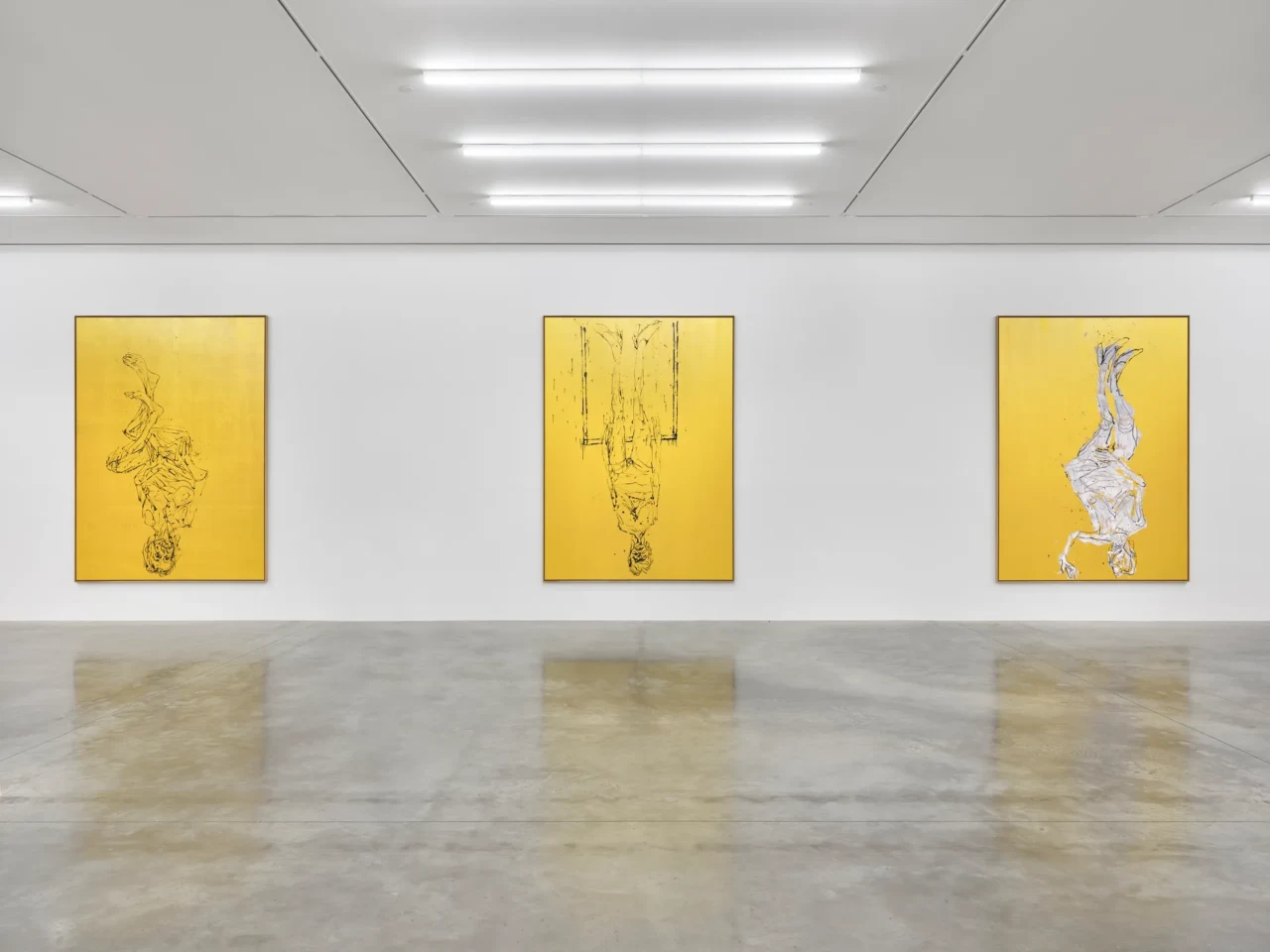
What becomes abundantly obvious at the White Cube is the fact that the majority of the monumental paintings and smaller works here show him using his internationally famous signature inversion of imagery. Baselitz created them in that manner rather than painting the “right way up” and turning canvases upside down for the purpose of display. This breaking of recognition was to ensure viewers’ attention is drawn to the paintings’ construction, namely colour, composition and balance.
The large-scale spaces of White Cube Bermondsey provide a suitably dramatic setting for these final blasts of sinuous gestures. In the North gallery, immense figures of the artist and his wife appear, sagging and frail, gender frequently hard to distinguish. Though painted seated or standing, their inversion convinces the observer that they are falling from a great height to their inexorable fate. The final and largest exhibition space is dominated by gigantic golden forms set against deep black canvases. On first inspection, one reads them as monstrous spiders or colossal humans desperately flailing their arms like a medley of doomed Icarus, raging (in the words of Dylan Thomas) against the dying of the night. It transpires, however, that this series of works, such as Habe Ich Indische Tänze Gesehen (I Saw Indian Dances) (2025) and Indische Tänze in Pittsburgh (2025), evoke the multi-armed Hindu goddess Durga, apparently the Hindi goddess of creative power, protection and destruction. A realisation of impending death is palpable, and yet there is also an urgent determination to continue exploring form and technique whilst confronting art history.
In a filmed interview with Baselitz, viewable at White Cube, the artist acknowledges how the gold backgrounds he chose here for several works in part stem from his past exposure to the gold leaf Early Renaissance work of Sienna and Tuscany. The by then wheel chair bound German explains how these huge canvases were painted on his studio floor using a brush on the end of a stick, a practical solution to his physical limitations whilst also clearly reminiscent of Jackson Pollock. As a rebellious youth, Baselitz became aware of Abstract Expressionism. Although never becoming an acolyte, he is seen in one room, rather arbitrarily adding vibrant “small quotations” by palette knife, he dubbed “de Kooning in the wrong place”. A final defiant act of impetuous fun at odds with the gloom, challenging conventions; a last dance of the brush before leaving the stage.
James White
Photos: Courtesy of the White Cube
Georg Baselitz: Back Again is at White Cube Bermondsey from 10th June until 30th August 2026. For further information or to book, visit the exhibition’s website here.










Facebook
Twitter
Instagram
YouTube
RSS