
Frederic Church: Through American Eyes at the National Gallery
 8 February 2013
This visually enthralling collection of work carries you though the thoughts and visions of Frederic Church, a man with a mind as vast as the impressions his vibrant paintings produce.
Born into a prosperous Connecticut home in 1826, Church’s talents did not go unnoticed, and the young artist was sent to study under renowned landscape painter Thomas Cole, who lived by the mantra “I must paint my places best.” Church took a different approach to his art, spending a career seeking new and exotic locations and muses to paint in his unique style.
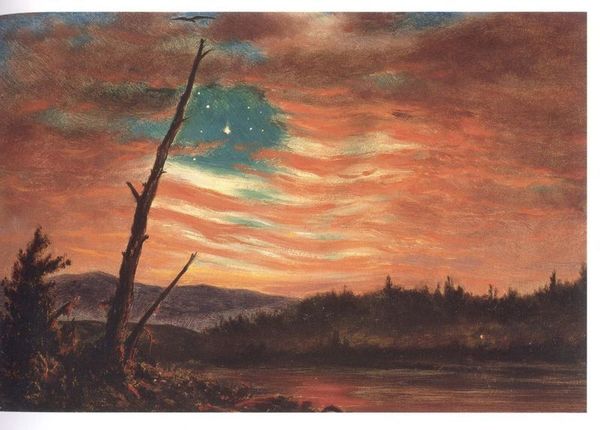
The collection starts with a piece entitled Our Banner in the Sky (1861) in oil on lithograph, a common combination in Church’s oeuvre. The painting depicts the sky with undertones of fantasy, presaging Van Gough’s famed Starry Night (1889). From a largely traditional painter, this is certainly the most abstract on display in terms of colour and style.
Forest Pool (1858-60) is so expertly detailed, one could be forgiven for mistaking it for a photograph. Church uses minute detail, with shades of sage and umber, creating a delicately multi-dimensional natural image.
This visual craftmanship continues through several paintings created during his period in Jamaica. Ridges in the Blue Mountains, although undeniably Church, bares palette and stroke similarities to one of his most noted inspirations, J M W Turner.
Turner, known lovingly as “The Painter of Light”, is best respected for his watercolour work, managing to achieve unassuming brush techniques alongside artistic finesse.
Church relied on oil sketches as precursors to his final, more detailed compositions: restrained, but never crude paintings with promise of inevitable beauty. Floating Iceberg, Labrador (1859) and The Iceberg (1875) are outstanding examples, the latter a highlight of the exhibit. His manipulation of light effects is the work of a trained and detailed eye, giving the image an air of three dimensional whimsy.
The exhibition displays the relevant chronology of Church’s work, featuring images from his extensive travels overseas, including Mexico, Yemen and Europe. The artist’s ability to interpret his immediate responses to nature, and equally architecture later on in his career, comes to a glorious and impressive crescendo with the final piece, Niagra Falls 1857. This is the largest scale painting, but does not overshadow the smaller pieces’ delicate beauty.
Victoria Sanz-Henry
Through American Eyes: Frederic Church and the Landscape Oil Sketch is at the National Gallery until 28th April 2013. For further information visit the gallery’s website here.







Facebook
Twitter
Instagram
YouTube
RSS