
Titian: Love, Desire, Death at the National Gallery
 13 March 2020

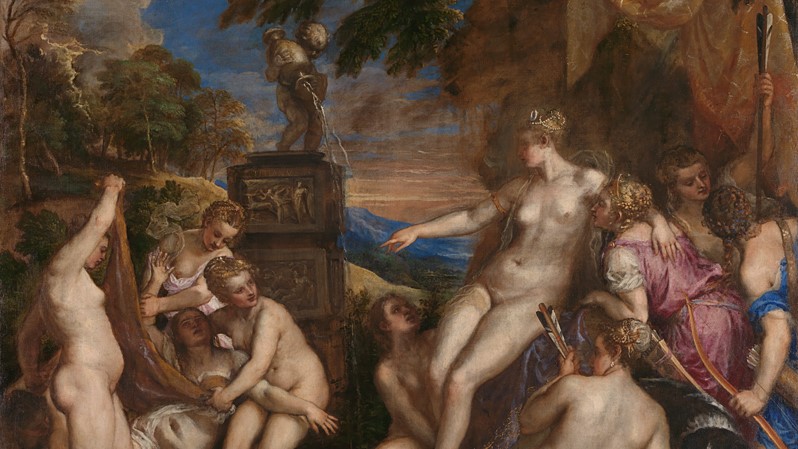
Renowned Renaissance painter Titian has his famous series of mythological paintings brought together at the National Gallery this month for the first time since the late 16th century. Originally commissioned by Philip II of Spain, the six paintings known as poesie depict stories from classical mythology drawn from the poet Ovid’s Metamorphoses. Titian: Love, Desire, Death invites us into a moment in history, to confront scenes of sexual violence and desire and to be engulfed by the visual storytelling of one of the most influential artists in history.
The exhibition consists of a short film and the six large-scale paintings from Titian’s poesie series: Danae, Venus and Adonis, Perseus and Andromeda, Diana and Callisto, The Rape of Europa, and finally The Death Of Actaeon. After viewing interviews and filmed information about the artist and the work, we enter a grand room and are met with the well-kept complete series. We witness the beautiful figures and vibrant colours; however, at a closer look, the subject matter of the poesie proves more complex and dark than the viewer’s first idyllic first impression. Paintings such as Danae (1551-3), Diana and Callisto (1556-9), and The Rape of Europa (1559-62) depict sexual violence and horrific emotions under the masterful brushstrokes. We are forced to witness the consequences of sexual assault entirely, and are prepared to reexamine our perception of the nude female figure as desire is subverted to empathy and sadness.
The series shows beauty while making the viewer feel uneasy and engrossed in a story. One cannot help but feel that these works are important to continue a dialogue regarding the objectification and violence still aimed at women today. The exhibition is a call to history, celebrating the artist’s skill in crafting a scene that can move his viewer, similar to poetry. It is detailed in describing the story of each painting; however, there seems to be a lack of description regarding the artist’s life during the creation of each individual work.
Emma-Jane Betts
Image: detail from Titian, Diana and Callisto (1556-9) © National Gallery
Titian: Love, Desire, Death is at the National Gallery from 16th March until 14th June 2020. For further information visit the exhibition’s website here.





















Facebook
Twitter
Instagram
YouTube
RSS