
Brasil! Brasil! The Birth of Modernism at the Royal Academy of Arts
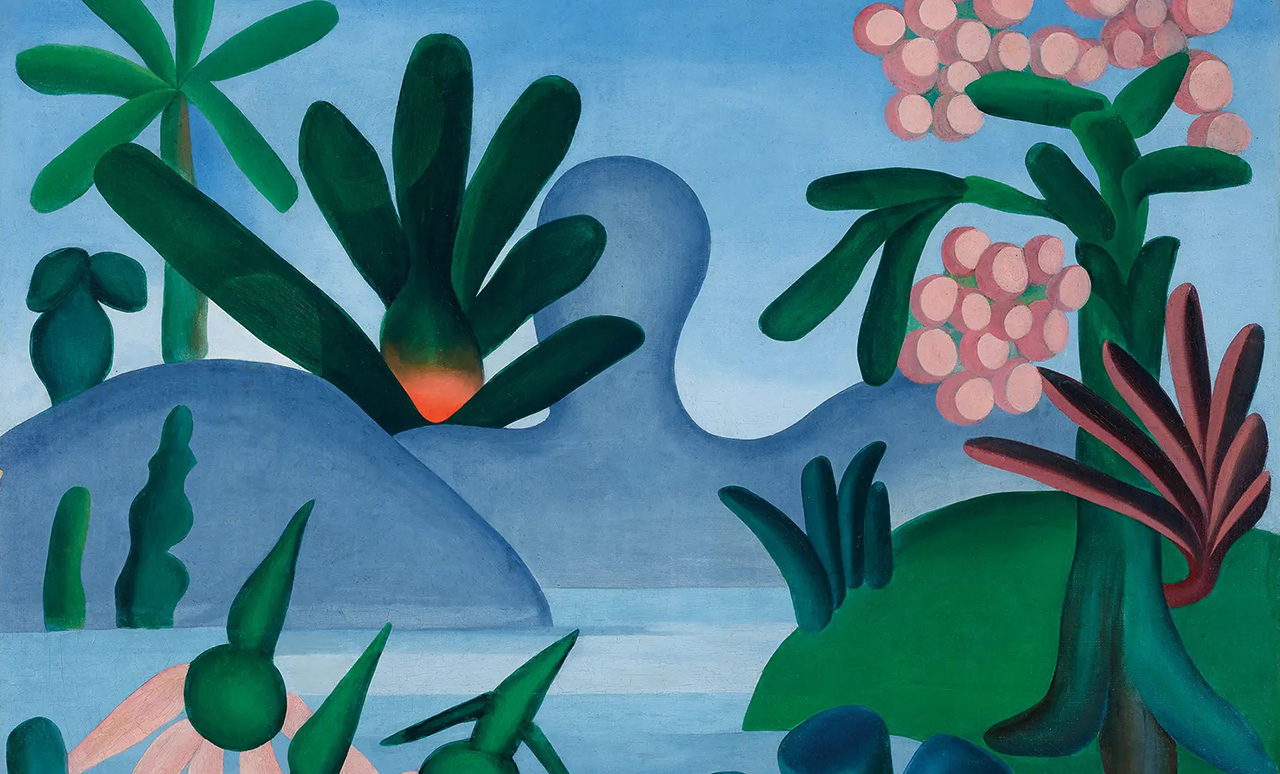

With its evocative title and a stunning selection of seldom-displayed installations, Brasil! Brasil! The Birth of Modernism at the Royal Academy of Arts delves into the genesis and evolution of Brazil’s artistic identity across six transformative decades. Told through the work of ten trailblazing artists, the exhibition captures Brazil’s bold response to the cultural currents of the 20th century.
The first hall revisits the historic Exhibition of Modern Brazilian Paintings, held in 1944, in the very same Main Galleries as the current exhibition. In a poignant reunion, seven of the 168 works originally displayed are brought together once more, including Lasar Segall’s Lucy with Flower (1939–1942). This serene portrait of Segall’s muse and student, Lucy Citti Ferreira, was one of the most lauded pieces of the 1944 exhibition. Now, it makes a poignant dual appearance: the warm-hued oil-on-canvas original and a striking black-and-white reproduction on a page of the framed facsimile of the exhibition catalogue, displayed meters away. This pairing bridges past and present, offering a unique glimpse into the movement’s history.
Extending its focus beyond remembrance, the subsequent displays delve into the artistic transformations that defined the nation’s modernist scene. Drawing from both foreign and indigenous influences, the compositions integrate these cultural elements to forge a unique and distinct artistic identity. In Chinese Woman (1921–1922), Anita Malfatti, the first Brazilian artist to draw from European and American modernism, employs her avant-garde visual language to render a poised figure in traditional blue attire, set against a dynamic burst of crimson. Vicente do Rego Monteiro’s Indigenous Composition (1922) draws directly from Brazil’s Marajoara heritage, with intricate patterns inspired by indigenous ceramics. A nearby photograph of an urn found on Marajó Island situates these motifs within their original context, emphasising the artist’s deep connection to Brazil’s ancestral legacy.
The exhibition culminates with a selection of Rubem Valentim’s sculptures and paintings, where geometric abstractions inspired by iconography from the African diasporic religion Candomblé provide a powerful conclusion to Brasil! Brasil! The Birth of Modernism. In its dialogue with the past, its people and the world, the exhibition captures the enduring energy of a cultural awakening that continues to resonate both within Brazil and beyond its borders.
Christina Yang
Image: Collection of Hecilda and Sérgio Fadel. Photo: Jaime Acioli. ©️ Tarsila do Amaral S/A Exhibition organised by the Zentrum Paul Klee, Bern in collaboration with the Royal Academy of Arts, London.
Brasil! Brasil! The Birth of Modernism is at the Royal Academy of Arts from 28th January until 21st April 2025. For further information or to book visit the exhibition’s website here.







Facebook
Twitter
Instagram
YouTube
RSS