
Jane Eyre at the Lyttelton
 24 September 2015
Charlotte Brontë’s masterpiece tells the inspiring story of a woman who overcomes an unjust life as an orphan and finds love through an exploration of morality, intellect and agency. The expectations around this premise are readily challenged by the first cue of Sally Cookson’s play: a fully-grown woman crying like a baby. It could be the beginning of a long night, witnessing a 170 year-old story as a play that runs for over three hours. But, once again, expectations are defeated as this Jane Eyre version is presented in an incredibly interesting way.
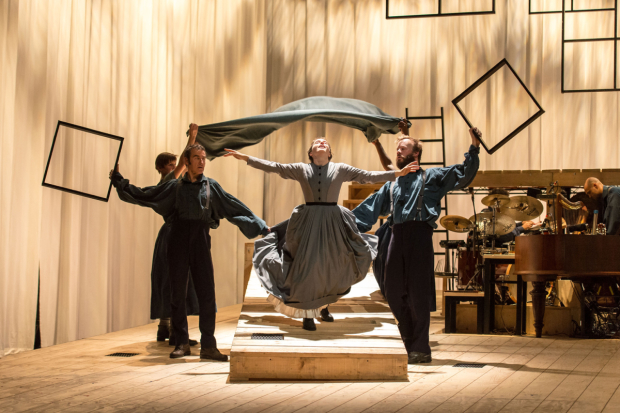
Madeleine Worral (Jane) hits the perfect spot: bold enough to convey conviction and intelligence, and sufficiently tender for the audience to become preoccupied with her future. Felix Hayes delivers a rough and attractive Rochester, faithful to the imagination of the Brontë sister. But the rest of the cast continuously change roles, not only playing different characters, but also animals, objects, and even abstract qualities. As free as a children’s game, they are all metaphors of movements, colours, moods and passage of time. One moment, an actor is a burning flame, the next, Eyre’s dear friend, Helen Burns, in her deathbed. The role of Pilot, Rochester’s dog, is enjoyed particularly by the audience, with a rope as a shaking tail that produces many genuine peals of laughter.
Black ladders and wooden platforms stand at the centre of the stage, which is itself surrounded by a wavy white curtain upon whichlighting evokes different hours, seasons and weathers. Characters choreographically go up and down throughout the play, never extinguishing their dynamism. Piano, harp, contrabass, accordion and percussion stand alongside a group of musicians as part of the mise-en-scène. The music gives the story an atmospheric theme of an almost cinematographic nature.
The length of the play often drags but, in spite of its many risks, this interpretation of Jane Eyre achieves a remarkable adherence to the original story, exploring all its inquiries on gender, class, romance and morality. It takes time to become engaged in its world, but once immersed, the result is compelling and entertaining. There is no attempt at showing the feminist heroine in a pastoral English environment because the concern is with her existential landscape. If this is not theatricality at its best, it gets pretty close, if only by revealing the many possibilities of theatre yet to be discovered.
Alejandra Arrieta
Jane Eyre is on at the Lyttelton until 25th October 2015, for further information or to book visit here.








Facebook
Twitter
Instagram
YouTube
RSS