
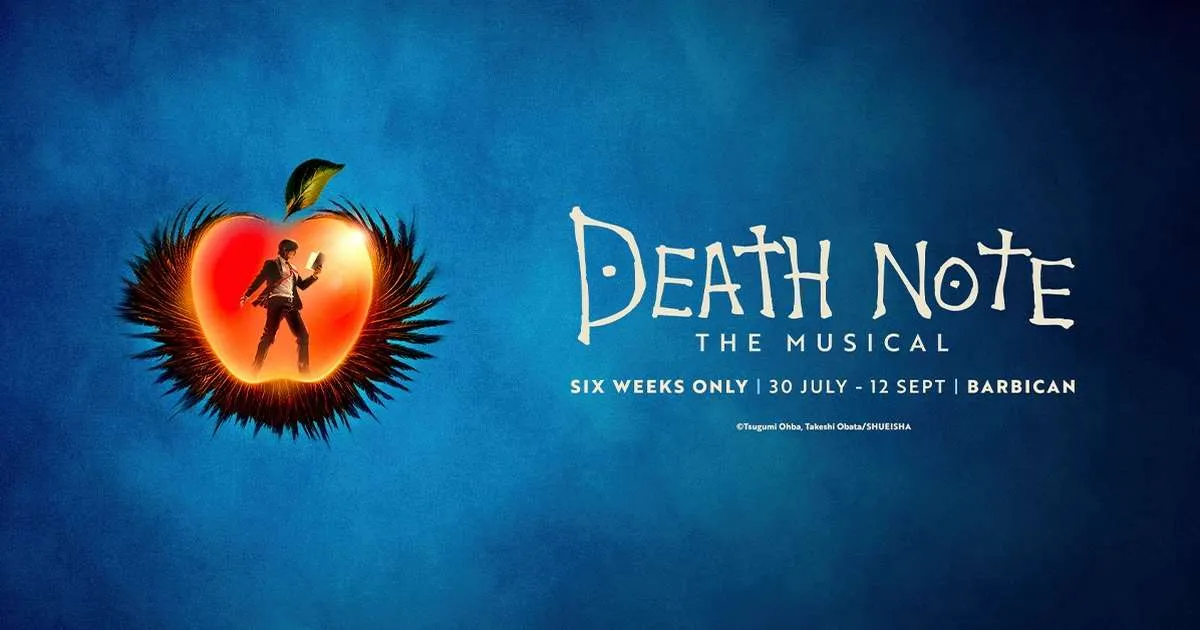
Death Note the Musical at Barbican Theatre
 12 August 2026
Death Note is a story about competing versions of justice, where L and Light battle over whose vision should prevail. Death Note has journeyed from manga to anime to musical, allowing each adaptation to reinterpret that central conflict. Frank Wildhorn’s version has now arrived on the London stage following its English-language concert at the London Palladium in 2023, bringing with it a mixture of returning and new cast members and creatives. There is plenty to admire here, particularly its ambitious staging and some excellent vocal performances. Still, the transition from concert to full blown musical has not entirely ironed out its narrative and structural weaknesses.
Death Note begins with a promising whisper of Japanese as the radio crackles, but quickly dissolves into English for the remainder of the show. A question that permeates throughout is: why not stick to the original Japanese? Why use English? Perhaps to make it more accessible to London audiences. The Barbican has become especially known for bringing productions like My Neighbour Totoro to its stage while retaining a connection to Japan through phrases and moments still in the original language. It raises the question of whether retaining more Japanese may have strengthened this version’s connection to its origins rather than adapting it almost entirely for an English-speaking audience.
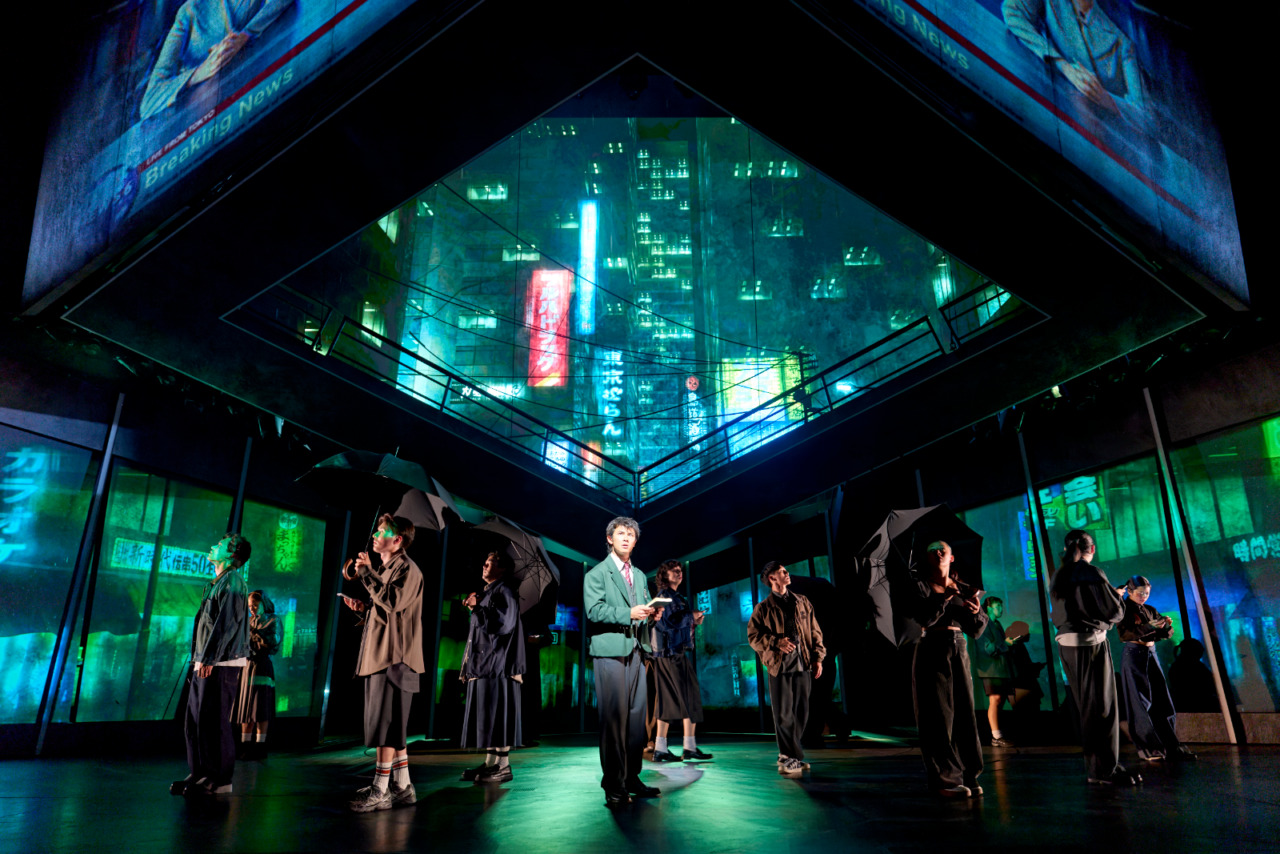
The most striking element is the staging. The two levels effectively establish a divide between the domain of the Shinigami and the human world, while the lighting complements the design to create a visually arresting theatrical world.
The well-known plot of Death Note means that seasoned fans will notice any revisions, inconsistencies, or rearrangements from the source. This is not always a bad thing; however, in this instance, one of the most important rules (needing to picture the face of the person when you write their name) is not explained until much later on, leaving audiences to wonder why, if someone shares a name with the person in the Death Note, they do not all die. Seemingly a small point, it is actually central to everything we come to understand up to that moment. It leaves a hole in our understanding of what is going on, and with a small rewrite could be rectified to help the story flow more freely.
Musical theatre offers a unique opportunity to breathe new life into familiar stories. In this adaptation, however, the music tends to interrupt the flow of the narrative, sometimes repeating information and thereby lessening the impact of both songs and dialogue. The transitions between numbers are often abrupt, with major songs following one another so closely that it can be difficult to discern their individual significance. With thoughtful editing and reorganisation, the piece could become far more dramatically cohesive. At times, it feels better suited to the concert format in which this version of Death Note was first experienced, where the music could take centre stage without the narrative demands of sustaining a complete theatrical narrative.
All that said, the music does the material justice, particularly in the hands of Misa (Stephanie Zaharis) and Rem (Grace Mouat). Their vocals are outstanding and provide a welcome lift in Act 2. In fact, all the actors are strong in their own right; it is the book that lets them down. Just as they begin to find their groove within a scene, the narrative frequently gives way to another number, occasionally making the songs feel inserted rather than organically motivated by the drama or chosen to articulate something that could not be expressed through speech alone.
One of the show’s more challenging character choices is its interpretation of Ryuk (Telly Yung), although Yung himself is a fantastic actor and singer. Ryuk is perhaps the character who suffers most in translation to the stage, with Yung leaning into his comic qualities at the expense of some of the sinister, otherworldly presence that makes him so compelling. Yes, Ryuk has moments of comedy in the manga and anime, but his sense of menace is ever-present. By making him more human, some of the character’s godlike, sinister qualities become less prominent than they perhaps should be.
L (Colin Ryan) is a breath of fresh air when we finally meet him towards the end of Act 2. His presence is more godlike than the Shinigami, because he manages the balance between unhinged and otherworldly without becoming a caricature of either. When he and Light (Xander Pang) have their showdown later on, however, some of that gravitas slips away. Strangely, his death comes just as the piece risks surrendering the very essence of what makes L so compelling.
There is potentially a great piece of musical theatre at the heart of this adaptation. The performances are strong, Wildhorn’s score contains several genuinely memorable moments, and its visual language gives the familiar material an exciting theatrical dimension. For fans of Death Note, there is plenty here to engage with, while newcomers may find an intriguing introduction to its world. With further refinement to the book and a more integrated relationship between dialogue, music and character, it could become a much more cohesive realisation of Light and L’s battle for justice.
Natallia Pearmain
Photos: Manual Harlan
Death Note the Musical is at Barbican Theatre from 30th July until 12th September 2026. For further information or to book, visit the theatre’s website here.
Watch the trailer for Death Note the Musical at Barbican Theatre here:











Facebook
Twitter
Instagram
YouTube
RSS