
Minamata
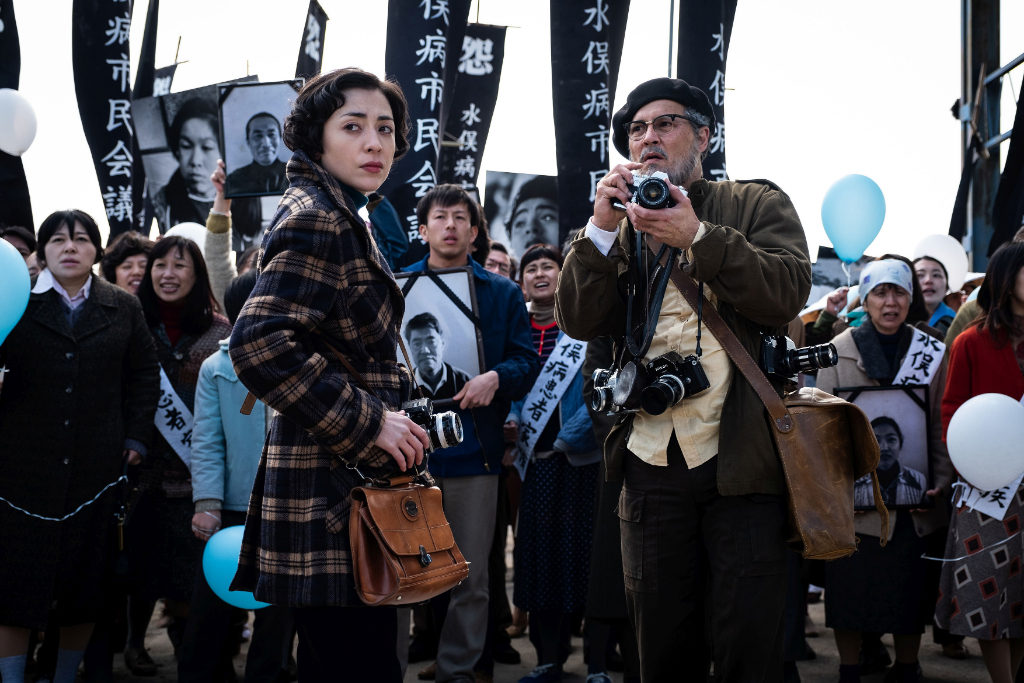



Johnny Depp tries to animate his recently moribund filmography with a serious-minded biopic of W. Eugene Smith, the Life photojournalist who helped to uncover the large-scale mercury poisoning of Japan’s coastal communities in the early 1970s. State and private bodies ignored longstanding activist concerns to further their financial ends. Minamata thus adds celebrity wallop and worthy politicking to an otherwise carefully curated and ambitious Berlinale selection.
Depp plays a self-hating, cantankerous alcoholic with a soft centre under his greenish pallor and broadly hostile exterior. It is unfortunate that so little of the film hangs together around him, a slovenly imitation of its central character. Director Andrew Levitas can’t decide whether to show a heartening biography of a relationship – between Smith and his Japanese translator Aileen (Minami Hinase) – or a fictionalized document of institutional injustice and incomparable human tragedy. Attempts to develop either strand result in unintended jarring. No plot development is intellectually, aesthetically, or narratively earned.
This is a senseless, arbitrary piece of work. Character motivations are not justified. Context is rendered irrelevant. Mercury poisoning and its associated effects function as a dulled aphrodisiac for a central romance which barely exists. That the film is based on real events and that it draws attention to this fact makes its sense of unreality all the more bizarre. It thwarts interpretation: the viewer struggles to read any psychology into its subjects. Ludicrous sequencing fails to evoke jeopardy and human cost. A victim’s act of self-harm produces only bathos. The CEO of the polluting company is shot comically in darkness before being offered a half-hearted route to redemption. The general tone is essentially confused.
Levitas’s direction struggles to advance the narrative. Action and consequence do not cohere. Smith’s job as a photographer explains the pointed lens-focusing that dominates the majority of scenes. Levitas’s co-authored screenplay is incurious about the illness it claims to depict, treating it as a universalized injustice despite some courteous shots of the poison’s physical consequences. The way the story invokes Smith’s PTSD is slipshod and insulting. Hiroyuki Sanada, Jun Kunimara, Bill Nighy, and Katherine Jenkins constitute the eccentric supporting cast, none of whom is able to mitigate the fundamental technical issues, which range from perverse sound mixing to the ungrammatical closing credits. A bit of a mess, overall.
Joseph Owen
Minamata does not have a UK release date yet.
Read more reviews from our Berlin Film Festival 2020 coverage here.
For further information about the event visit the Berlin Film Festival website here.























Facebook
Twitter
Instagram
YouTube
RSS