
Love’s Labour’s Lost at Shakespeare’s Globe
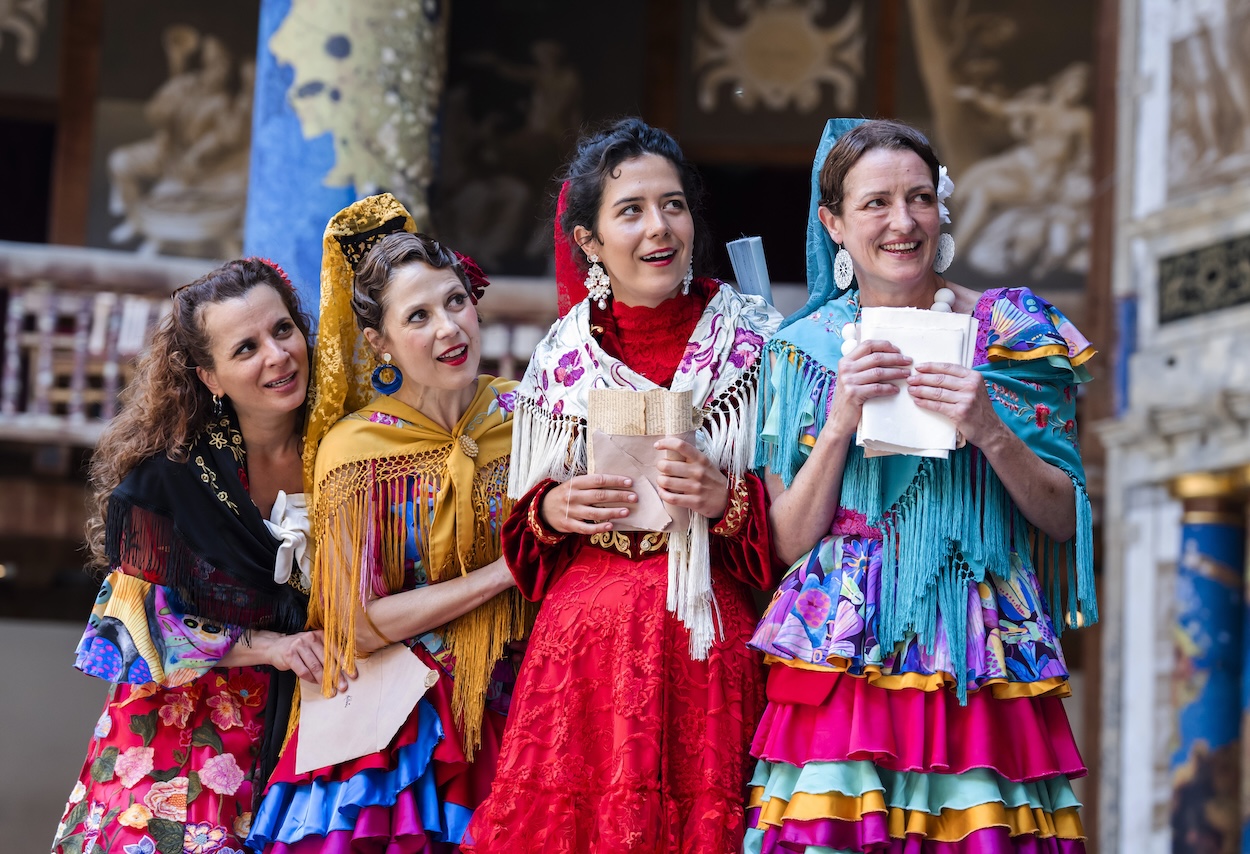



Love’s Labour’s Lost is one of the Bard’s less frequently performed comedies – even at London’s “wooden O” – and for the 2026 summer season, director Indiana Lown-Collins has made it a memorable one. Theatregoers are transported to Spain, where flamenco seamlessly intertwines with words in a production that revels in ambiguity and lyrical eloquence.
The King of Navarre (Ned Costello) and three of his noblemen vow to abstain from distractions – namely food, sleep and women – in order to devote themselves entirely to study. The timing could hardly be worse, as the Princess of Spain (Norah Lopez Holden) and her three ladies are on their way to Navarre. When the women hear about the oath, they almost ridicule the situation; yet they are asked to stay in the fields rather than at court, as a royal welcome would ordinarily dictate. Despite the physical distance the men attempt to maintain, they nevertheless fall in love with the charming female embassy, and a series of mix-ups, mishaps and masquerades ensue.
The shift to the Iberian Peninsula – in an undefined period – rather than the original French setting allows the creative team to draw on one of the most visceral and pulsating art forms: flamenco. The rhythmic footwork is the production’s undisputed protagonist, opening the show before sweeping through the dialogue and becoming the backbone of both conversations and monologues. The soniquete is relentless, setting the pace, driving each sequence and propelling the action forward. Through their bodies, the cast achieves a harmony equal to, if not greater than, that of the words (certainly more so than the blending of the occasional Spanish phrase into the script). A potent example is the bullfighting scene, staged on an island platform in the middle of the yard, where Holden and Pablo Egea become locked in an utterly dramatic, almost entirely touchless flamenco duet.
Humour is conveyed chiefly through exaggeration rather than sophisticated wordplay, and it’s a balance that works very well. The irreverent subversion of class and erudition through language is toned down, while slapstick lightens the overall production and gives it a more immediate comic tone. The scene in which the lords, in turn, confess their love playfully nods to contemporary pop music while delivering a well-executed comedy of errors; the English teacher (Katy Stephens) mocks Mediterranean tourism through over-the-top cliches. Less effective is the Muscovites’ disguise, despite the hilarious costumes and movements.
Heels, faralaes dresses, tight pantalones and boleros make for a vibrant visual spectacle. The Navarre quartet are dressed in white uniforms, while the women wear colourful hues, upending ideas of masculine passion and feminine innocence.
Arditti and Costello are superlative entertainers, while Stephens works wonders in her alternation between roles. True showstoppers are Egea and Anita La Maltesa, both outstanding flamenco dancers inseparable from the band led by cantaor Carlos Lobo Cordón.
Where this early comedy may not possess the maturity of the Bard’s later works, it already contains their essential ingredients, and this production brings them to the fore, weaving them together with passionate beats and a flamboyant stagecraft for an exuberant time at the theatre.
Cristiana Ferrauti
Photo: Tristram Kenton
Love’s Labour’s Lost is at Shakespeare’s Globe from 17th July until 13th September 2026. For further information or to book, visit the theatre’s website here.
Watch the trailer for Love’s Labour’s Lost at Shakespeare’s Globe here:






















Facebook
Twitter
Instagram
YouTube
RSS