
Frida: The Making of an Icon at Tate Modern
 25 June 2026
Few artists, if any, have become interwoven into the fabric of their national identity as Magdalena Carmen Frida Kahlo y Calderón (1907-1954), known to the world, of course, as Frida Kahlo. Tate Modern’s hugely anticipated new exhibition devoted to the Mexican’s career, influences and international phenomenon status, is already attracting incredible levels of interest from the public. So great is Kahlo’s prestige in her homeland (in 1984 she was decreed to be a “national artistic monument”) that a legal apparatus is in place to ensure that much of her works remain on the walls of Mexico’s temples of art. History would suggest that the Tate have moved mountains to negotiate the loans of 30 pieces from galleries and private ownership. Anyone expecting an archetypal traditional retrospective, however, is in for a surprise; the UK institution has already held one of those in 2005. Instead, curators are expanding their scope to examine not only Kahlo’s life and career but also how her multifarious identities have both inspired other artists and her ascent to cultural superstardom.
Each room is painted in different colours, one assumes to evoke a sense of the boldness of Kahlo’s palette and a life marked by passion and physical hardship. Early on, one finds the artist’s personal narrative charted, including details of her Mexican mother and photographer father of German birth. Afflicted by polio, and then narrowly escaping death in a terrible road accident involving the bus she was travelling in and a tram, chronic pain became Frida’s constant reality. That fateful day in September 1925 left her with life-changing injuries, including a spine fractured in three places and a broken pelvis that would prove a barrier to carrying children. And yet, in the face of the catastrophe, this determined young woman was able to find strength and purpose in her art. Kahlo’s parents had a specially designed easel attached to her bed (a photo of Frida using it is displayed), along with a large mounted mirror to help her paint through the months of recovery. The displayed corsets, braces and supportive footwear devised to alleviate suffering tell their own tale.
Photography and film play an important role throughout this exhibition, capturing Kahlo’s transition from youthful self-possession to her tempestuous relationship with the giant of Mexican muralism, Diego Rivera. An excerpt of a film by Nickolas Muray from 1941, made at their home, la Casa Azul, highlights their physical differences: he tall and enormously corpulent, she comparatively diminutive. As her career gains momentum, one increasingly sees photography playing a major role in shaping her reputation. New York gallery owner Julian Levy’s 1938 black and white photographs of the artist and coloured images from four years later by Lola Alvarez Bravo reveal the Mexican’s charismatic gaze and comfort before a lens.
Kahlo’s life is often conflated with her art, but with good reason. Originally a high-achieving student harbouring ambitions to become a doctor, her accident led her to draw upon her interest in human anatomy in the pursuit of an artistic career. For example, Self-Portrait (in a Velvet Dress) (1926), highlights the indomitable spirit of a young woman, apparently reminding her then boyfriend, Alejandro Gómez Arias, that her feminine charms remained intact despite her injuries. Three years later came another seismic event in the artist’s life, her first of her two marriages to Rivera. The fourth anniversary of her second marriage inspired Frida to create the remarkable painting, Diego and Frida 1929-1944 (1944); displayed at Tate, it incorporates Rivera’s face into her self-portrait, joined by intertwining roots, a sun and a moon, further emphasising their close relationship. All are set within a specially chosen frame of clam shells. It must be said, some of the frames on show are pretty spectacular in their own right.
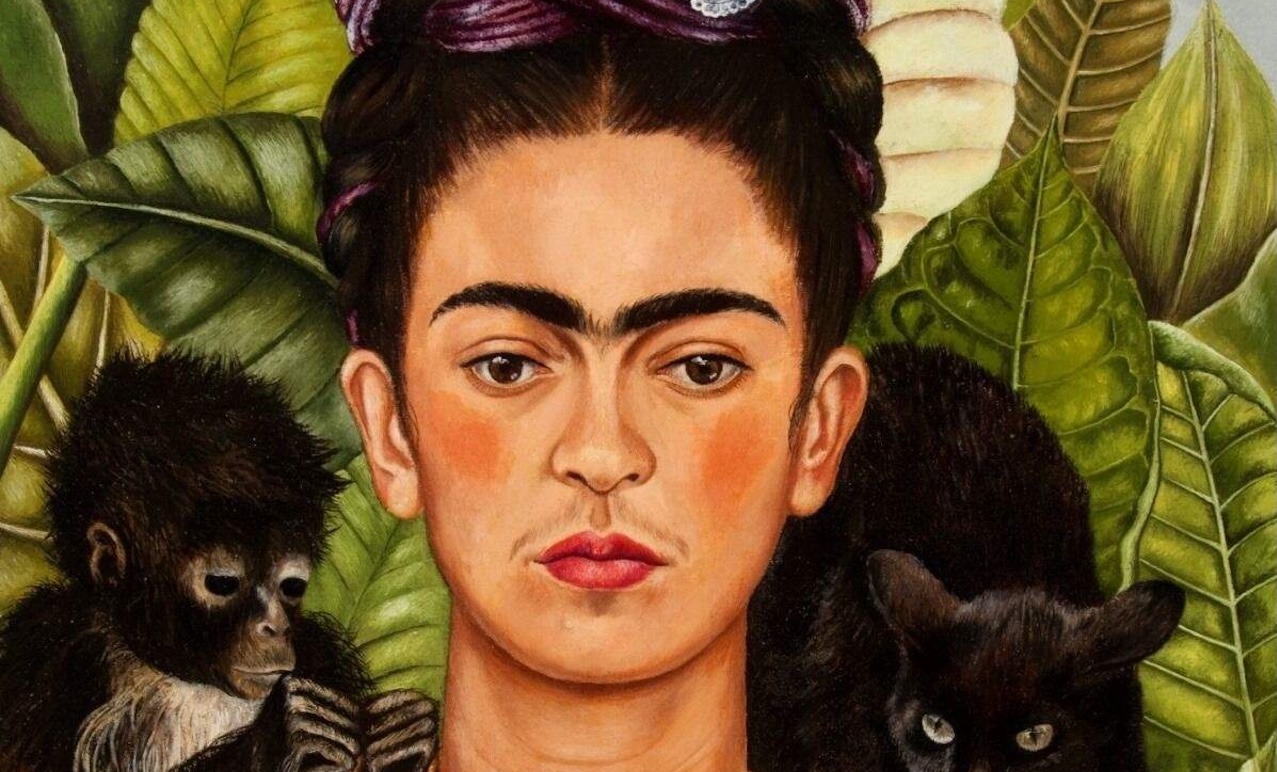
From the mid-30s onwards, one finds Kahlo adopting traditional Tehuana-style South Mexican dress. With both she and her husband passionate communists and fervent nationalists, it was a celebration of indigenous culture and an act of defiance against foreign imperialism. Her father’s German roots are conveniently forgotten. Some exotic dresses from Kahlo’s wardrobe appear in cases, alongside ornate pieces of her jewellery. Thanks in no small measure to Rivera’s European links, Frida is seen attracting the attention of André Breton, who became convinced she was a Surrealist. It was a description she wholeheartedly rejected, and yet the Mexican was more than happy to take part in a 1939 Paris exhibition organised by Breton. Kahlo’s celebrated Self-Portrait with Thorn Necklace and Hummingbird (1940), evoking the artist’s feelings following the end of her first marriage and an absolute highlight at the Tate, has frequently been classified as Surrealism. This is in spite of Frida’s protestations that the work is rooted not in dream-fueled juxtaposition but in lived trauma. Another earlier painting, Memory, The Heart (1937), seems to deploy a surrealist pictorial device of dividing a sense of self. Carrying psychological and physical charge, the composition features a crying figure of Kahlo who stands between land and sea, calm despite a pole piercing her chest. Dislocated arms reach out to her from a school uniform and a Tehuana dress, respectively, as a giant disembodied heart lies on the ground before her. Whether it is intended to symbolise marital turbulence or her post-accident physical challenges remains a mystery.
Kahlo’s work is frequently shown in dialogue with other contemporary artists, many of whom were part of her social circle, and who depicted similar macabre subject matter. Rosa Roland’s 1952 self-portrait, where she foregrounds herself in front of a medley of dancing figures and skeletons, questions gender roles, an interest she shared with other artists featured here, including María Izquierdo. Izquierdo’s gouache painting, Prisoners (1936), finds a disconsolate female figure, believed to be the artist, prostrate on the ground, apparently condemning what she viewed to be the emotional and physical restrictions placed on women in her Mexican homeland. Another intriguing Mexican painting, this time from an earlier era, the Peres Maldonado Ex-voto (c1777), makes the case that themes explored by Kahlo already had historical precedent in her country’s art. A devotional work (artist unknown), it shows a woman undergoing a mastectomy, commissioned by the grateful patient who believed divine intervention had enabled her to see off breast cancer. Kahlo’s The Suicide of Dorothy Hale (1938-39), displayed here alongside the aforementioned 18th-century work, might be subsequently seen in a different light. Commissioned by Hale’s playwright friend, Clare Boothe Luce, to create a memorial portrait of the deceased, Frida chose to show Hale, a failed actress, falling from the apartment window from which she had leapt. A description at the foot of the canvas describes the incident in the manner of a traditional religious painting.
The remainder of the exhibition turns its focus to how other artists around the world have found inspiration in Kahlo. Over the years since her death, the Mexican has become acclaimed as a guiding light of feminism, gender fluidity and disability issues. One of her orthopaedic corsets on display, entitled, Hammer and Sickle (and unborn baby) (circa 1950), sees Kahlo painting the Communist symbol and a baby within a uterus, underscoring both her political ideals and traumatic attempts at pregnancy. A late self-portrait depicts her in a wheelchair next to an easel on which she is painting her surgeon, Dr Farill. The contemporary Mexican sculptor, Berenice Olmedo’s sculpture featured at Tate, Efélide (2018), consisting of a plastic cervical collar and spinal corset, resonates with Kahlo’s considerations of disability and gender.
The iconic Mexican’s impact on the LGBTQIA+ community is brought to the fore here. An Inner Dialogue with Frida Kahlo (Hand Shaped Earring) (2001), a self-portrait by Yasumasa Morimura, finds the Japanese artist sporting Frida-esque makeup and dress. Instantly, one recalls the photograph appearing earlier in the show of the teenage Kahlo cutting a dash in her father’s suit for the family album. Time and again, Frida’s image is appropriated, sometimes more successfully than others. A case in point can be seen in Mary McCartney’s 2000 photographic work of Tracey Emin posing in the guise of the Mexican. The Margate-based artist’s similarly powerful gaze and shared thematic exploration of bodily suffering combine to make the image a worthy homage. However, all too often, one encounters pastiches lacking much of the emotional depth and elegance of the works they stem from. For all the particular ambitions of curators, the exhibition suffers from a lack of actual key Kahlo works. With frustrating regularity, cards appear on walls featuring photographs of unsecured paintings. Notable in their absence are the two masterpieces, The Two Fridas (1939) and The Broken Column (1944).
Tate Modern’s final gallery throws a spotlight on the rise of the “Fridamania” phenomenon. The visitor finds Kahlo as a global commodity with glass cabinets filled with merchandise bearing the artist’s image. Those instantly recognisable features appear on mass-produced bottles of tequila, trainers and tote bags alike. In direct contrast with this unapologetic commercialism, there are also handmade objects created by artists and artisans in homage to Kahlo, a significant number fueled by Catholic fervour. Amongst them are devotional shrines with the artist featured as “Saint Frida” and as a skeletal character linked with the Day of the Dead. In the years since her death, the image of Kahlo has become seared into our collective consciousness. Undeniably, the artist herself was at the heart of its cultivation and yet the global commodification of Kahlo’s image threatens to overshadow her artistic depth, doing her legacy a serious disservice.
James White
Image: Frida Kahlo (Mexican, 1907–1954), Untitled [Self-portrait with thorn necklace and hummingbird], 1940. Oil on canvas mounted to board. Nickolas Muray Collection of Mexican Art, 66.6. Harry Ransom Center.
Frida: The Making of an Icon is at Tate Modern from 25th June until 3rd January 2027. For further information or to book, visit the exhibition’s website here.












Facebook
Twitter
Instagram
YouTube
RSS