
Painting the French Riviera at The Royal Academy
 2 October 2026
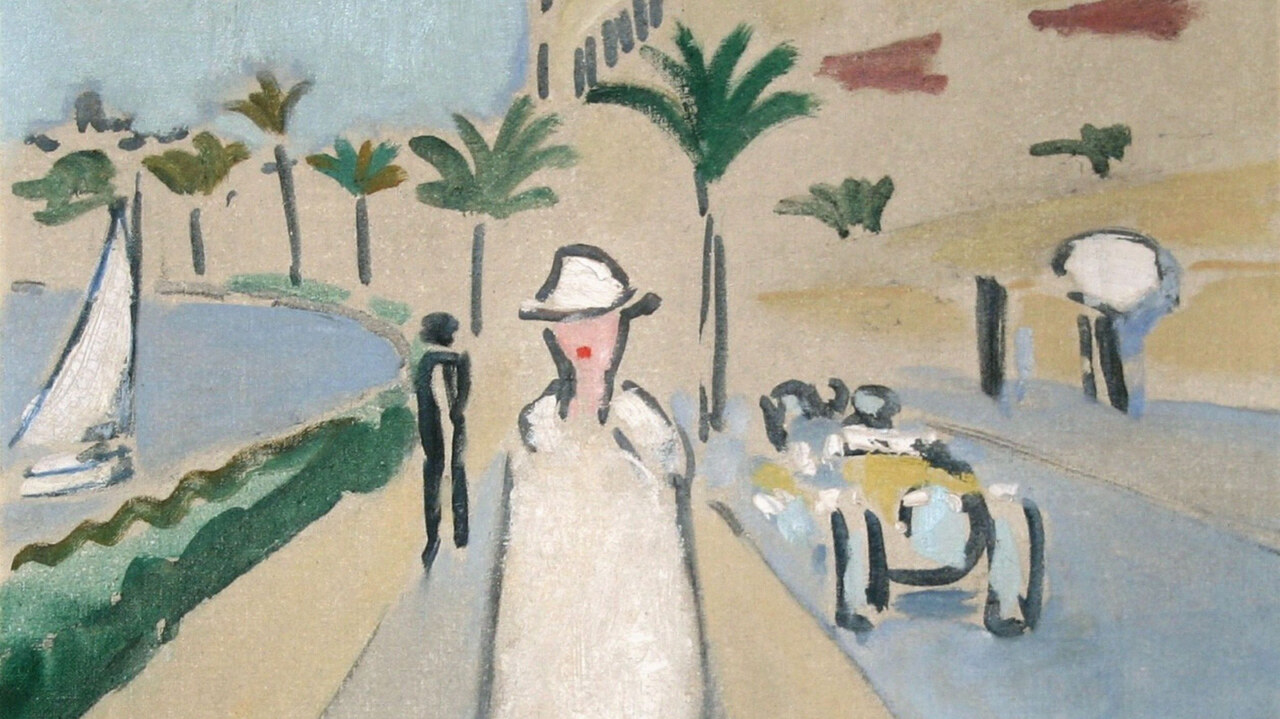
With its glistening sea, luminous blue skies and intense light, the Côte d’Azur has long since held a special allure for artists. A pantheon of big hitters from Monet, Renoir and Signac to Matisse and Picasso have been enticed here, charmed by the Riviera’s beauty and glamour. As the nights start to lengthen, the Royal Academy provides a welcome injection of aesthetic serotonin in an uplifting new exhibition focusing on the art inspired by that most sophisticated of coastal destinations from the 1870s until the 1960s. Comprising some 120 paintings, works on paper and sculptures, alongside travel posters and film, the show encompasses nine decades of sun-drenched creativity.
The expansion of the French railways in the mid-19th century saw a surge of visitors to the South as urbanites and tourists alike sought respite from the relentless grind of modern city life. In the opening gallery at the RA, Cézanne is found in the 1870s visiting the fishing port of L’Estaque, breaking down its coast into geometric planes and facets of colour. His three Bathers works (1890-92) see figures rendered in simplified shapes, seemingly blending into the landscape. Located to the northwest of Marseille, the springboard for these paintings is not in the French Riviera and yet the Aix-en-Provence native’s presence there proved instrumental in luring contemporaries, notably Monet, to the South. The Father of Impressionism first journeyed to the Côte d’Azur by train in December 1883 and was destined to frequently return to Antibes and Bordighera, entranced by their beauty. His serene landscapes, Morning at Antibes (1888) and Antibes Seen from the Salis Gardens (1888), juxtaposing yellow and violet, capture the same view in different light conditions, a tendency that would become a mainstay of his career. Renoir too had gleefully ventured down South, alongside Monet, partly to glean inspiration from the region and partly to combat his rheumatoid arthritis. The delicate, feathery execution and lively deep blue, green and golden palette of his Rocky Crags at L’Estaque (1882), created during his visit to Cézanne, notably contrast with his host’s painterly response to the same location. Renoir, influenced by his friend’s Bathers, would be, by the 1890s, painting classical nudes, exemplified by Bathers Playing with a Crab (1897). He too was destined to fall under the spell of the Riviera, ultimately building himself a house in Cagnes-sur-Mer, near Nice, in 1908.
The rapturous response to the sun-bleached Southern France idyll continues into the Post Impressionists. Paul Signac’s pointillist depictions of St Tropez, on an occasion revealing his anarchist leanings and Henri-Edmond Cross’s no less vibrant seascapes feature here in not insignificant numbers. Braque, whose early foundational Cubism was characteristically austere, adopts a palette of luminous colour here. Metres away, Matisse’s sensuous Study for Luxe, Calme et Volupté (1904), ostensibly depicts classical nudes but, in reality, its landscape has been identified as Saint-Tropez, where the artist was staying with Signac that summer. Matisse is seen experimenting with his friend’s pointillistic technique, although shortly he would develop the bold, expressive Fauvist use of colour. His fellow “wild beast” Derain’s View of Collioure (1905) dazzles in its energy, revelling against traditional handling of paint.
Pierre Bonnard was so enchanted by the Riviera that he ended up moving there permanently. His hotel rooms can exude a hazy warmth, a prime example being Breakfast, Radiator (Breakfast at Le Cannet) (1930). An open window fills the room with light, captured in tones of yellow and orange. Elsewhere one encounters the dreamscapes of Chagall and, perhaps inevitably, a large central gallery entirely devoted to Pablo Picasso. Having first visited the Côte d’Azur in the 1920s with his then wife, Olga Khokhlova, Picasso would find himself marooned in Paris during the years of German occupation. In 1946, peace restored, the Malagan is seen returning, like a bird released, to Antibes. Invigorated by his new relationship with the young artist, Françoise Gilot, the ageing lothario playfully depicts bathers, sea urchins, mischievous fauns and satyrs. One wonderfully exuberant, gestural canvas, The Doves, 6 September 1957 (1957), sees Picasso painting a sea of white doves on the balcony of La Californie, his villa in Cannes. Beyond the window lies a tranquil Mediterranean and a riot of lush vegetation; the frame-within-a-frame device is also found being deployed here by Matisse, Dufy and Bonnard. By the 1920s, the growing reputation of the Côte d’Azur as the playground of the European elite had inspired Sergei Diaghilev’s Ballets Russes to create a ballet named after the luxurious train that was then transporting well-heeled travellers from Calais and Paris to the Riviera. The swimsuit costumes for Le Train Bleu (1924) designed by Coco Chanel appear in the RA’s final, circular gallery before a huge wall projection of Picasso’s Two Women Running on the Beach (The Race) (1924). Originally a gouache painted by the Spanish master in Brittany, an 11 metre reproduction was created as a vast curtain for the stage.
Art is clearly presented to have cultivated the myth of the Côte d’Azur. Equally as undeniably, this coastal theatre of dreams has for over a century inspired the evolution of modern art. As the exhibition reaches its closing stages, one enters a room devoted to imagery of a more commercial nature, travel posters promising sunshine and delight to pleasure-seeking travellers. Evidently, neither Picasso nor Matisse saw themselves to be above graphic advertising. The latter’s poster, Nice: Work and Happiness (1947), sees him enticing the public to his beloved coastal idyll via one of his inimitable still lifes. In the same room, film clips from Powell and Pressburger’s The Red Shoes (1948) and To Catch a Thief (1955), starring Grace Kelly and Cary Grant, testify to the fact that even golden era Hollywood succumbed to the Riviera’s charms.
A change of mood pervades the final room where one encounters Nicolas de Staël’s abstracted seascapes, including View of Marseille (1954). The Franco-Russian painter would tragically take his own life by jumping from the terrace of his Antibes apartment. Another artist of enduring impact on the development of modern art, and sadly with an equally youthful demise, Yves Klein also features here. The Nice native sought to challenge the boundaries of creativity through his use of unconventional materials and nature. The distinctive sky of the Mediterranean inspired the creation of his famous International Klein Blue, with the rich, patented colour found in several works on display, notably monochrome paintings and Anthropométries (1958-1961), where female models pressed their paint-covered bodies onto the canvas. It is a truly avant-garde finale to this entertaining examination of the glorious French Riviera as a hub of artistic originality over the course of a century.
James White
Image: Courtesy of The Royal Academy
Painting the French Riviera is at The Royal Academy from 2nd October until 31st January 2027. For further information or to book, visit the exhibition’s website here.














Facebook
Twitter
Instagram
YouTube
RSS