
The Minack Theatre in Porthcurno, Cornwall
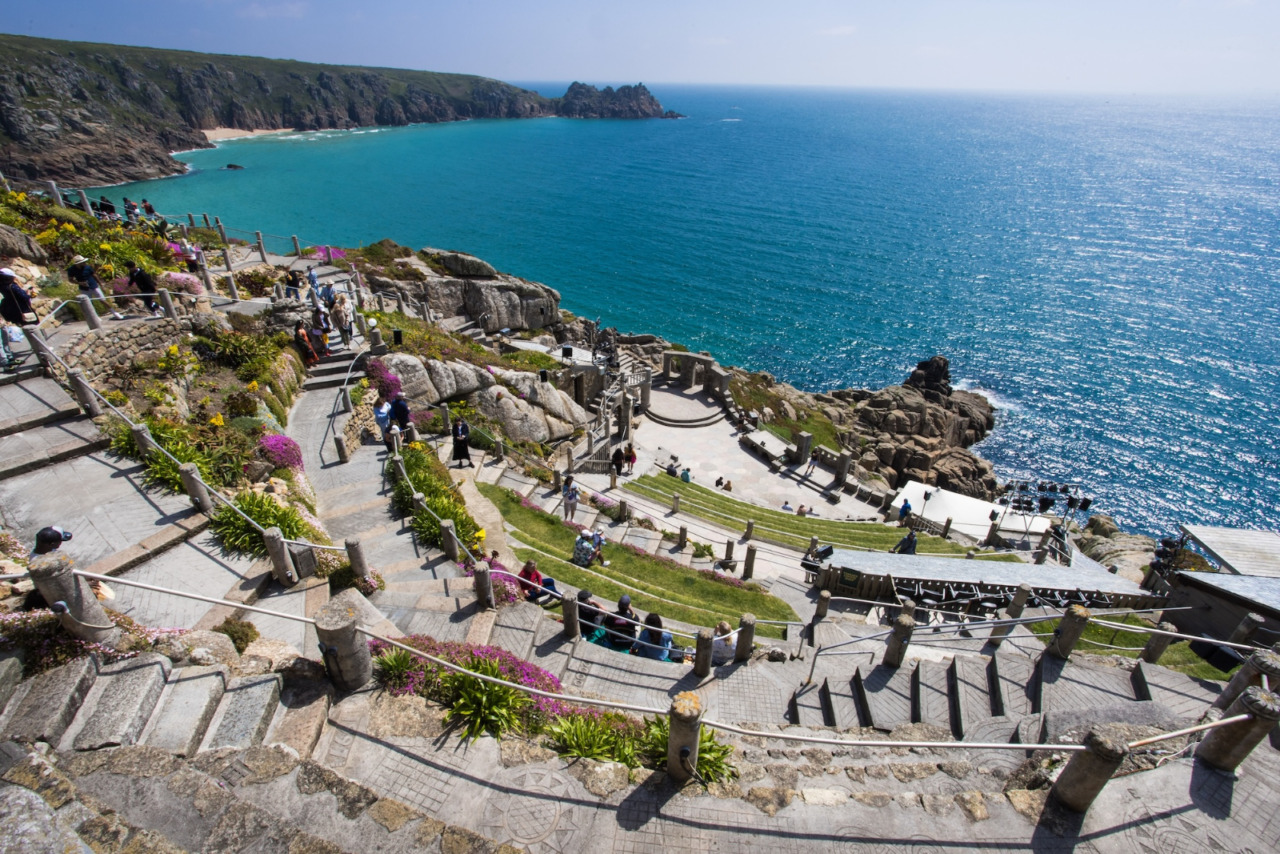


On a high cliff at the far end of Cornwall sits the Minack Theatre, a marvel of performance-space architecture born from the idea of a single woman and nowadays serving a whole community (and beyond).
Theatres began as outdoor spaces in ancient Greece, later developing into the great stone theatres found across Greece and Magna Graecia – where some ruins of those grand old constructions are still visible today. In modern cities, open-air theatres take the form of polished amphitheatres and wooden structures. The Minack (meaning, in old Cornish, “rocky place”) combines a stony structure with an extreme (and that is a rather moderate adjective) location – so interconnected with the natural landscape and so rudimentary-looking that one may be excused for mistaking it for a Roman-era theatre. The site, overlooking the golden Porthcurno Beach, is both a challenging and a spellbinding setting. The theatre opens from the end of April until October, yet mild weather is not always guaranteed. Nevertheless, the marvellous scenery unfolding before the audience’s eyes, with the deep blue sea and the wind sweeping in, is unparalleled.
Despite its antique aspect, the origin of the theatre dates back no further than 1932, when Rowena Cade, an artist from a well-to-do Edwardian family, was looking for the best location for the next production, The Tempest, by a theatre company she had recently joined. The headland, with its rugged and fierce landscape, fit the bill. The only issue was that, at the time, it was little more than a collection of stones. Together with her gardener, Billy Rawlings, Cade started moving pieces and soil by hand to flatten an area big enough for the performers to act and create some alcoves for the public to sit. The result of that first show is written into the continuation of the project to the present day. The construction of the theatre progressed over the years, with the duo equipped with little more than concrete, sand from the beach below, a screwdriver and, occasionally, dynamite to blast away obstructing rocks here and there.
This story is marvellously told by Mark Harandon, who takes on the character of Billy Rawlings – complete with his rough language and mannerisms – in a solo monologue performed on a few mornings during the week and free to attend as part of a regular visit to the theatre. It’s hilarious and moving – in addition to being instructive, particularly for those coming from outside Cornwall, for the snippets learnt about life in days gone by in this part of the country.
Archive photos and details on the development of the venture are contained in the Rowena Cade Exhibition, which showcases not only the determined character of its founder, but also how increasingly the project became a labour of love and a treasure shared by the whole community. Among the various examples are the illustrations of Hilda Quick, an artist from Penzance, and the ongoing series of activities for young people that attract budding thespians.
The spot earned considerable attention – especially from London, as it seems – when it featured in the 1944 film Love Story – quite an irony, given that it was then still closed because of the war and at the end of the conflict would emerge badly damaged, forcing Cade to restart the building works (again with bare hands and with Rawlings’s steadfast support).
A ticket to a theatre visit includes the gardens, another charming addition to the niches carved out along the gully, first established by local gardeners Niall and Jill Milligan in the late 1990s and now covering one and a half acres in total. Subtropical plants from South Africa, South America and the Canary Islands, resistant to the constant wind (from gentle breezes to strong gales) and temperature swings, find their perfect habitat here thanks to the special climate the grounds enjoy, with dry, virtually frost-free winters and scorching-hot summers.
Over 200 shows are staged throughout the year, comprising plays, musicals, operas and family events, with both matinees and evening performances. In autumn, the equipment may need up to three months of repairs, replacements and maintenance, due to the adverse conditions it is exposed to during the six-month season. Orchestras, scenographers and costume designers also face quite a challenge, having to secure anything light enough to risk being blown off the cliff. Shakespeare remains, undoubtedly, a favourite, but a quick glance over the engravings on the stone seats – a tradition Rowena herself began, etching into the very building blocks a record of the theatre’s repertoire – reveals just how wide-ranging the programmes have been, and continue to be. And why such a singular place holds such appeal, whether to be part of a production, attend a show or simply visit.
Cristiana Ferrauti
Photo: Idenna
For further information, visit the exhibition’s website here.















Facebook
Twitter
Instagram
YouTube
RSS