
The Eden Project in Par, Cornwall


This year marks the 25th anniversary of the Eden Project, which describes itself as an “educational charity”, and yet its exploration provides not only a learning experience for all ages: it opens up an unforgettable world of amazement.
Half an hour from St Austell train station, the complex may require a fair amount of planning when travelling from London, but makes for an easier journey once already out and about in Cornwall – a destination in its own right, in more ways than one.
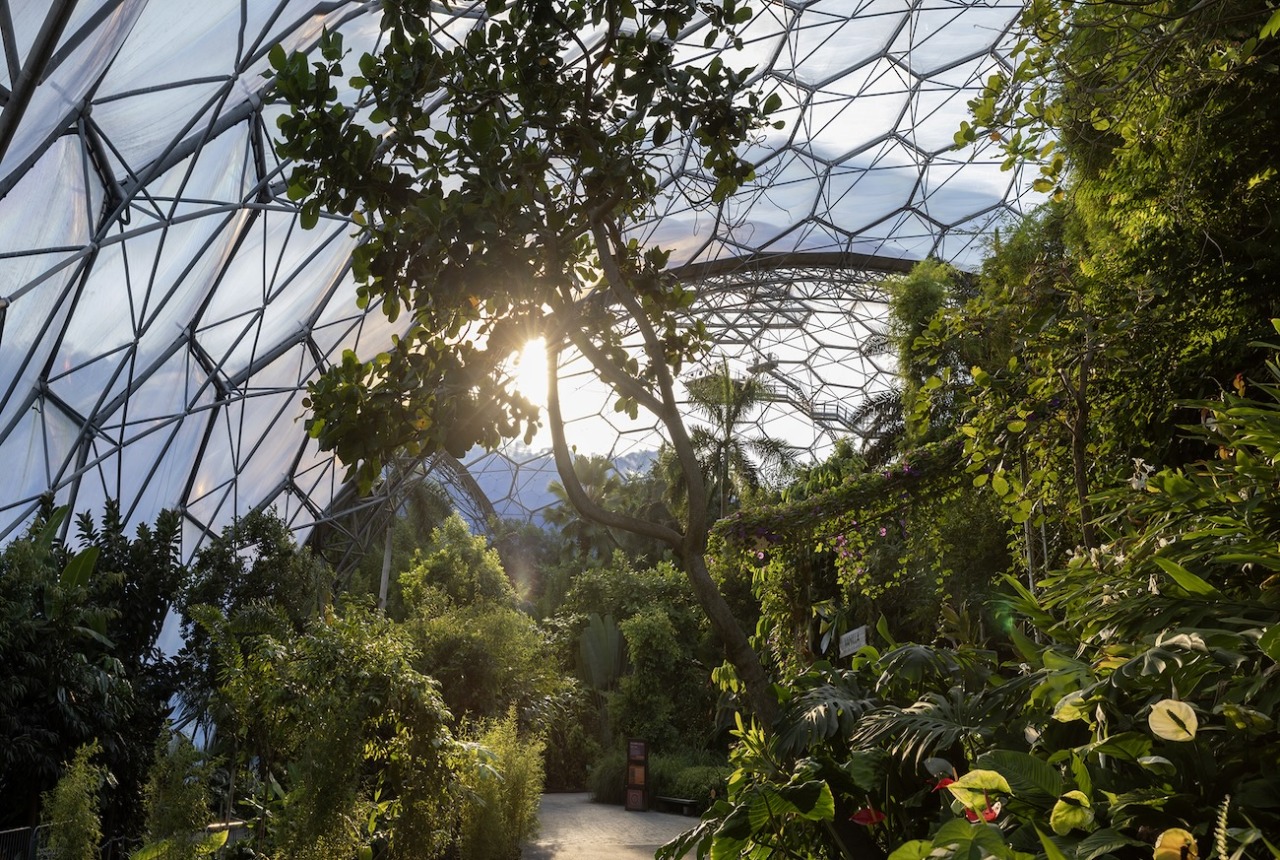
The protagonists and first occupants of the 13 hectares of former clay mine on which the project is based are two Biomes, designed by Grimshaw Architects. These gigantic bubbles are constructed on a frame of hexagons, across which a light and incredibly sturdy skin is stretched, made from three layers of ethylene tetrafluoroethylene copolymer (ETFE) and inflated to create a pillow of air. The Eden Project officially opened its doors in March 2001 and, over time, developed further buildings, a calendar of events and academic programmes, while, most importantly, expanding its biological diversity, welcomed by these flourishing and monumental greenhouses connected by the Link Building.
The Rainforest Biome showcases the world of plants enduring and thriving between 23.5° North and 23.5° South of the Equator. The area within these latitudes provides the lungs of the Earth: the tropical regions comprise the Amazon rainforest in Central and South America, the expansive fruit trees of West Africa, and the island realms across the Indian and Pacific Oceans, where canoes help humans move through nature. Upon entering this highly curated and rich dome, the feeling is exactly that: mankind is secondary here, trying to find ways to walk through, knowingly disturbing the heavenly kingdom of heterogeneous beauty.
The Coconut Palm, the Nasturtium, the Kava, the Wild Indigo, the Portia Tree, the Yam and the Indian Mulberry are some of the 27 canoe plants the Polynesians took to Hawaii. In the tidy tangle of branches and leaves, there are familiar names, such as the banana and the rubber tree, and less familiar varieties, the likes of Coffea canephora. The changes in temperature and humidity help recreate the conditions this vegetation needs, fully immersing visitors in their habitat.
Along the route, there are stalls that represent how local communities make use of and engage with what the fields offer, whether it be the selling of spices or unrefined sugar. The Canopy Walkway bridges land and sky for another breathtaking perspective, while panels explain in accessible detail the mechanisms of oxygen production and the consequences currently faced because of deforestation, the abuse of soil resources and the unregulated management of the land. It’s not all doom and gloom, though, when the subject of climate change is brought in: there are also suggested solutions, at both macro/governmental and micro/individual levels, with the starting point always being a realisation of the beautiful and intricate workings of nature.
Entering the Mediterranean Biome, the first impression may be that one has mistakenly stepped into a dainty garden somewhere in Southern Europe: the walls and paths attempt to recreate a corner of the Greek outdoors. As the scenery gives way to Californian vegetation and North African desert-resistant plants, the variety of Mediterranean and temperate regions – those extending beyond the 20-degree parallel – intrigues with its textures and colours. Olive trees and vines are at different stages of maturation, and an elongated plot brings together various chilli plants, demystifying the stereotype that this pepper is characterised only by extreme heat as a flavour note. The humble courgette sits opposite the Australian grass tree (Xanthorrhoea); golden kangaroo paws are a few steps away from the South African Afromontane forest; the Californian chaparral yucca provides a dramatic counterpoint to the flowery entrance.
Each area is more neatly separated than in the Rainforest Biome – even the succulents have their own private space. And whether it be because of the closer similarities with the flora around the country or the milder temperatures, inside this Biome there is also a café with tables.
The Outdoor Gardens are designed as a succession of sections for a pleasant walk that continues the immersion in the botanical world in the open air: the Wild Edge explores the soil and landscapes of wild Cornwall, while the Crops practise polyculture – once the norm, yet now almost lost under the pressure of large-scale industrial production – proving how simple crop rotation, following nature’s rhythms, can make for a more sustainable diet and a more responsible guardianship of the land.
The Eden Project is constantly striving to adopt the latest and most dynamic systems to maintain a self-sustaining and environmentally friendly venture, from rainwater collection to green energy.
In Lancashire, meanwhile, the very early stages of construction of Eden Project Morecambe are under way: a rather different site, themed around the rhythms of the intertidal setting and exploring the interconnectedness between seascape and community, guided by the same ethos and inspirational principles as the original concept.
From notions to action, the Eden Project celebrates 25 years and counting as a slice of paradise in Cornwall.
Cristiana Ferrauti
Photo: Courtesy of The Eden Project
For further information, visit the exhibition’s website here.
















Facebook
Twitter
Instagram
YouTube
RSS