
The Opera house entered through an entertainment complex
 24 August 2026
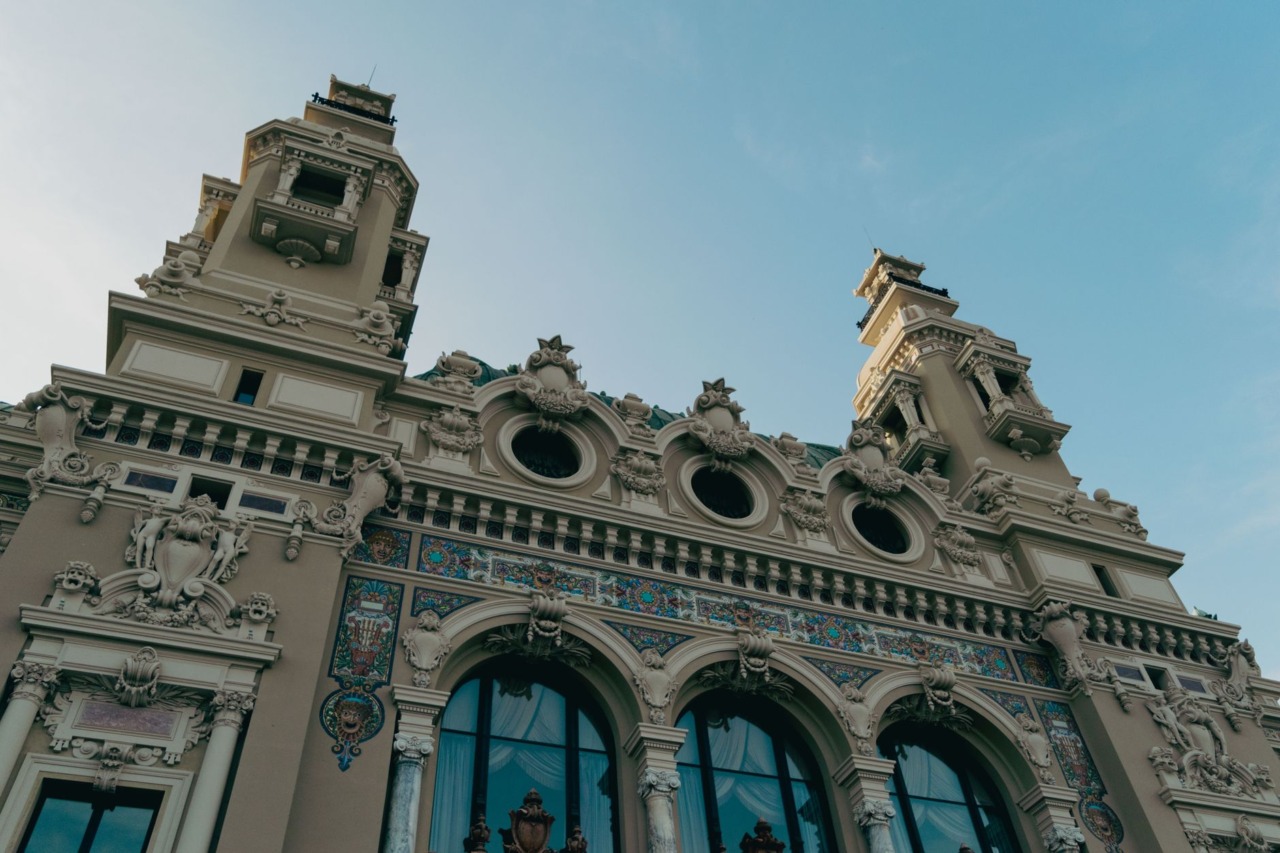
To reach the Opéra de Monte-Carlo, visitors walk in through the entertainment rooms. The main public entrance to the auditorium has always been from the main floor, and Prince Charles III kept a private door on the western side for himself.
That is not an accident of planning or a later conversion. The two were commissioned together, designed by the same architect and paid for out of the same accounts. Anyone who assumes the relationship between commercial entertainment and the arts in nineteenth-century Europe was an awkward one has the history backwards.
The debt that made it possible
Start in Paris, because that is where the money came from.
By the mid-1870s the Palais Garnier was unfinished and France was financially exhausted after the war of 1870. Charles Garnier had been building it since 1861 and there was no obvious route to completion.
The 4,800,000 gold francs required to finish it were put up by François Blanc, the man who ran Monte-Carlo’s principal entertainment complex.
So when Blanc died in 1877 and his widow Marie took over the Société des Bains de Mer, she was in the fortunate position of hiring an architect who owed her family a considerable debt. She commissioned Garnier to demolish the old complex, replace it and add a concert hall. She gave him six months.
Nothing about that arrangement has a modern equivalent. Blanc’s business answered to a single prince, held the only licence of consequence on the continent and drew the whole of Europe toward one address on one hillside.
The European entertainment market today is the precise inverse. Every member state licenses independently, each with its own authority: Malta through the MGA, Sweden through Spelinspektionen, Denmark through Spillemyndigheden, Germany through the GGL, the Netherlands through the KSA, Italy through the ADM and Spain through the DGOJ. An operator wanting to serve players across the bloc needs separate permissions in each, under different rules on games, advertising and payments, and the Dot Esports list of EU casinos sets out how that field currently looks across those jurisdictions.
Marie Blanc had one licence, from one sovereign, who lived next door.
Eight and a half months
The old entertainment buildings came down in 1878. Operations moved temporarily into the Hôtel de Paris while more than two thousand workers built the replacement day and night.
Garnier gave the structure the silhouette it still has, crowning it with a dome and two pinnacles. The iron roof beams were designed by Gustave Eiffel, a decade before the tower. The whole thing took eight months and sixteen days, which was two months late against Marie Blanc’s demand and remains an absurd figure for a building of that quality.
For comparison, the Palais Garnier took fourteen years.
The Salle Garnier was inaugurated on 25 January 1879. Sarah Bernhardt appeared dressed as a nymph and recited a poem Jean Aicard had written for the occasion. The programme that night was unremarkable, mostly operatic arias and symphonic excerpts. A fortnight later, on 8 February, Robert Planquette’s one-act Le Chevalier Gaston received its premiere, written for the room.
Contemporary critics grumbled about decorative heaviness and a style too obviously Second Empire. They also agreed it worked.
What actually happened in the room
This is the part that gets lost when the building is described as an entertainment amenity.
From 1892 to 1958, a single director ran the place. Raoul Gunsbourg held the post for sixty-six years and staged more than six hundred operas, which is not a record likely to be threatened.
Under him and after, the Opéra de Monte-Carlo became a genuine site of first performances rather than a receiving house. Berlioz’s La Damnation de Faust was staged there in 1893. Massenet’s Don Quichotte premiered in 1910, Saint-Saëns’ Déjanire in 1911. Ravel’s L’Enfant et les sortilèges had its first performance there in 1925.
Diaghilev’s Ballets Russes took up residence repeatedly, which means a substantial portion of early twentieth-century dance was made in a building attached to an entertainment hall.
The singers were the singers of the age. Nellie Melba, Enrico Caruso, Tito Schipa, Georges Thill. Later Pavarotti, Domingo and more recently Bartoli and Alagna.
Small room, which is the point
The Salle Garnier seats somewhere around 520. The Palais Garnier seats about two thousand.
That ratio is the whole character of the place. Monte-Carlo was never trying to be Paris, and the smallness is not a compromise but the product: an audience close enough to see a singer breathe, in a room with acoustics that reward restraint rather than volume. Garnier’s ornamentation, criticised at the time as excessive, reads differently at that scale. In a hall this size the gilding is not grandiosity, it is intimacy with the lights up.
It also explains why composers took commissions there. A premiere in a 520-seat room in front of the wealthiest audience in Europe was a different proposition from opening cold in Paris.
Still a working theatre
It would be neat to end with the building as a preserved artefact. It is not.
The Salle Garnier was extensively renovated at the turn of this century, with the company decamping to the Grimaldi Forum during the works, and it has continued to programme rather than curate. The Monte-Carlo Jazz Festival runs there each autumn. Prince played the room. So have Patti Smith, Lana Del Rey, Lionel Richie and Jane Birkin.
There is something appropriate about a hall built in eight months by an entertainment business turning out to be more adaptable than most purpose-built concert venues.
Why it is worth knowing
The easy version of this story is that commercial entertainment money bought respectability, and there is some truth in it. Marie Blanc wanted the Principality taken seriously and understood that a concert hall does that in a way another attraction does not.
But the sequence matters. The entertainment proprietor finished the Paris Opera before his widow built Monte-Carlo’s. The money moved from commerce to the arts first, and in the direction nobody assumes.
For visitors in that part of the coast, the interesting thing is not the façade everybody photographs. It is that the door to one of Europe’s most consequential small opera houses is on the other side of the main entertainment floor, and always has been.
The editorial unit
















Facebook
Twitter
Instagram
YouTube
RSS