
A Girl’s Story



Judith Godrèche’s adaptation of Annie Ernaux’s 2016 memoir returns to the summer that would come to define and distort a young woman’s understanding of herself for years afterwards. Set in 1958, A Girl’s Story (Memoire de fille) centres on Annie (Tess Barthélemy), who leaves rural Normandy to work as a counsellor at a summer camp. What initially feels like a small act of independence gradually becomes something far more destabilising.
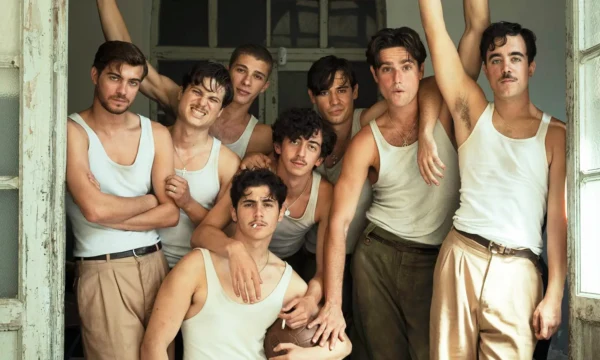
Godrèche perfectly captures the awkwardness of entering a new social world at 17. Annie arrives eager and completely unsure of herself among a crowd of young counsellors who seem impossibly sophisticated. There are shirtless boys hauling furniture around and smirking at her, glamorous older girls smoking and dancing with winged eyeliner and all the confidence in the world, and hushed, giggling conversations after lights-out. One counsellor, with bleached Marilyn Monroe hair and an earthier imitation of her style, intimidates Annie, while her frosty roommate eventually warms to her and helps her apply makeup before a party. Godrèche captures all these rituals of adolescent reinvention without smoothing over their cruelty.
At home, Annie has been raised under the strict hand of Catholic school and her prim and proper mother (Ariane Labed), who fusses over appearances and respectability right up to the drive to camp. One of the picture’s sharpest moments comes early on, when Annie dismisses the job as “just a counsellor position” and a friend immediately corrects her: it is freedom. Barthélemy plays Annie with an awkward openness, desperate to become the kind of laid-back young woman she thinks everyone else already is.
That desperation shapes her relationship with H./Hervé (Victor Bonnel), the older head counsellor who is spoken about long before he appears onscreen. Around camp, he has the status of a local legend, for better or worse. Bonnel wisely plays him with casual arrogance and cruelty, speaking in clipped tones and saying very little. The feature never pushes him into caricature, which makes his behaviour more unsettling. Annie sees him as cool and experienced, while the audience can see how thoroughly he takes advantage of her inexperience.
Godrèche handles the material with restraint, especially in the way she allows contradictory feelings to exist at once. Annie’s shame, desire, humiliation and excitement are all tangled together. The story does not try to impose a clean moral framework onto memories that Ernaux herself wrote about with painful uncertainty. Instead, A Girl’s Story becomes an examination of how young women learn to narrate their own experiences – and how long it can take to recognise what really happened.
Christina Yang
Read more reviews from our Cannes Film Festival 2026 coverage here.
For further information about the event visit the Cannes Film Festival website here.


















Facebook
Twitter
Instagram
YouTube
RSS