The Welkin at the National Theatre
Immense"/ "Deserves to become a curriculum mainstay"/ "Dazzling


- 1
- 2
Duran Duran at the O2 Arena
Selina Begum
- 3
George Michael: The Faith Tour
Antonia Georgiou
- 4
- 5
Merry Christmas Aubrey Flint
Andrew Murray





Meet Jessica Rosval, the world’s best female chef
Food & Travel Desk
Godzilla Minus Zero
Christopher Connor
Players Social launches free challenge zone The Box in Spitalfields
Food & Travel Desk





I Play Rocky
Umar Ali
Think of England
Antonia Georgiou
Stereophonics celebrate 30 years with new greatest hits album Tune!
The editorial unit




Scrubbing, brushing, sloshing, wailing: these are the sounds that open Lucy Kirkwood’s The Welkin. A symphony of housework. All absent for the rest of the play.
Instead, once the jury of matrons is convened – there to discuss whether the murderer Sally Poppy (Ria Zmitrowicz) is with child; if not, she will hang – they are free to talk. And think. Away from the daily chores that absorb all their time, and the husbands who dictate to them. Blissfully, the only man in the room is required to remain silent.
As the dozen jurors debate the girl’s fate, they are challenged at every turn by the fierce morality of Maxine Peake’s midwife Lizzie, who is unwilling to give up Sally’s body to the baying mob that sits outside the window.
The women of The Welkin are fed crumbs by the society they live in. Freed from domestic duty, but just temporarily, and only for the discussion of “womanly” matters. Given authority on the punishment, but wholly absent from the sentencing. And even then, not really: a midwife’s authority – a lifetime of childbirth’s authority – is usurped by a quick visit from a male doctor.
Writing a “period drama” should, ideally, be writing about contemporary problems in fancy dress. That’s what Kirkwood does here. Ask any American woman, or Irish woman, or just a woman who has had to fight with their doctor over getting the right treatment for an illness that’s dismissed or misdiagnosed. Or whose anatomy has been used against them in court. Women aren’t trusted with their own bodies; more than that, the justice system often uses them as evidence to be coldly probed or even weaponised.
All this is complicated, or rather underscored, by the fact Zmitrowicz’s Sally is unrepentant. She has a devilish glint in her eye and a mouth that barks out cruelties. She is the image of the “demonised woman”. But she is also truthful and knowledgeable about her own body and its wants, justifiably angry at those who have while she has not. Her guilt doesn’t change the injustice she faces.
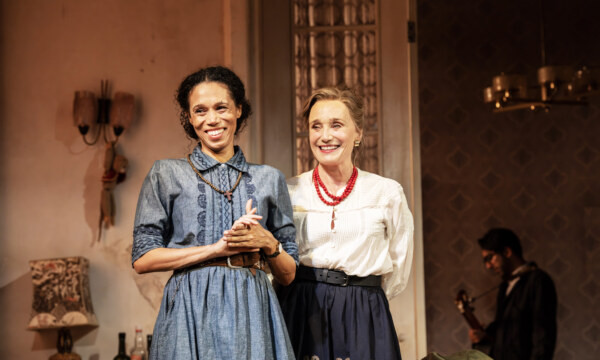
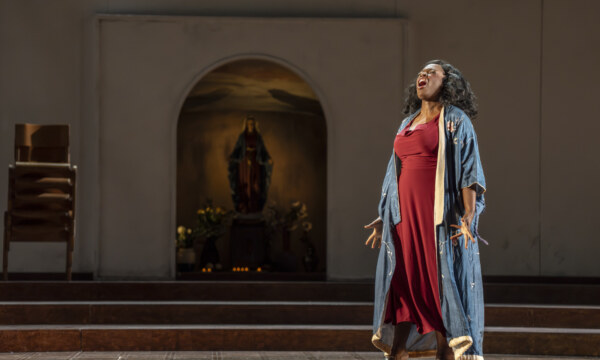
The style and force with which this is approached is immense. Kirkwood has written the kind of meaty, witty, bountifully charactered play that deserves to become a curriculum mainstay. Alongside Zmitrowicz’s dazzling turn is a bevy of excellent performances from Peake, regular National Theatre MVP Cecilia Noble and Hadyn Gwynne. And director James McDonald and designer Bunny Christie have conjured a thing of beauty. Silhouetted tableaus, widescreen scenes that feel like theatre in IMAX, a room that has the stifling grandeur of a gallery stripped of its paintings.
The point of the play doesn’t lie in the answers surrounding the narrative, but rather its questions of authority and justice. Who has it? Who does it serve? Because, now and then, it certainly doesn’t care a jot for these women.
Connor Campbell
Photo: Brinkhoff-Moegenburg
The Welkin is at the National Theatre from 15th January until 23rd May 2020. For further information or to book visit the theatre’s website here.