
The Girl from Plainville
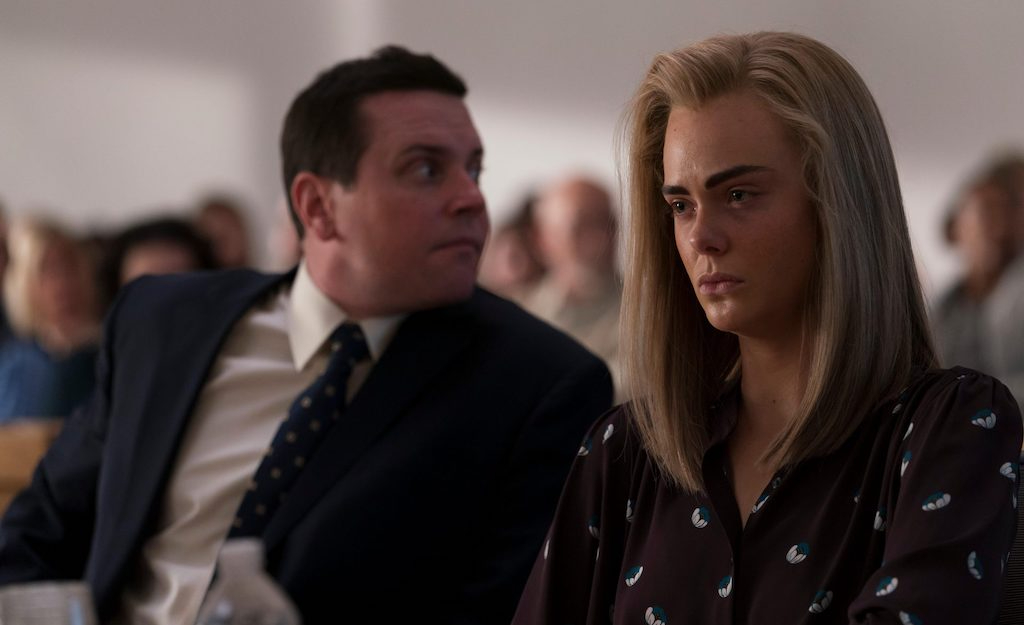



The Michelle Carter/Conrad Roy III “texting-suicide” case shook the United States and beyond when the details and messages were made public. The pair’s relationship was evidently limited and complicated, but more striking were the events that followed Roy’s death, leading ultimately to Carter’s conviction of involuntary manslaughter. Liz Hannah and Patrick Macmanus present The Girl from Plainville, an eight-part retelling of the events before and after the teenager’s death that drew nationwide media attention and led all parents to pay closer attention to the text messages their children send each other.
The real story of what happened is as distressing as what is portrayed in this series. In typical American fashion, the setting is a town called Plainville, where the real Michelle Carter is from, but that is where the associations end, as there is nothing plain about this tale. Elle Fanning gives a chilling performance as Michelle Carter, acting the hell out of the role. At first, viewers may think she is over-egging the pudding, but one soon realises she is actually portraying a frightening and disturbing individual who struggles with her own demons and lack of popularity.
Likewise, Colton Ryan knocks it out of the park as Conrad, but his performance is far more upsetting to observe. He’s an honest boy, wishing to live his best life but with a father who beats him and without the support network he requires. His mother, Lynn (Chloë Sevigny), who undoubtedly received the highest degree of manipulation from Michelle in the wake of her son’s death, is his only life ring. This series is just as much about them as it is about Carter.
This is undeniably gripping viewing, slowly peeling back the layers of each character’s facade to reveal depression, anxieties and greater complexity in how the events played out. A relationship builds and then falls as things begin to unravel after Roy’s death and mental fragility is pushed to the point of shattering. However, this is all presented in a scrambled timeline and the viewer is left to put together the pieces. It still flows, but the slicing of sequences does require a little more work than expected.
At eight episodes, it could be argued that the series is too long, given the limited narrative it is portraying; it waits until the third episode to really address the police investigation, when it could have been done far earlier. There are also numerous scenes involving the recital of correspondence, and dreamlike sequences between Conrad and Michelle that feel a little am-dram in their presentation, but perhaps this is to simply try and build a physical connection between the two characters, since only met a handful of times in real life.
The Girl from Plainville doesn’t particularly present an argument or a perspective to provoke opinion or debate, and it is difficult to differentiate between fact and fiction, but it does prove to be an unnerving depiction of a tragic story.
Guy Lambert
The Girl from Plainville is released on 10th July 2022.
Watch the trailer for The Girl from Plainville here:






















Facebook
Twitter
Instagram
YouTube
RSS