
The End of It
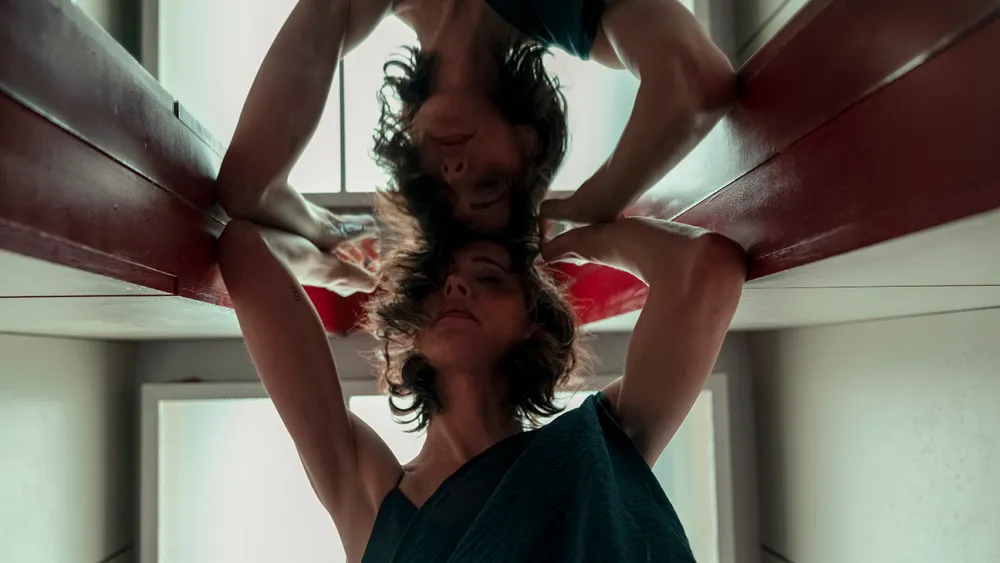



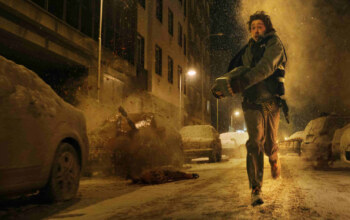
Some milestones come with psychological crises. The 250th birthday of The End of It‘s protagonist Claire (Rebecca Hall) painfully unveils the woman’s boredom with the futuristic world she lives in, where the plastification of the human body renders ageing a mere formality. When Claire announces that she is ready to discontinue the life-sustaining measures in place, the people around her assume an agenda behind her willingness to die. Her increasing disconnect from her loved ones drives her to explore the roots of human existence on her way out.
Spanish director Maria Martinez Bayona’s feature debut introduces a number of interesting thought experiments that reflect the viewer’s own reality, which is not as distant from the utopia/dystopia presented in the film as one might hope, and finds vivid visual metaphors to express these themes. However, many of these ideas demand more contemplation than the film’s 102-minute runtime and its sprint of a script allows. Claire’s daughter (portrayed by Noomi Rapace) pleads with her mother to inherit the room she vacates on Earth, so she can become a mother herself. This concept of population regulation alone could have sustained an entire feature – as we recently saw with Fleur Fortuné’s The Assessment. Here it amounts to little more than a passing detail.
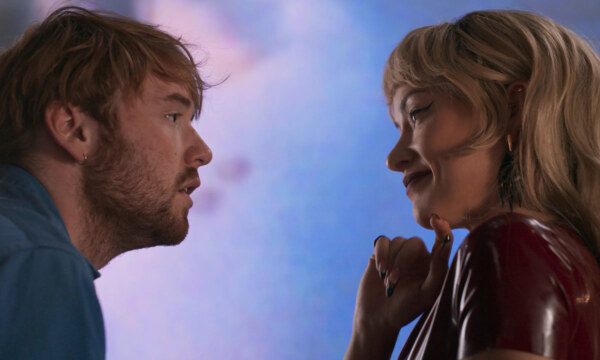
Unlike the familiar image of AI assistants as robotic, emotionless machines, Beanie Feldstein plays this embodiment with gentle, at times naive curiosity, not quite capable of comprehending the inherent contradictions of the human psyche. Her careful probing has a therapeutic function almost as a side effect (Think: And how does that make one feel?)
Naturally, as the lead, Hall has the most substantial material to work with and the only thoroughly complex emotional arc. Unfortunately, the immeasurable talent of the rest of the cast is not sufficiently tapped into. Gael García Bernal’s role as Claire’s husband amounts to little more than room decor, adorned with a strange-looking wig. There is an intriguing fight between the couple when his memories of an experience don’t align with hers, but it is so underdeveloped within the plot that its very inclusion feels questionable instead of necessary.
Even if it does not maximise the potential of all its moving parts, The End of It offers a stylish sci-fi exploration of collective concerns ranging from overpopulation to the cultural obsession with youthful appearance as a desire to defy mortality. Martinez Bayona plants a garden of ideas, and while many have barely begun to bloom by the time the credits roll, their roots continue to spread in the audience’s imagination.
Selina Sondermann
Read more reviews from our Cannes Film Festival 2026 coverage here.
For further information about the event, visit the Cannes Film Festival website here.










Facebook
Twitter
Instagram
YouTube
RSS