
Hepworth in Colour at The Courtauld Gallery
 31 August 2026
When Dame Barbara Hepworth (1903-1975) tragically died in a house fire 51 years ago, British art lost one of its most defining talents of the 20th century. Born in the West Riding of Yorkshire, fate would see her settle in the avant-garde creative hub of late-30s-Hampstead – Piet Mondrian was a neighbour and friend – before the threat of German bombing shortly before the outbreak of World War II led her and her husband, the painter Ben Nicholson, to move their young family down to St Ives in Cornwall. There she would remain for the rest of her life. Over the ensuing years, the rugged, wind-swept coastline of that ancient county would prove a constant source of inspiration, her carved forms frequently referencing stones and landscape shaped by both man and nature. Since her 20s, Hepworth had enjoyed a burgeoning reputation, initially as a major contributor to British Constructivism before becoming a dominant force in abstract sculpture. The current exhibition devoted to the artist at the Courtauld Gallery, featuring some 20 sculptures and 30 drawings, sheds light on a largely unheralded element of Hepworth’s career: the role of colour in her work.
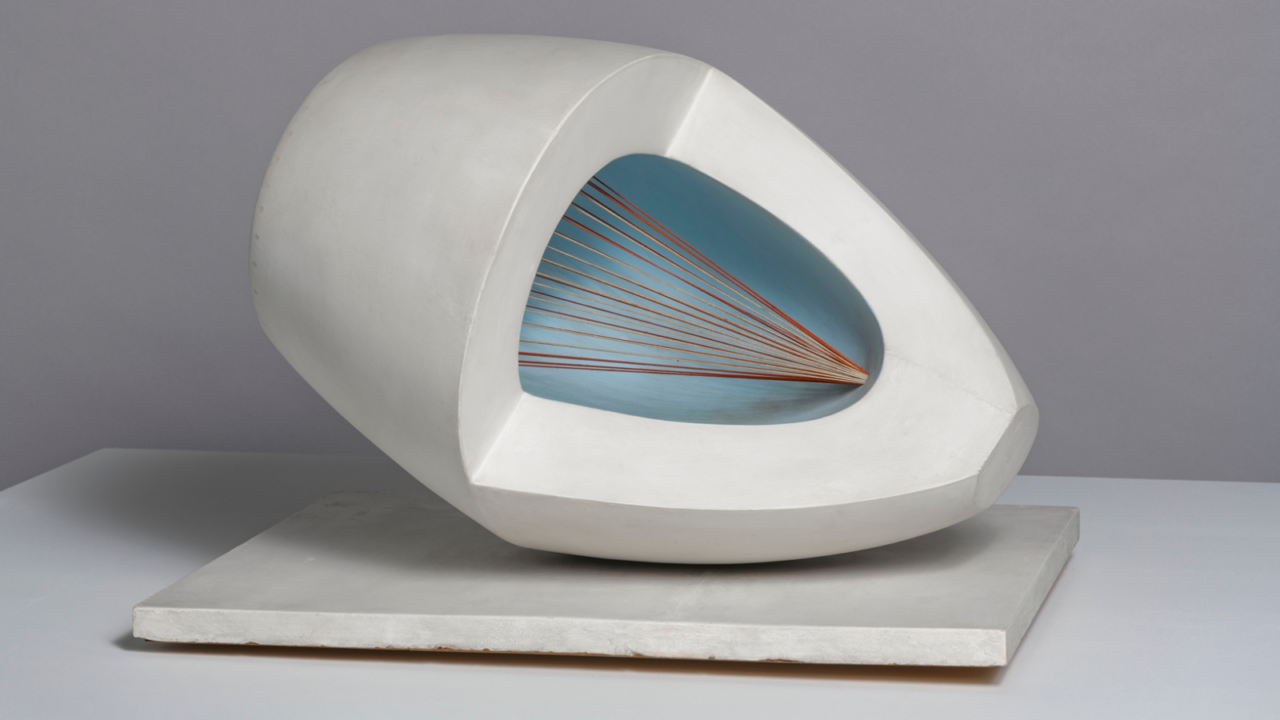
The opening room reveals the impact of Mondrian’s sensibility on Hepworth’s practice. Both her 1935 visit to the Dutchman’s Paris studio and their year-long period as neighbours in Hampstead exposed the Yorkshire-born artist to Mondrian’s usage of rectangles of primary colours: red, yellow and blue. Hepworth’s gouaches on board, Composition and Abstract, each executed in 1940, testify to that influence whilst simultaneously evidencing how, deprived of materials thanks to the War, the artist found drawing to be a crucial source of income. Unquestionably one of the exhibition’s highlights is found nearby, Sculpture with Colour (Oval Form): Pale Blue and Red (1943). The artist brought a maquette of the work with her when she sought safety in Cornwall in 1939, with the resulting sculpture being one of her first to incorporate taut coloured strings and a sky-blue interior. In 2025, the piece was purchased by the Hepworth Wakefield gallery thanks to public funds. Despite being originally conceived in London, Sculpture with Colour ultimately bears out Hepworth’s enrapturement with West Penwith’s skies and natural features.
The years from 1940-48 see the artist producing an impressive series of painted sculptures. Her carved form in elm, Pelagos (1946), would appear to evoke a crashing wave, with an underside of white paint. Stretched strings imply the tension of Cornish wind, sea and cliffs. Sculpture with Colour (Eos) (1946), refers to the Greek Goddess of the Dawn. A socket rendered in striking blue appears like an abyss with the curved grey stone, a crescent carving resembling a moon still visible at the break of day; pigment is repeatedly used to create depth. Hepworth’s distinctive brand of precise geometrical structure is a significant presence in many of the drawings displayed on the walls here, like Counterpoise (1946) featuring curves and the intersection of lines. A number of drawings are preparatory studies for sculptures, while others are intended to be viewed as independent works.
Hepworth continued exploring the potential of colour into the 50s and 60s. In Sea Form (Porthmeor) (1958), she delves into the effects of painterly bronze patinas, creating the illusion of the sculpture rusting away on the ocean floor. The following decade, she can be viewed experimenting with coloured marble in Two Opposing Forms (Grey and Green) (1969). The show concludes with Sphere with Inside and Outside Colour (1967), an aluminium work featuring the primary colours on recurring circular motifs. Designed by Hepworth for the Globe Playhouse Trust Ltd, the forerunner of the present Globe Theatre, it could easily be mistaken for the celebrated, minimalist American artist Donald Judd’s work.
Hepworth’s profound love affair with the landscape of Cornwall is an interweaving thread here. There is also ample evidence of the extent to which much of her aesthetic language was rooted in European modernism. Intriguingly, the artist’s painting palette is displayed at the show; anyone who has paid a visit to her preserved working area in Trewyn Studio in St Ives will have seen the chisels and hammers of her trade left for posterity and yet such is Hepworth’s reputation for shape and form that this well-used palette still strikes one as something of a surprise. In retrospect, taking these factors into consideration, it should come as no surprise that this great figure of British sculpture chose to incorporate blues of every hue, vivid reds, greens and yellows into both her three-dimensional forms and drawings. As the artist once opined, “In a way the colour has been accepted but never understood.” This exhibition will at least go some way to begin to remedy that state of affairs.
James White
Image: Courtesy of The Courtauld Gallery
Hepworth in Colour is at The Courtauld Gallery from 12th June until 6th September 2026. For further information or to book, visit the exhibition’s website here.













Facebook
Twitter
Instagram
YouTube
RSS