
Mire Lee: Open Wound at the Tate Modern
 8 October 2024
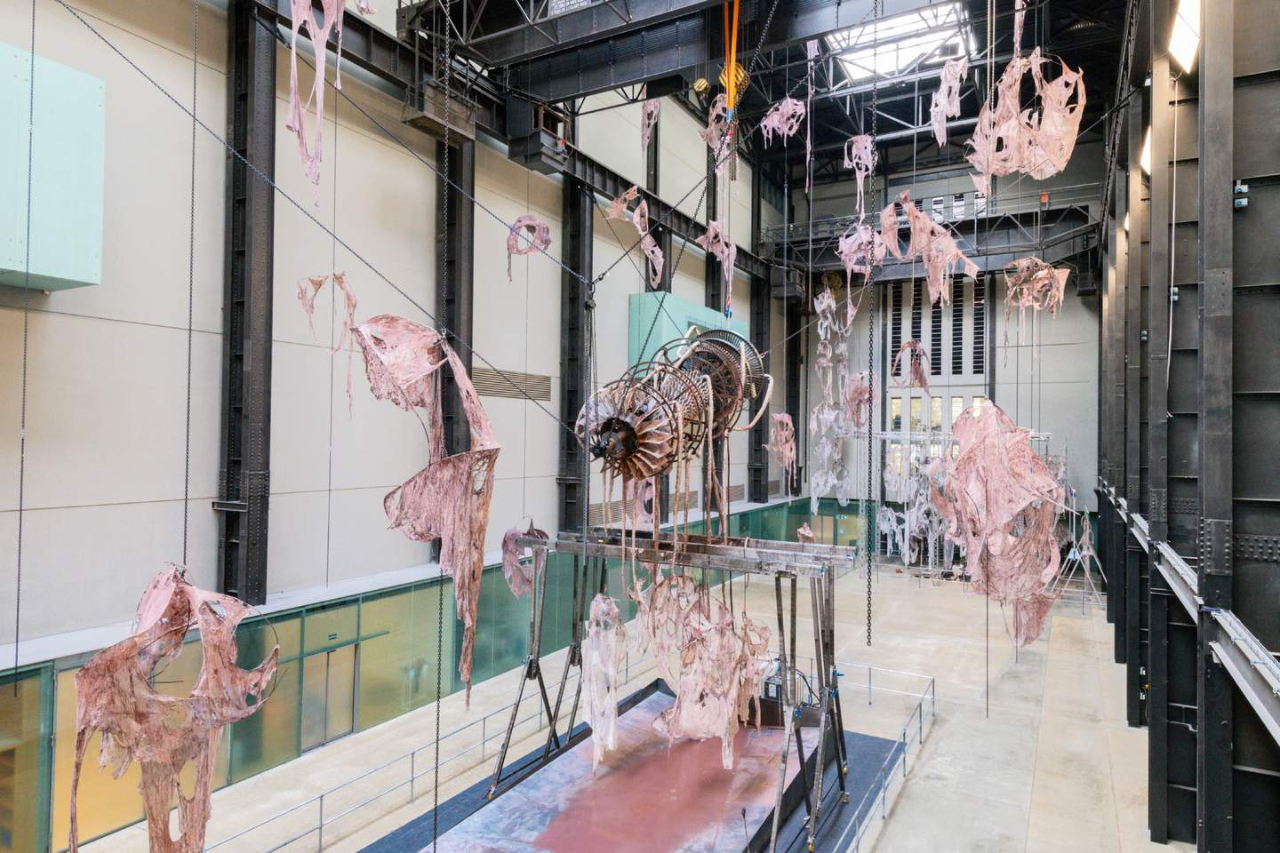
In her installation Open Wound, Mire Lee responds to the industrial history of Tate Modern’s turbine hall with thin, flesh-like cloths, which Lee refers to as “skins”, suspended from the ceiling by heavy chains. In the centre, a spinning turbine laced with even more “skins” brings turbines back into the turbine hall. Before viewers even lay their eyes on the cogwheels, they can hear the drip of water that trickles through the cloth and falls like clots onto the large, rusting surface below.
The organic images Lee has put into motion recall the past of the space and how it is intertwined with human labour. The piece will develop in the coming months as the “skins” which spin along the turbine structure will be unravelled, dried on nearby racks, and hung up along with the existing “skins”, a process which will occur during opening hours so that viewers can bear witness. With the already many “skins” hanging threateningly from the ceiling, turning the museum into a butcher shop, one can only wonder how much more heavy the space will feel when the artwork reaches its final stages. The intrigue of this installation lies in the transformation that will occur over the coming months as a performance and therefore its full impact remains to be seen.
Lee’s oeuvre is a sensory goldmine, bringing together industrial and natural materials to create forms that resemble the human body. Contemporary art often relies on shocking evocations of death and gore to explore human stories, but Lee achieves a soft and even compassionate take on such imagery in the midst of mechanical textures. Her work is inspired by the sites they inhabit, and Open Wound is no exception, as Lee sought to refer back to the labour that was initially carried out in the space. The “skins” represent the necessary human touch that lies behind any form of production. This aspect of the work is reflected again in its maintenance; museum staff will be responsible for unravelling the skins on the turbine, hanging them to dry and installing them on the metal chains. Large-scale, contemporary installations are rarely without a workforce. For example, the previous year’s Hyundai Commission by El Anatsui employed nearly 200 individuals based in Ghana who crafted the work.
Open Wound sources its materials from around the UK, giving Lee’s work a remarkably local quality. The artist brings direct attention to the nature of labour both through her visuality and materiality as well as in the performance of the artwork’s maintenance. In its previous life, Tate Modern relied on a workforce to provide the city with electricity, and in its current life, the museum relies on a workforce to provide art. Open Wound does not merely fill the space, but rather it responds to it, bringing attention to the skeleton of Tate Modern and its earlier purpose through a dynamic and visceral performance.
Perihaan Khan
Photo: Hyundai Commission: Mire Lee: Open Wound, Installation View. Photo © Tate (Lucy Green)
Mire Lee: Open Wound is at Tate Modern from 9th October 2024 until 16th March 2025. For further information or to book visit the exhibition’s website here.














Facebook
Twitter
Instagram
YouTube
RSS